
Your birthday candle count might lie because biological aging ticks at completely different speeds across your individual internal organs.
🧬 Medical diagnostics historically grouped men and women under a single generalized biological aging framework, completely ignoring crucial chromosome and lifestyle dynamics. A ground-breaking study published in the prestigious journal Nature Medicine reveals that male and female bodies do not follow a single, unified aging timeline.
🔬 Led by visionary researchers Zhiyuan Song, Derek Feng, and Junhao Wen, the team deployed 38 distinct AI-driven aging clocks across 14 organs. Their astonishing multi-omics data proved that relying on standard, combined diagnostic models actively hides critical health risks, prompting an urgent shift toward sex-stratified medicine.
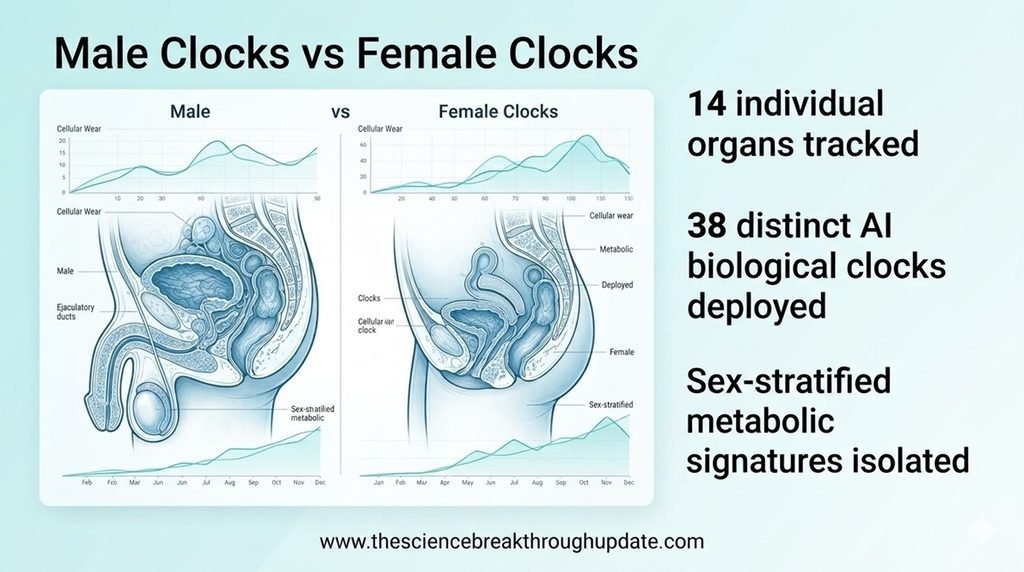
The Hidden Danger of Shared Medical References
- ⚠️ Traditional diagnostics effectively mask early warning signs because organ failure triggers exhibit distinct physiological paths in females versus males.
- 🏥 Clinicians frequently miscalculate actual disease susceptibility by relying on these shared references, leaving thousands vulnerable to sudden systemic conditions.
- 📉 The flawed approach of using combined frameworks completely ignores crucial chromosome, hormonal, and lifestyle dynamics unique to each gender.
- 🧬 Standard pooled data models dilute unique molecular signals, making it nearly impossible to predict personalized organ decline trajectories accurately.
Breaking the Code of Sex-Stratified Biological Clocks
- 💻 Scientists developed explicitly separated learning algorithms to isolate multi-organ metabolic, vascular, and immune network signatures between the sexes.
- 📊 The specialized tracking system accurately calculated independent biological age gaps by measuring dispersed genetic variances across diverse organ systems.
- 🧬 Comprehensive longitudinal analysis confirmed that specific organs like the liver or skin exhibit vastly different heritability patterns in men compared to women.
- 🤖 This targeted machine learning method successfully preserves highly structured molecular variations that combined data streams completely erase.
The Transformation of Longevity Science and Diagnostics
- 🧠 Transitioning to sex-specific tracking allows doctors to foresee cognitive decline and Alzheimer’s progression with exponentially higher precision.
- 💊 The research empowers the healthcare industry to develop highly customized therapeutic drugs tailored to how specific genders process cellular wear.
- 🎯 Patients gain the ability to pinpoint their fastest-aging internal organs, unlocking true personalized preventive habits before clinical symptoms appear.
- 📜 This diagnostic shift establishes an entirely new foundation for global longevity studies, fundamentally rewriting the rules of modern geriatric care.
My Take: This shifts medical science away from lazy, one-size-fits-all defaults. Treating men and women as biologically unique aging systems will practically eliminate diagnostic blind spots and save lives early.
Reader Doubts: Core Questions Answered
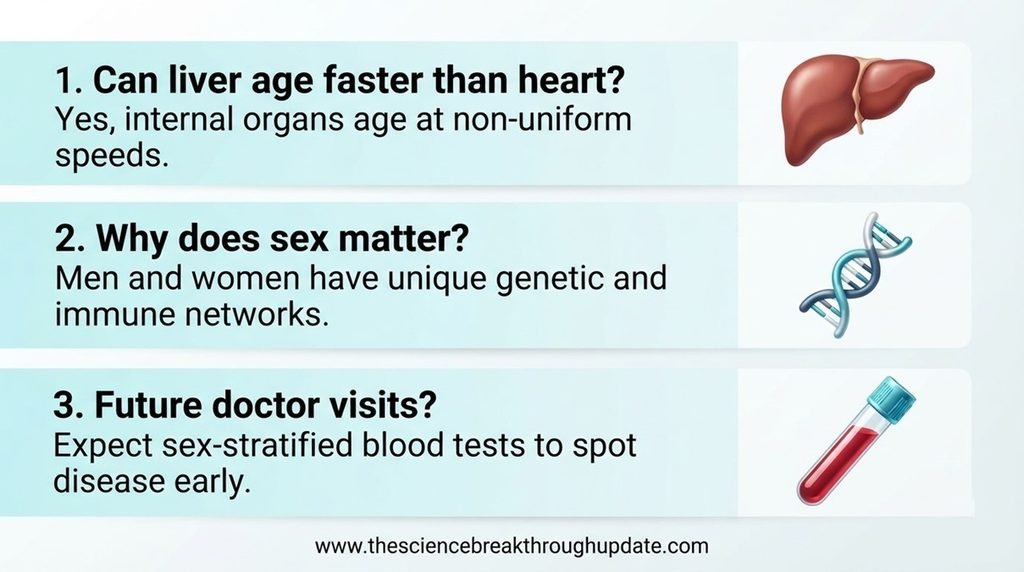
- Can my liver age faster than my heart?
- 🔄 Yes. Internal organs do not grow old at a uniform speed, meaning your metabolic system could be biologically older than your cardiovascular system.
- Why does sex matter for biological aging?
- 🧬 Men and women possess fundamentally distinct genetic, immune, and vascular networks, which directly control how cells deteriorate over time.
- How will this research change doctor visits?
- 🩺 Physicians will eventually use sex-stratified blood tests to spot organ-specific disease risks years before they manifest into severe illnesses.
News source link: Nature Medicine
Share this useful knowledge with your friends now!
Disclaimer: This content is for educational and informational purposes only.