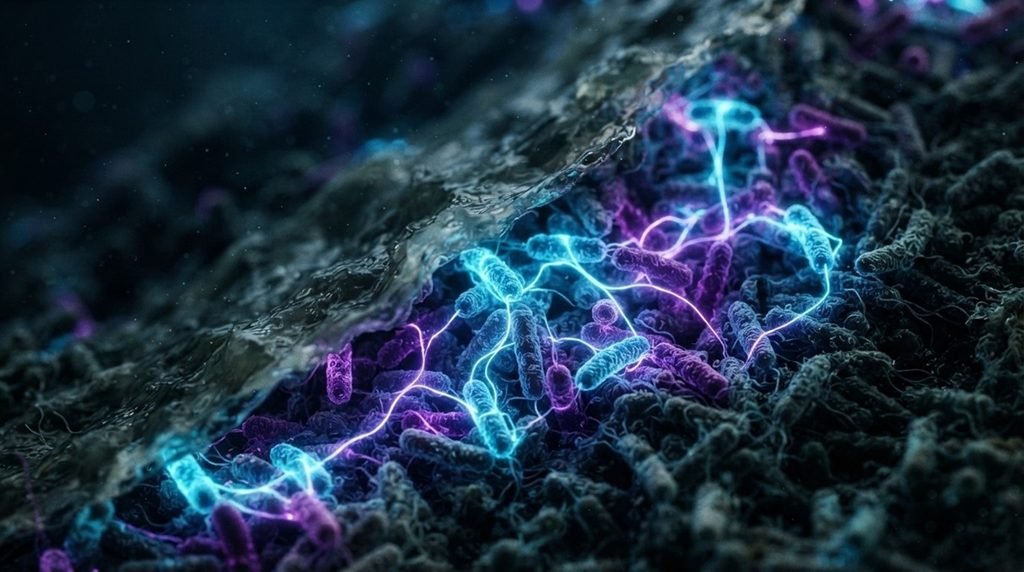
🚀 Microscopic organisms constantly update their hidden chatrooms just to outsmart deadly environmental chaos and survive.
Bacteria are not solitary rogues simply reacting to their environment; they actively talk to each other. Scientists call this quorum sensing, a chemical messaging system that allows single-celled organisms to sense their population density and act as a unified team.
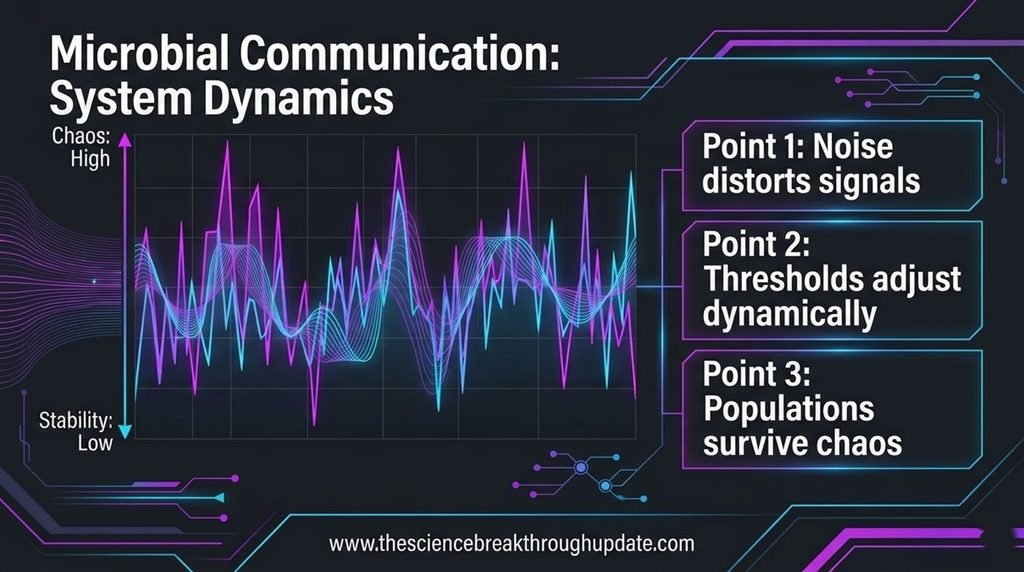
New research reveals that constant environmental shifts force bacterial communities to radically alter how they manage their internal communication networks. Changing surroundings create unpredictable noise that disrupts the chemical signals bacteria rely on to calculate their current population size.
⚠️ The Chaos Breaking Bacterial Communication
- Unpredictable environmental shifts introduce heavy stochastic noise that distorts the chemical signals bacteria use to talk.
- Bacterial populations frequently misjudge their actual group density when sudden external changes dilute or trap their molecular messages.
- Making a premature collective move based on corrupted data wastes precious metabolic energy and threatens population survival.
- Traditional evolutionary models fail to explain how microbes maintain reliable quorum sensing when their surroundings change rapidly.
🔬 How Microbes Calibrate Their Chemical Chatrooms
- Researchers simulated how fluctuating habitats force bacteria to evolve dynamic, highly responsive signal production strategies.
- The study reveals that bacteria adjust their chemical thresholds dynamically to match the frequency of environmental disruptions.
- Microbes utilize natural genetic variations to ensure at least some cells correctly interpret quorum sensing signals during chaos.
- This flexible evolutionary mechanism allows bacterial populations to maintain stable communication without needing a centralized control system.
🩺 Why Microscopic Conversations Matter To Us
- Understanding these adaptive communication rules helps scientists design smarter treatments to disrupt harmful bacterial networks.
- Medical researchers can exploit these communication vulnerabilities to prevent bacteria from forming drug-resistant protective biofilms.
- Tracking how environmental noise shapes cellular evolution provides fresh insights into engineering robust synthetic biology systems.
- This discovery alters how we combat chronic infections by targeting the microbes’ ability to coordinate collective attacks.
My Take: Interceptors that jam these cellular chatrooms could finally break superbug resistance. Mapping this microbial noise shifts our entire medical strategy from chasing mutations to short-circuiting basic bacterial teamwork.
💬 Reader Doubts: Core Questions Answered
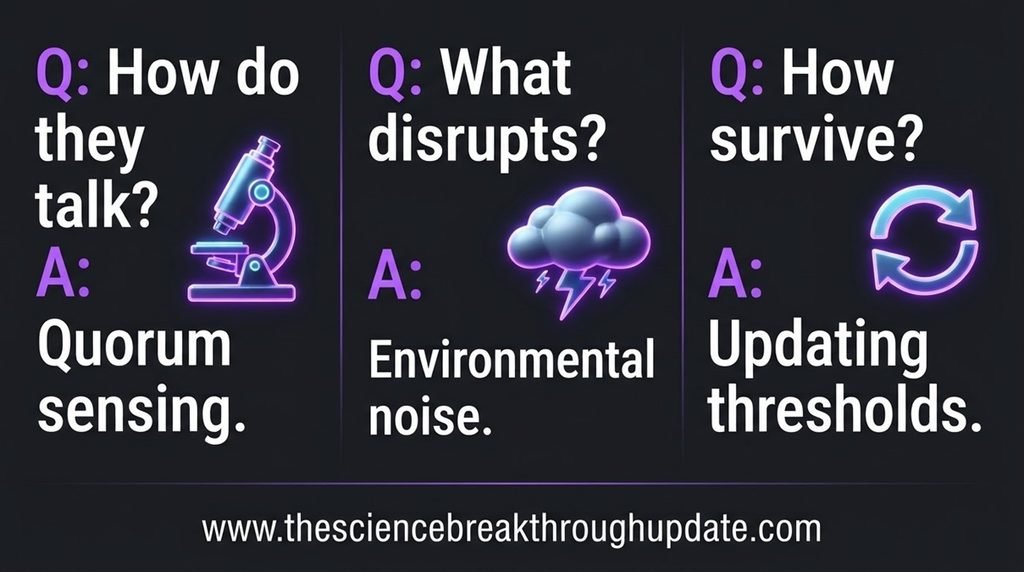
1. How do bacteria talk to each other?
Bacteria communicate using a chemical process called quorum sensing. They release small signaling molecules into their environment. When the concentration reaches a specific threshold, the group triggers coordinated actions.
2. Why does changing the environment disrupt their chatrooms?
Sudden shifts in the environment change how chemical signals spread, dilute, or degrade. This unpredictability creates sensory noise. As a result, individual bacteria cannot accurately measure their group size.
3. Can we use this discovery to stop dangerous infections?
Yes, scientists can develop therapies that jam these chemical signals. If we disrupt their quorum sensing networks, we can prevent them from building drug-resistant shields and launching coordinated attacks.
Source Document Link: arXiv.org
Share this useful knowledge with your friends now!”
Disclaimer: This content is based on preliminary scientific research (Preprints) from arXiv.org and current global findings. It is shared strictly for educational and informational purposes and does not constitute professional, legal. Readers are encouraged to verify facts independently and consult relevant experts before making any decisions.