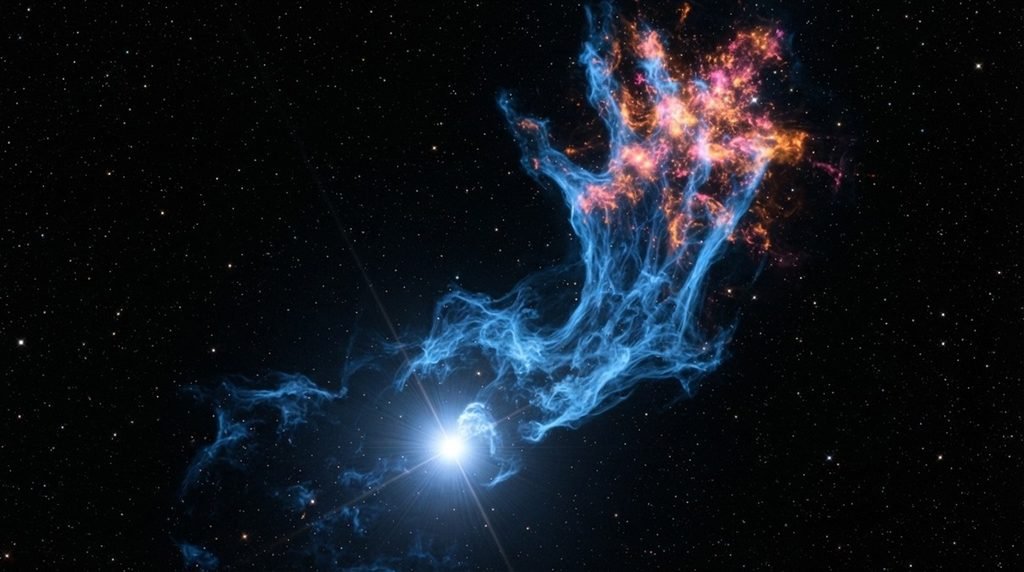
🌌 Deep space observations just caught a massive cosmic ghost reaching out across the universe with a startling message for modern physics.
A massive nebula shaped like a giant glowing hand has puzzled astronomers for decades. This cosmic structure, known as MSH 15-52, stretches across deep space but its internal layers and violent interactions with surrounding gas remained largely hidden behind thick clouds of interstellar dust.
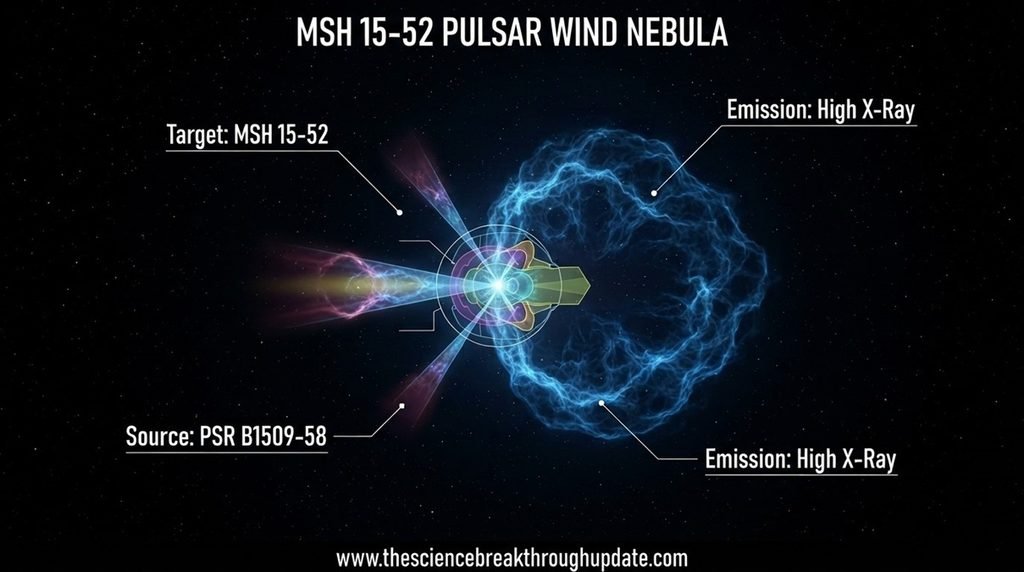
Now, a team led by researcher Lingxiao Dang has peeled back these dusty layers to reveal how a spinning dead star creates this shape. By analyzing high-energy data, scientists can finally see the chaotic structural boundaries where stellar winds clash with debris left behind by an ancient supernova.
🛑 The Hidden Chaos Blurring Our View of Deep Space Structures
- Astronomers struggled for years to see past the bright glare of the central pulsar to map the outer boundaries of MSH 15-52.
- The thick shells of gas surrounding the nebula block standard optical telescopes from capturing how the structures interact over time.
- Traditional imaging methods could not separate the high-speed particle jets from the slower moving debris of the older supernova remnant.
- This lack of clear structural data prevented theorists from understanding how magnetic fields shape large clouds of cosmic matter.
🛰️ Peeling Back the Dust Layers With High Energy X-Ray Vision
- The research team utilized advanced space telescopes to track specific X-ray emissions breaking through the dense interstellar clouds.
- Scientists mapped the precise layout of the outer shell by measuring how energetic particles collide with cold surrounding gas.
- The study tracked the flow of the stellar jet to show exactly where it injects energy into the older remnant.
- This new mapping technique allowed the team to isolate the skeletal structure of the nebula from background space noise.
🧲 Rewriting the Rules of How Dead Stars Shape the Universe
- The new data proves that magnetic forces from the pulsar control the shape of the nebula much more than previously assumed.
- Discovering these clean structural lines helps theorists build highly accurate models of how energy behaves around neutron stars.
- Knowing the exact density of the outer shell allows researchers to calculate how fast the nebula will expand into space.
- This breakthrough provides a clear blueprint for studying other distant cosmic structures that are currently hidden by heavy space dust.
My Take: Stripping away the cosmic dust proves we can map extreme stellar physics from afar. This structural breakthrough forces theorists to rethink magnetic power, changing how we analyze universe expansion.
❓ Reader Doubts: Core Questions Answered
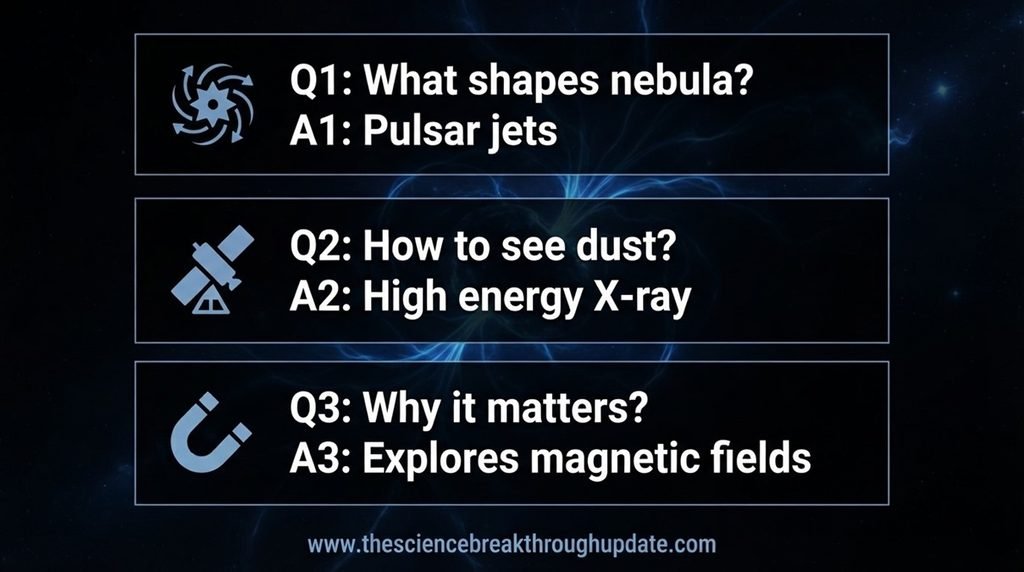
1. What exactly creates the shape of the Hand of God nebula?
A rapidly spinning neutron star called a pulsar shoots out massive jets of matter and antimatter. These particles hit surrounding gas clouds left over from an old stellar explosion, creating the unique glowing shape.
2. How do scientists see through the thick space dust to study it?
Astronomers use specialized space telescopes that detect high-energy X-rays instead of visible light. These X-rays pass right through cosmic dust clouds, allowing scientists to map the hidden structures inside.
3. Why does this specific discovery matter to everyday people?
Studying these extreme environments helps scientists understand how matter behaves under intense gravity and magnetic fields that are impossible to recreate on Earth. This knowledge ultimately drives advancements in fundamental physics and new technology.
Source Document Link: arXiv.org
Share this useful knowledge with your friends now!”
Disclaimer: This content is based on preliminary scientific research (Preprints) from arXiv.org and current global findings. It is shared strictly for educational and informational purposes and does not constitute professional, legal. Readers are encouraged to verify facts independently and consult relevant experts before making any decisions.