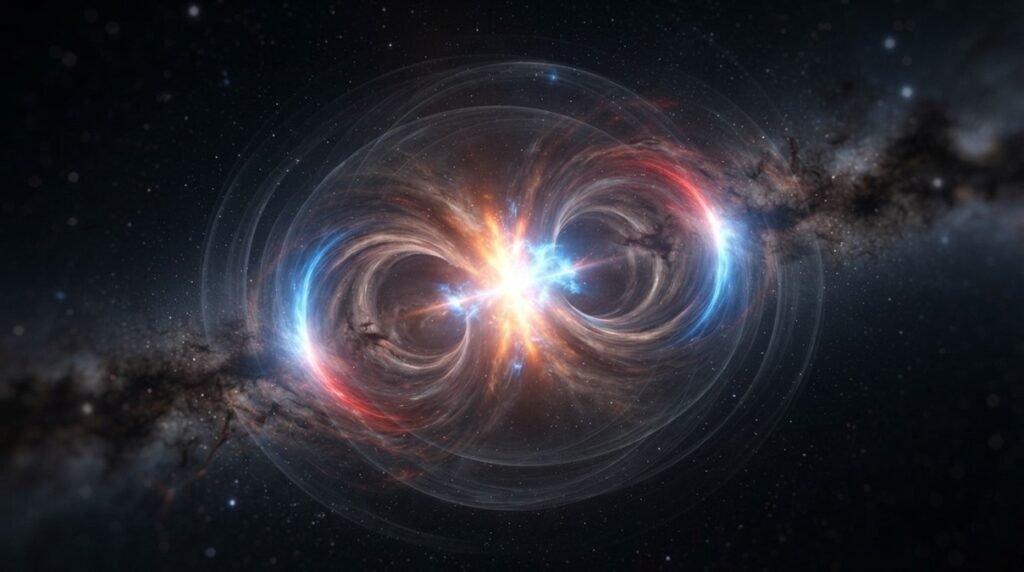
🚀 If two shortcuts to distant regions of the cosmos slam into each other, do they create a permanent portal or destroy space-time entirely?
Astrophysicists frequently dream about traversable wormholes acting as stable cosmic shortcuts across the universe. However, calculating the physical results when two massive celestial drainholes interact remained an unresolved mystery because of extreme gravitational instabilities and complex mathematical constraints.
Now, expert researchers are finally mapping these interactions using advanced three-dimensional numerical relativity simulations. Their latest model reveals what happens during close encounters, showing that colliding shortcuts face a far more violent fate than traditional science fiction ever suggested.
🌌 The Fatal Instabilities Keeping Cosmic Doorways Open
- Static cosmic throats represent highly unstable fixed points that inevitably collapse or inflate under the slightest physical truncation noise.
- Massive drainholes require an exotic classical phantom scalar field with negative energy density to prevent the throat from pinching shut instantly.
- Traditional gravitational frameworks cannot easily predict binary dynamics because this unique matter model explicitly violates the standard null energy condition.
- Classical laws of general relativity completely forbid any topological change, meaning two independent space-time handles cannot simply fuse into one.
💻 Supercomputers Map the First 3D Interactions of Wormhole Binaries
- Professional physicists Nikita M. Shirokov and Ilya Nachevsky simulated these complex binary systems using the advanced GRTeclyn simulation code.
- The research team successfully tracked these numerical interactions at the Moscow Institute of Physics and Technology and the Higher School of Economics.
- Their rigorous calculations revealed a strict charge-sign rule where like scalar charges repel while opposite cosmic charges strongly attract each other.
- When opposite-signed pairs collide head-on, they form a common marginal outer trapped surface born with roughly their combined surface area.
💥 The Rapid Collapse Into Black Holes and Ghost Waves
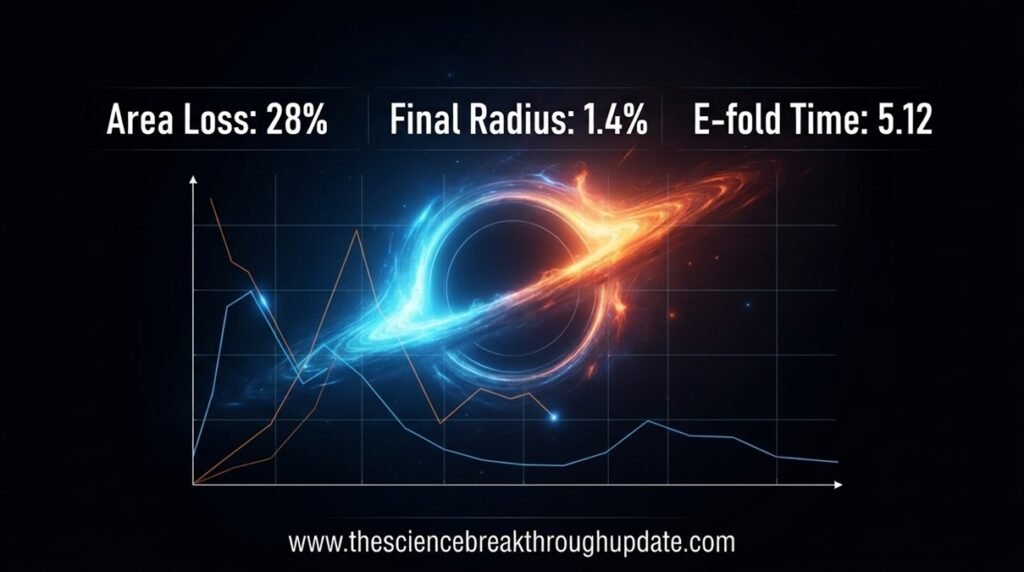
- Instead of remaining a stable doorway, the newly formed common horizon loses 28% of its area by swallowing the phantom field.
- By the final simulation step, the shrinking merged core sits within 1.4% of the Schwarzschild radius of the pair’s mass.
- Every violent deep-space encounter radiates a unique burst of gravitational waves alongside a negative-energy scalar dipole across the cosmic fabric.
- This negative-energy dipole pumps the orbit instead of draining it, meaning these exotic binaries completely lack a standard gravitational inspiral.
My Take: This simulation shatters our sci-fi dreams of stable cosmic portals. By proving wormholes collapse into black holes during collisions, physics shows reality is far harsher—and vastly more fascinating—than fiction.
❓ Reader Doubts: Core Questions Answered
1. Can a spaceship safely travel through these structures before they collide?
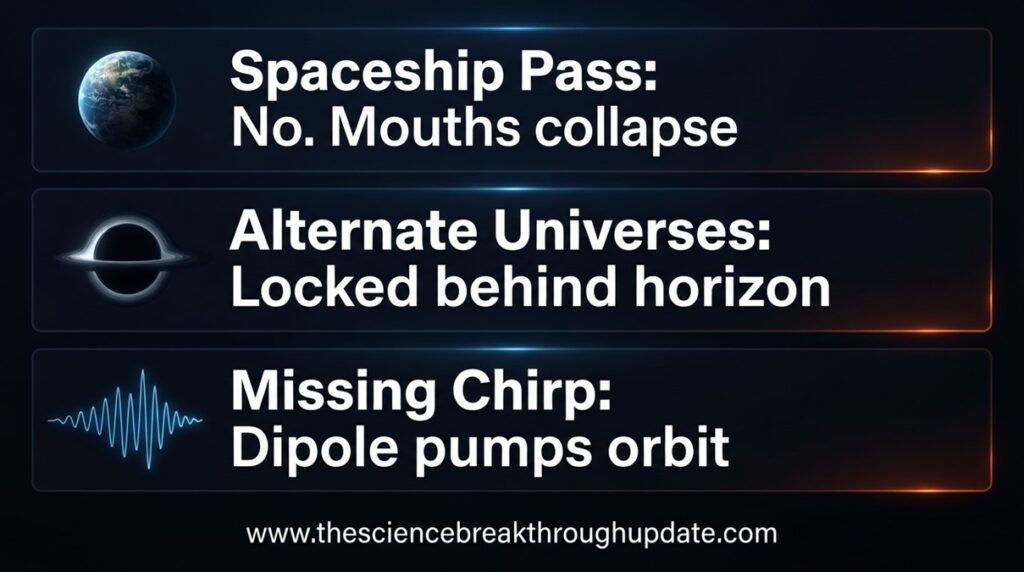
A lone ghost-supported throat remains highly unstable and either collapses into a black hole or inflates rapidly. For instance, a stellar-mass drainhole decays completely within milliseconds, meaning physical matter cannot safely pass through the throat. Therefore, intrepid space astronauts would face certain destruction long before reaching the far side of the universe.
2. What happens to the alternate regions of space-time after a merger?
The mathematical simulation demonstrates that both open throats end up trapped behind a single common apparent horizon after a head-on collision. This dark boundary completely censors the interior from the outside world according to classical topological censorship principles. Consequently, the two distant universes become permanently cut off from our own space-time region.
3. Why do these colliding cosmic systems fail to emit a normal chirp?
Standard binary black hole systems emit a rising gravitational chirp signal because orbital friction continuously drains energy from the system. These exotic pairs do not chirp because their unique scalar dipole pumps energy directly back into the orbit. This continuous interaction prevents traditional orbital decay, leaving only a single non-periodic energy burst across the cosmos.
Source Document Link: arXiv.org
Share this useful knowledge with your friends now!”
Disclaimer: This content is for educational and informational purposes only.