
🌌 Deep space contains billions of wandering alien rocks, and astrobiologists just discovered that twin suns use hidden gravitational traps to steal them and build entirely new worlds.
Building a planet is a chaotic cosmic puzzle that requires tiny dust particles to grow over 12 orders of magnitude. However, growing these rocks into massive planetesimals is incredibly difficult because powerful gas currents often destroy them before they can fully form.
This major cosmic bottleneck becomes even worse inside binary star systems where intense gravitational disruptions tear apart forming worlds. To solve this mystery, researchers Alia Pollard and Evgeni Grishin from Monash University investigated how twin stars bypass this roadblock.
⚠️ Why Twin Suns Struggle to Create Newborn Planets
- Growing cosmic rocks face a deadly radial drift barrier because aerodynamic gas friction forces centimeter-sized boulders to spiral rapidly into their central host stars.
- This destructive spiral process occurs in just 1000 years, which completely depletes the solid material before streaming instability can cluster them into planets.
- Surrounding space environments get far more hostile around twin suns because a companion star physically truncates the available protoplanetary disc boundary size.
- These violent gravitational disruptions create massive zones of orbital instability that completely prevent standard in-situ planet formation from occurring inside binary setups.
🧲 How Gravity Traps Steal Wandering Alien Space Rocks
- Instead of growing local material, binary star systems bypass these traditional growth limits by directly capturing rogue interstellar planetesimals from deep interstellar space.
- Aerodynamic gas drag inside the active disc slows down these fast-moving alien rocks, which rapidly strips their energy to trigger a true capture event.
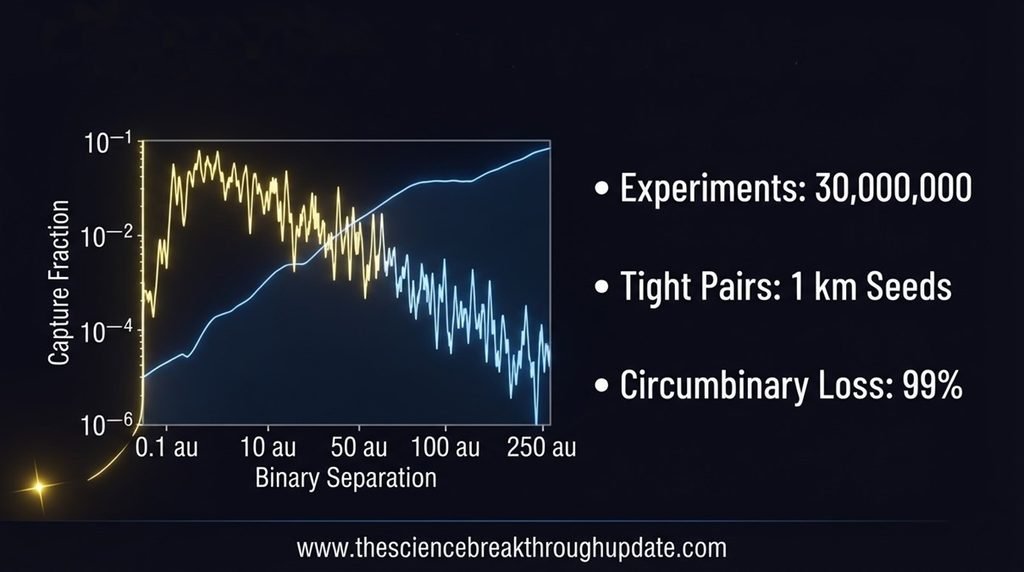
- The research team executed over 30,000,000 distinct numerical experiments to systematically analyze how different stellar gaps alter these interstellar capture statistics.
- Tighter stellar pairs utilize extreme gravitational focusing to pull large rocks deep into their high-density gaseous layers where friction efficiently traps them.
🚀 The New Cosmic Blueprint for Multi-Star Solar Systems
- Tightly bound stellar systems with 10 au separations easily secure 1 kilometer-sized seed, providing the necessary foundations for successful subsequent planet growth.
- Wider binary configurations capture over 10 massive alien rocks during their early lifetimes, proving that planetesimal seeding remains an incredibly efficient process.
- Conversely, wide circumbinary setups lose 99% of their capture efficiency because their massive central cavities completely lack dense inner gas discs.
- These simulated capture rates match real-world data perfectly, explaining why discovered circumbinary planets predominantly exist only around tightly bound twin suns.
My Take: This changes everything about alien world hunting. Proving that double suns actively steal cosmic debris tells us that harsh, unstable star systems are far more capable of building planets than we ever imagined.

❓ Reader Doubts: Core Questions Answered
- What is an interstellar planetesimal?
An interstellar planetesimal is a rogue cosmic rock, asteroid, or comet like 1I/2017 U1 (‘Oumuamua) that completely escapes its original planetary birth system. These unbound objects wander indefinitely through the dark space between stars until the gravitational reach of a new system influences them. They act as vital ready-made seeds that can kickstart the formation of new worlds without relying on local dust growth. - How do twin stars trap these alien rocks?
Twin stars utilize a powerful combination of intense gravitational attraction and extremely dense gaseous material within their orbital discs. When a drifting alien rock plunges directly through the thick gas, aerodynamic friction acts like a giant brake pad to strip away its kinetic energy. This massive energy loss slows the object down significantly, permanently trapping it into a stable, circularized planetary orbit. - Why do wide circumbinary stars fail to capture planets?
Wide twin stars create a massive gravitational clearing or cavity directly at the center of their shared circumbinary disc. Because this vast central region completely lacks the dense gas necessary to slow incoming objects down, extremely fast-moving space rocks fly straight through. Without friction to dissipate their immense speed, these large interstellar bodies easily escape the system into deep space.
Source Document Link: arXiv.org
Share this useful knowledge with your friends now!”
Disclaimer: This content is for educational and informational purposes only.