


🧠 Artificial intelligence is secretly accelerating scientific discovery behind lab doors, turning decades of human trial-and-error into hours of automated data crunching.
🔬 For centuries, researchers spent years sitting in laboratories running thousands of repetitive physical experiments just to discover a single working molecular compound. Today, advanced machine learning models operate as digital lab assistants, rapidly scanning millions of academic papers to predict successful results instantly. This shift allows modern scientists to bypass traditional research bottlenecks and focus entirely on high-level breakthrough theories.
⏳ The traditional scientific method relies heavily on slow human execution, manual data collection, and limited sample sizes that restrict quick discoveries.
The Hidden Stagnation of Modern Scientific Innovation
- 🛑 Traditional research methods require years of manual trial-and-error to validate a single scientific hypothesis in the laboratory.
- 📚 Human researchers face massive bottlenecks when trying to read, analyze, and synthesize millions of global academic papers simultaneously.
- 💸 High operational costs and limited lab equipment prevent scientists from running large-scale physical experiments concurrently.
- ⏳ Brilliant minds frequently waste valuable time on repetitive data collection instead of focusing on creative scientific breakthroughs.
How Intelligent Algorithms Are Rewiring the Laboratory
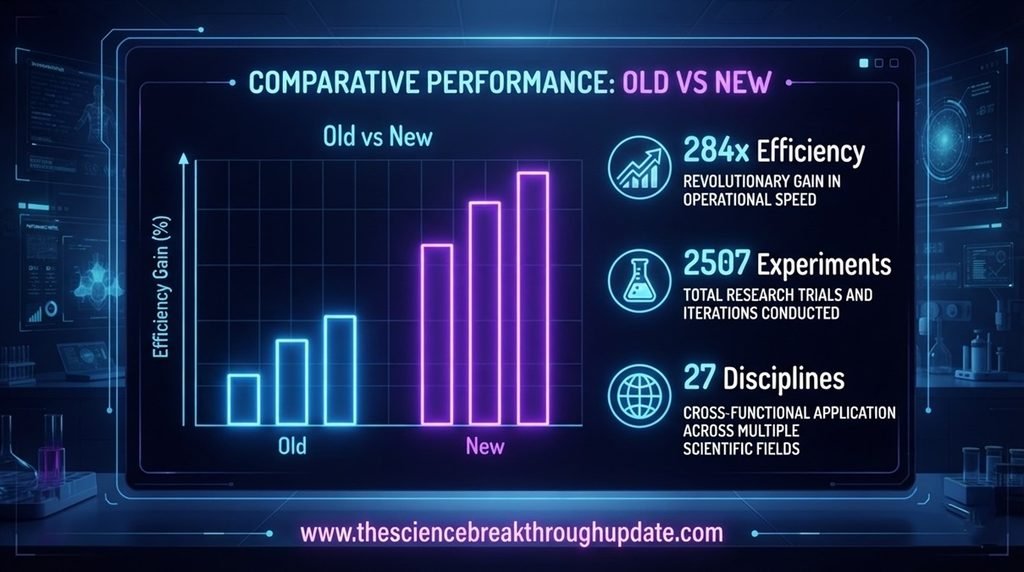
- 🧑🔬 Researchers Gabriel Manso, Emma Fu, and Neil Thompson analyzed 2507 head-to-head comparisons proving AI vastly outperforms older techniques across 27 disciplines.
- ⚡ Systematic data tracking reveals that integrating these specialized models boosts research efficiency by an astonishing 284 times over traditional computational methods.
- 🔍 Automated data pipelines extract hidden patterns from historical research archives to spark new interdisciplinary scientific theories.
- ⚙️ Implementing specialized AI tools directly optimizes workflows, allowing global scientists to process complex data math at unprecedented computational speeds.
The Global Impact on Medicine Technology and Future Progress
- 💊 Transforming the research pipeline means life-saving medications will reach global consumer markets in months instead of decades.
- 🏭 Lowering experimentation costs allows smaller independent laboratories to achieve massive technological breakthroughs once reserved for wealthy corporations.
- ☀️ Accelerating materials science enables the immediate creation of highly efficient solar panels and sustainable clean energy solutions.
- 🌍 Shifting mundane tasks to automated systems frees human scientists to solve the most complex global environmental challenges.
My Take: This discovery proves artificial intelligence is no longer a mere chatbot gimmick, functioning instead as a vital powerhouse that accelerates life-saving science and reduces lab times for everyone.
Reader Doubts: Core Questions Answered
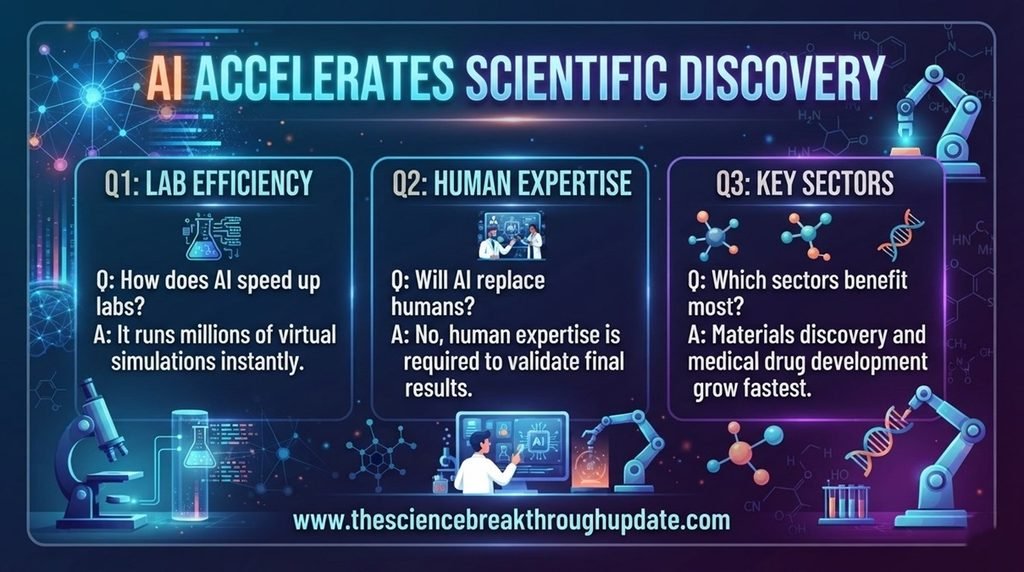
- How does AI actually help scientists discover new things faster?
- ⚡ AI acts as a superfast pattern recognition tool that analyzes massive datasets instantly. A comprehensive study proved that specialized AI models provide a 284 times efficiency advantage over traditional computational analysis methods.
- Will AI replace human scientists in the near future?
- 🤝 No, these tools only handle the repetitive work like data scanning and running simulations. Human scientists remain essential for evaluating results, providing domain expertise, and conducting independent physical validation.
- What real-world sectors are seeing the biggest benefits from this tech?
- 🧪 Materials discovery, biotechnology, and medical drug development are currently seeing the fastest growth. Laboratories use these algorithms to crunch data across 27 different scientific disciplines simultaneously.
News source link: arXiv.org
Share this useful knowledge with your friends now!
Disclaimer: This content is for educational and informational purposes only.



