
🚀 Astronomers have just picked up an unprecedented radio signal from a giant planet outside our solar system, changing everything we know about alien worlds.
🌌 Astronomers just made history by capturing mysterious low-frequency radio emissions coming directly from a nearby giant exoplanet. This breakthrough marks the first time scientists have successfully isolated radio waves from a planet orbiting a distant star system.
📡 Researchers used advanced ground-based arrays to filter out intense background noise and lock onto this faint cosmic broadcast. Finding these hidden signals confirms that the alien world possesses a powerful, active magnetic field protecting its atmosphere.
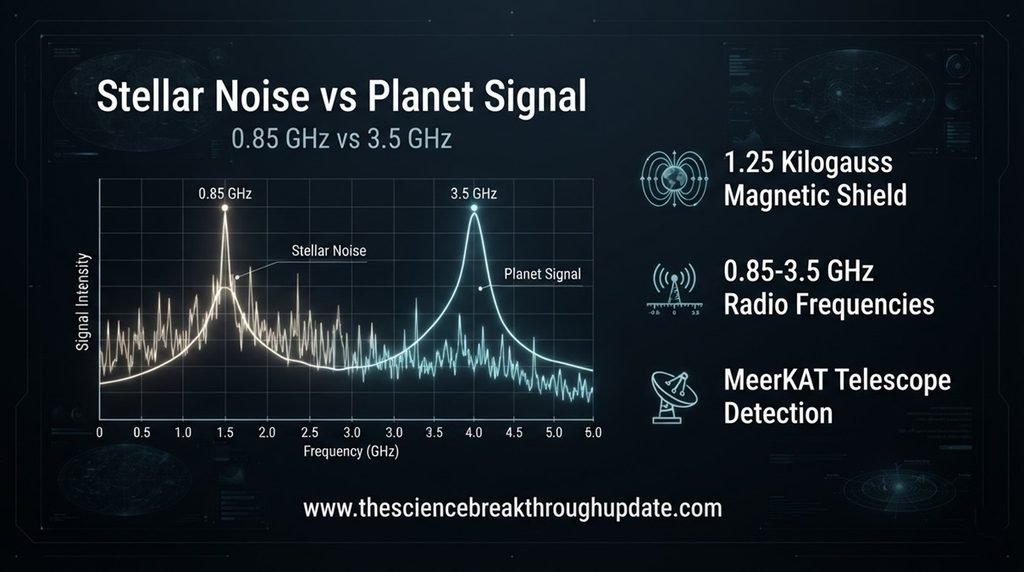
The Challenge of Hearing Faint Cosmic Whispers
- 🌌 Deep space telescopes constantly struggle to separate weak planetary radio signals from the blinding radiation emitted by host stars.
- 📻 Most distant planets remain completely silent to our instruments because their weak radio emissions get lost in cosmic static.
- 🛠️ Scientists previously lacked the precise data-filtering tools needed to isolate low-frequency planetary transmissions from stellar flares and noise.
- ⏳ Identifying true alien planetary signatures required long observation windows and highly sensitive hardware capable of tracking long-term signals.
Cracking the Radio Code of a Giant Planet
- 🎓 Astrophysicists Kevin N. Ortiz Ceballos, Edo Berger, and Yvette Cendes led the team that successfully captured these elusive signals.
- 🔭 The researchers utilized the advanced MeerKAT array to monitor the target star system over prolonged periods of continuous observation.
- 💻 Custom data-reduction techniques successfully stripped away the blinding stellar background noise to reveal the planet’s distinct radio signature.
- 🪐 The team confirmed the signal originated directly from the gas giant Beta Pictoris b by matching the emission patterns.
Why This Discovery Alters Our Search for Life
- 🛡️ Detecting these specific radio waves proves the planet has a strong magnetic field measuring at least 1.25 kilogauss at its source.
- 🗺️ Mapping planetary magnetic fields gives scientists a new blueprint to identify worlds that might sustain habitable conditions.
- 🔄 This tracking method allows astronomers to measure the rotation speed and internal structure of planets without direct imaging.
- 🔓 The breakthrough opens a new era of radio astronomy focused on scanning the galaxy for shielded exoplanets.
My Take: Hearing a planet speak from the darkness changes everything. We are no longer blindly looking for rocks in space; we are now actively tuning into their protective shields to find potential homes.
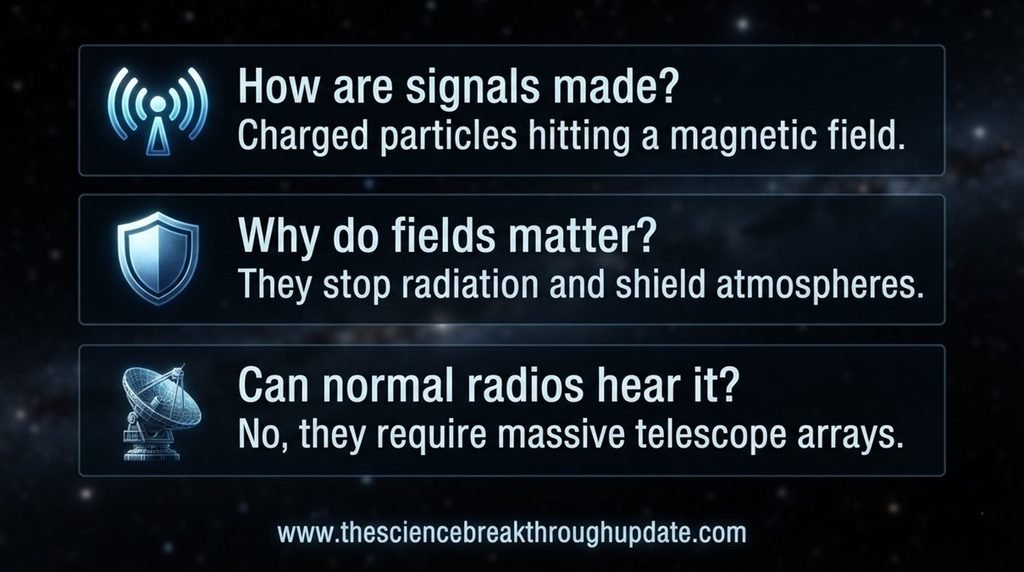
Reader Doubts: Core Questions Answered
1. How do planets emit radio signals?
- ⚡ Planets generate radio waves when energetic charged particles interact with the planet’s magnetic field. This interaction creates an electron cyclotron maser instability that produces powerful, circularly polarized radio bursts.
2. Why is a magnetic field important for a planet?
- 🛡️ A magnetic field acts as a protective shield against harmful stellar radiation and solar winds. Without this vital protection, a planet’s atmosphere gets stripped away over time, making life impossible.
3. Can we listen to these signals with a regular radio?
- 📡 No, these low-frequency cosmic signals ranging from 0.85 to 3.5 GHz are incredibly faint and require massive installations. Scientists must use highly specialized ground-based arrays like the MeerKAT telescope to capture and decode them.
News source link: arXiv.org
Share this useful knowledge with your friends now!
Disclaimer: This content is for educational and informational purposes only.