
🧠 Your brain has a hidden forgetting curve, and researchers have finally built a tiny AI model that cracks its code.
Human memory remains a complex puzzle for educational software developers trying to design efficient study tools. Traditional flashcard applications attempt to predict when a student will forget information. However, these platforms rely on bulky algorithms that function like uninterpretable black boxes.
To solve this issue, researcher Anders Schill from Stockholm created a streamlined memory model called SBD. This open-source algorithm maps human forgetfulness with incredible precision. It helps flashcard software schedule perfect review intervals without relying on bloated software code.

🧠 The Cost of Managing Overcomplicated Educational Algorithms
- Existing spaced repetition systems like FSRS-7 rely on massive architectures containing 34 distinct parameter weights to track daily student review logs.
- These giant neural networks cannot accurately predict memory dropouts when students try to study outside the narrow, pre-programmed application intervals chosen by schedulers.
- Traditional software models lack a simple mechanistic interpretation, making it completely impossible for educational developers to audit how individual predictions are made.
- Educational applications running these heavy models consume excessive mobile processing power when calculating custom study schedules for large decks of digital flashcards.
🛠️ A Parsimonious Model Rebuilt Around Core Human Psychology
- The SBD memory model tracks human forgetfulness and learning dynamics using only 3 state variables named stability, brittleness, and difficulty.
- This streamlined mathematical architecture uses just 7 fitted weights, making the entire digital footprint 80% smaller than current state-of-the-art options.
- The algorithm applies Gamma frailty equations to model how a student’s brain naturally repairs memory traces during practical daily review sessions.
- The open-source code utilizes Jost’s law principles to ensure that your custom flashcard intervals expand reliably across long periods of time.
🚀 Optimizing Human Learning Environments Without Algorithmic Bloat
- App developers can easily integrate this lightweight binary model into mobile platforms to calculate custom review intervals without causing device lag.
- This mathematical structure allows researchers to solve tough scheduling conflicts directly using Whittle relaxation index policies for expanding student card decks.
- This transparent tool completely eliminates complex features measured after reviews, ensuring that software simulators can roll future states forward with absolute certainty.
- Students receive optimized review schedules that adapt perfectly to their personal memory traits without wasting time on unnecessary early flashcard repetitions.
My Take: By stripping away algorithmic bloat, this code proves that smarter tech does not mean bigger data. It hands actual control back to students, making personal growth efficient and accessible.
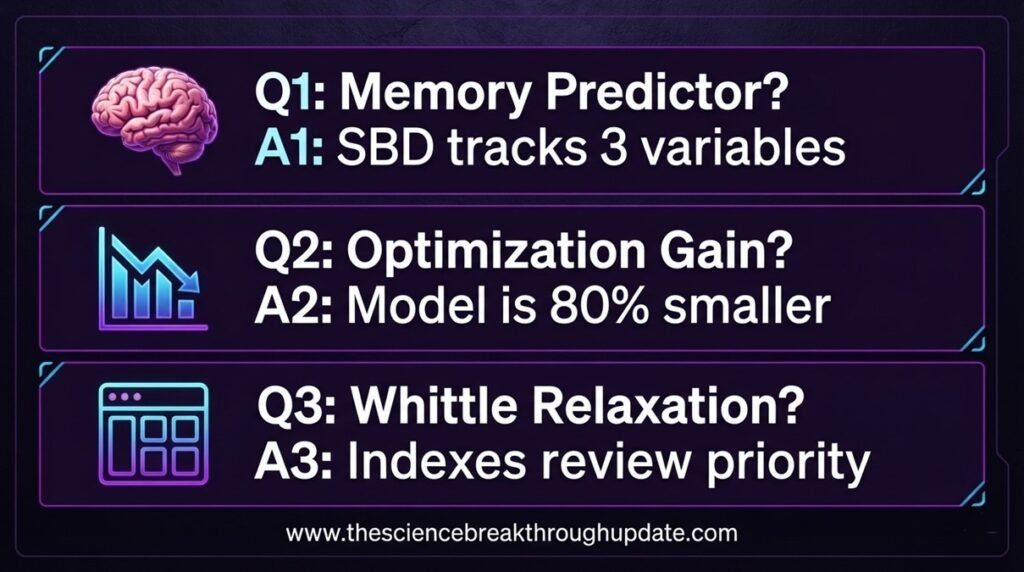
❓ Reader Doubts: Core Questions Answered
- How does the SBD model predict when a student will forget information?
The model tracks memory decay using 3 distinct core metrics called stability, brittleness, and difficulty. It applies Gamma frailty math to compute the exact probability that a flashcard is retained after a specific number of days. This allows the system to adjust dynamically every time a user rates their recall. - Why is an 80% smaller model beneficial for educational apps?
Smaller models require significantly less computing power and digital memory to operate smoothly on standard mobile devices. They also prevent algorithm overfitting on narrow datasets, which allows the software to extrapolate custom review intervals more reliably. This transparency makes the tool incredibly easy for developers to audit and modify. - What is the role of Whittle relaxation in this research?
Whittle relaxation helps manage large flashcard decks efficiently when daily study budgets restrict the total number of reviews. It assigns a unique mathematical index to each card based on the current interval. This ranking ensures that students always review the highest priority items first.
Source Document Link: arXiv.org
Share this useful knowledge with your friends now!”
Disclaimer: The information on this website is for educational and informational purposes only and is not intended as medical advice. Always consult a qualified healthcare professional before making any medical decisions or changes to your treatment plan.