
🚨 Every single glass of water you drink might contain thousands of invisible microplastics that slipped through the earth’s natural soil filters.
When rain falls, it sweeps tiny microplastic particles into the ground, threatening global groundwater reservoirs. Because natural soil structures are completely opaque, tracking how these dangerous pollutants migrate through underground channels has remained an impossible challenge for environmental scientists.
To solve this, researchers Hao Liu and Stephan Gekle mapped soil geometries using X-ray micro-computed tomography scans. By analyzing the physical pathways of water-saturated sediments, they cracked the code on how plastic fragments travel straight into water supplies.
🔬 The Invisible Underground Maze Defeating Environmental Scientists
- Deep underground soils form an incredibly complex, highly irregular network of microscopic pore channels that transport dangerous particulate contaminants.
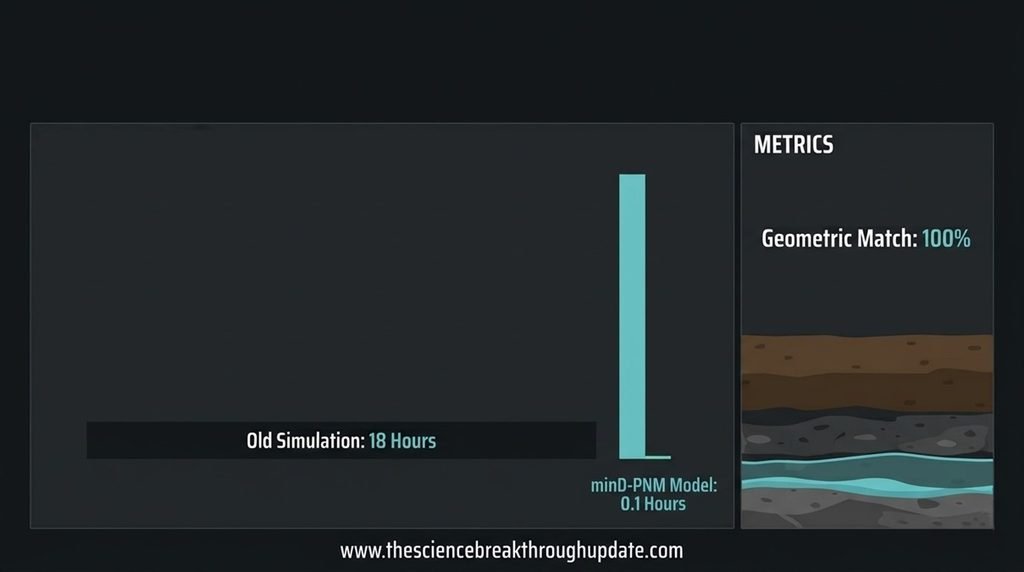
- Traditional fluid dynamics simulations require massive computer clusters and up to 18 hours of processing to track small soil blocks.
- Opaque dirt structures prevent direct visual tracking of synthetic fibers, leaving environmental protection agencies blind to the exact pollution speed.
- Existing mathematical models rely on heavy guesswork because they cannot calculate how liquid velocity fluctuates inside individual pore bodies.
🧩 An Elegant Physics Model Map Built Entirely on Geometry
- The research team developed a highly efficient software framework called minD-PNM that maps particle paths using only pore shapes.
- This model applies a clever minimum-dissipation optimization algorithm to partition complicated pore spaces into clean, single-conduit pathways.
- By calculating fluid resistance across these subdomains, the system predicts travel times without solving heavy, full-scale hydrodynamic equations.
- The algorithm replaces explicit particle tracking with an incredibly fast, flux-weighted random walk framework mimicking real-world sediment dynamics.
🌊 Securing the Long-Term Safety of Global Groundwater Reserves
- The new geometric framework slashes total computing time from 18 hours down to just 0.1 hours with exceptional accuracy.
- Testing against live laboratory columns filled with polystyrene microplastics proved that this model perfectly mirrors actual water pollution.
- Environmental engineers can now easily scale up simulations to analyze massive, macroscopic field samples previously impossible to calculate.
- This tool provides contaminant hydrology projects with a highly practical, open-access method to monitor long-term toxic plastic migration.
My Take: By replacing brutal computing hours with clever geometry, this software finally lets cities track invisible groundwater toxins. It is a massive win for public safety that will protect clean drinking water worldwide.
❓Reader Doubts: Core Questions Answered
1. How do microplastics manage to pass through thick layers of natural soil?
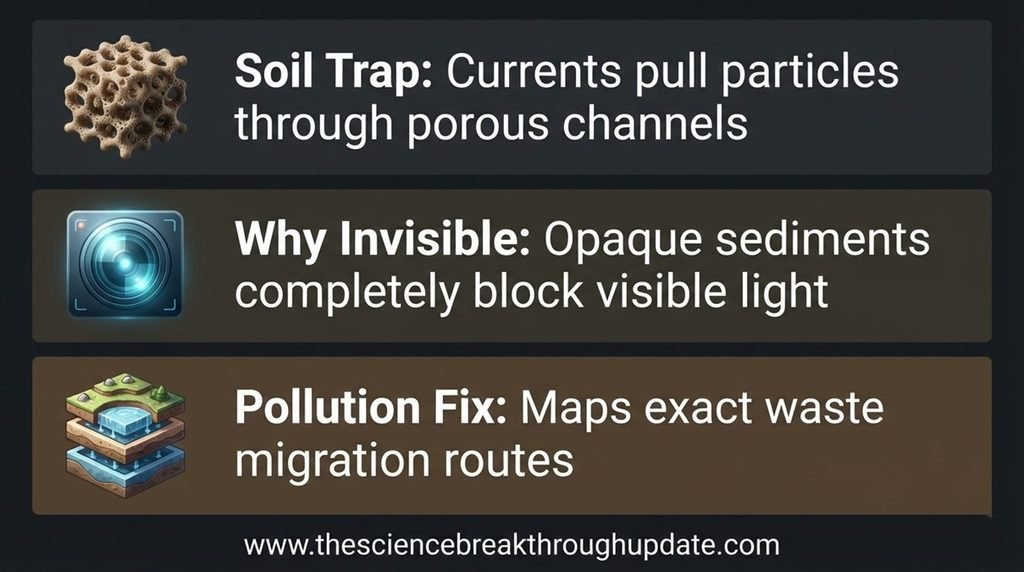
Water-saturated soils contain thousands of tiny interconnected pathways called pore networks. When rainwater enters the ground, it creates fast-flowing channels that pull small suspended plastic particles forward before they can attach to the surrounding sand grains.
2. Why can we not just track these plastic particles using traditional cameras?
Natural soil and quartz sediments are completely opaque, which blocks all visible light and prevents standard optical microscopes from seeing inside. Scientists must rely on non-destructive X-ray scans to recreate digital maps of the hidden underground architecture.
3. Can this new physics framework prevent future microplastic water pollution?
While the software does not physically filter water, it allows researchers to accurately predict where plastic pollutants will accumulate over time. This data helps cities design smarter groundwater protection zones and more effective environmental filtration barriers.
Source Document Link: arXiv.org
Share this useful knowledge with your friends now!”
Disclaimer: The information on this website is for educational and informational purposes only and is not intended as medical advice. Always consult a qualified healthcare professional before making any medical decisions or changes to your treatment plan.