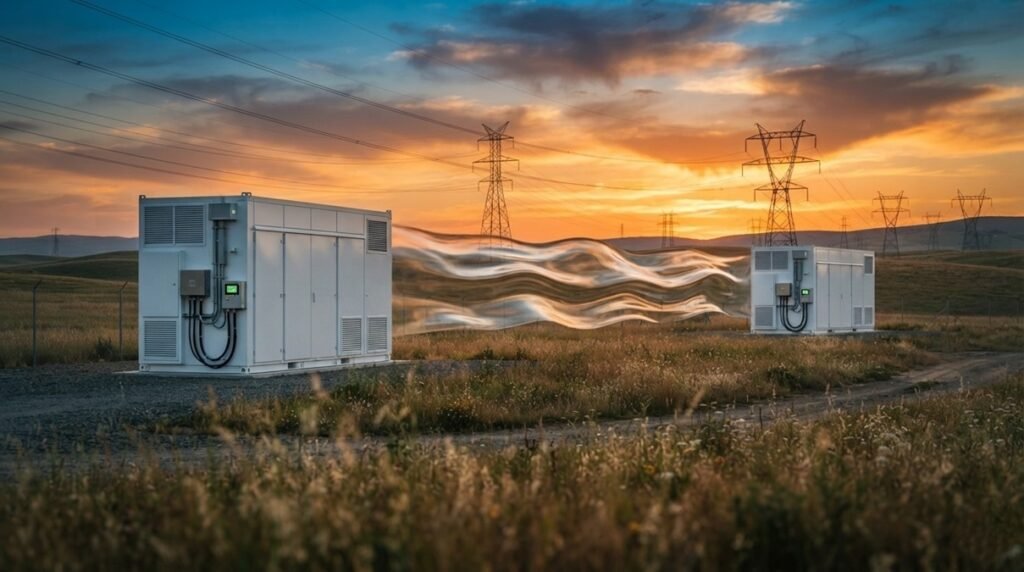
⚡ Moving massive amounts of clean electrical power without constructing a single new physical transmission line remains a critical goal for modern energy grids.
Modern power systems face severe network congestion as massive integrated data centers and variable renewable energy resources expand rapidly. Commissioning traditional physical transmission lines often takes up to a decade due to permitting and infrastructure construction delays, creating a multi-year infrastructure mismatch that triggers load shedding and gridlock.
To bridge this capacity gap, researchers Qiushi Wang and Xingpeng Li from the University of Houston developed a long-term mathematical planning framework. Their strategy coordinates paired battery systems to form a virtual transmission line that mitigates transmission capacity shortages without building new physical towers.
🛑 Why Modern Power Networks Face Severe Infrastructure Mismatches
- Rapid global deployment of modern integrated data centers driven by massive artificial intelligence networks adds heavy projected peak demand to regional transmission organizations.
- Developing traditional physical overhead transmission infrastructure typically requires up to a full decade to complete environmental mapping, site acquisition, and complex routing design.
- Growing penetration of variable utility-scale renewable energy resources introduces significant operational uncertainty and severe local network congestion during peak generation periods.
- Chronic grid capacity shortages unfortunately force costly renewable energy curtailment when typical cost-driven expansion plans fail to alleviate modern structural marketplace gridlock.
🔋 The Coordinated Storage System Simulating Nodal Power Balance
- The mathematical planning framework uses a unique mixed-integer linear formulation to co-optimize generation resources, physical transmission lines, and flexible battery energy storage systems.
- The relaxed virtual model applies explicit operational constraints that effectively prevent the two paired battery units from charging or discharging simultaneously at any given hour.
- By actively shifting spatial patterns of power injections and power withdrawals, this system coordination successfully mimics traditional transmission line flow dynamics without errors.
- This strategic asset positioning serves as a viable, non-wire storage in place of transmission asset strategy during periods of rapid industrial grid expansion.
📈 Slashing System Congestion Metrics With Minimal Planning Cost
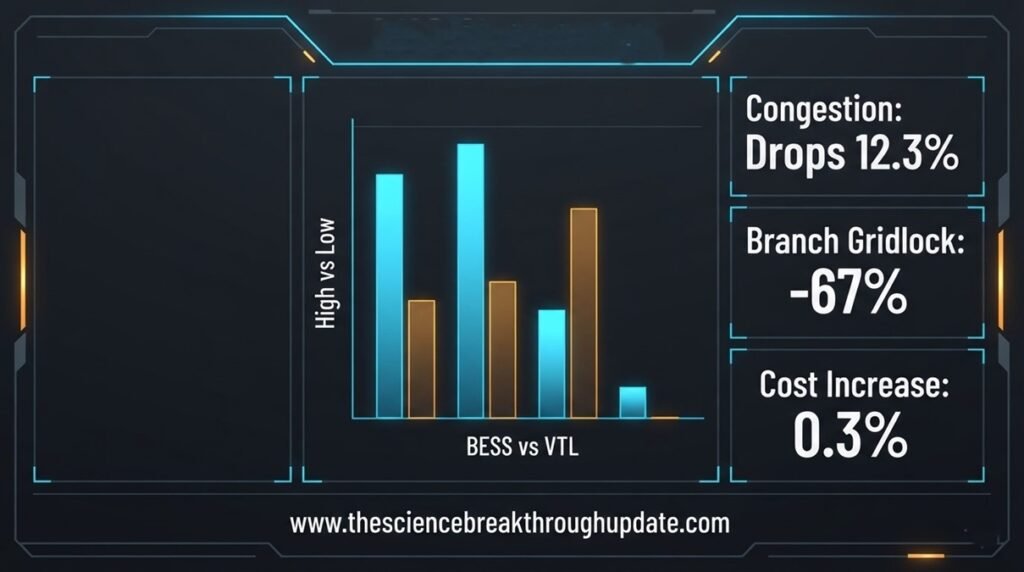
- Rigorous base case studies conducted on a revised IEEE 24-bus system demonstrate a solid 12.3% reduction in weighted total system congestion metrics.
- These coordinated battery operations successfully achieve up to an approximate 67% reduction in network congestion on specific heavily bottlenecked individual transmission branches.
- Deploying this advanced virtual transmission line strategy requires an incredibly small 0.3% marginal increase in total long-term system planning costs for utilities.
- The operational configuration significantly reduces overall carbon dioxide emissions compared to traditional expansion plans by actively promoting clean generation instead of gas units.
My Take: This clever software patch bypasses decades of red tape. By turning standard batteries into invisible power lines, it fixes the grid instantly, proving the smartest infrastructure isn’t built, it’s programmed.
🤔 Reader Doubts: Core Questions Answered
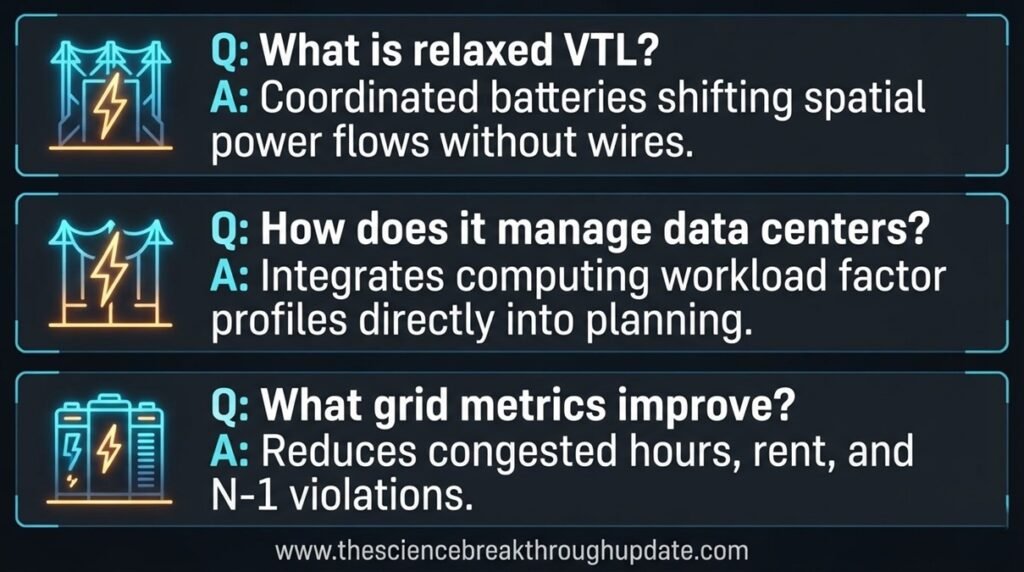
- What is a relaxed virtual transmission line?
It is an advanced transmission strategy that coordinates two separate battery energy storage systems placed at opposite endpoints of a network path. The framework strictly prevents both batteries from charging or discharging at the exact same time to relieve local capacity constraints. This unique approach successfully mimics actual power line flows without requiring identical hourly energy exchange rates. Utility providers can deploy this software-driven grid coordination method rapidly to prevent unexpected regional blackouts. - How does this framework handle massive data center growth?
The model integrates projected dynamic computing workloads and idle baseline power profiles directly into long-term system expansion planning equations. This mathematical forecasting ensures that the grid can strategically time battery and generation investments to support rapid industrial demand without experiencing critical failures. This allows energy managers to proactively safeguard localized distribution paths against sudden unexpected peak workloads. - What specific congestion metrics does this strategy improve?
The research confirms that this operational framework reduces congested line-hours, decreases total congestion rent, and mitigates risky N-1 transmission violation instances. It achieves these impressive system-wide benefits across the entire surrounding network rather than just on the specific lines directly linked to the batteries. These comprehensive improvements ensure safety.
Source Document Link: arXiv.org
Share this useful knowledge with your friends now!”
Disclaimer: This content is based on preliminary scientific research (Preprints) from arXiv.org and current global findings. It is shared strictly for educational and informational purposes and does not constitute professional, legal. Readers are encouraged to verify facts independently and consult relevant experts before making any decisions.