
🚨 What if the biggest threat to our planet is not how much the climate changes, but how incredibly fast it happens?
The global conversation about climate change usually focuses on total temperature rise. However, a research team from the University of Edinburgh and Heriot-Watt University just exposed a terrifying, invisible reality that could trigger a sudden ecological collapse without warning.
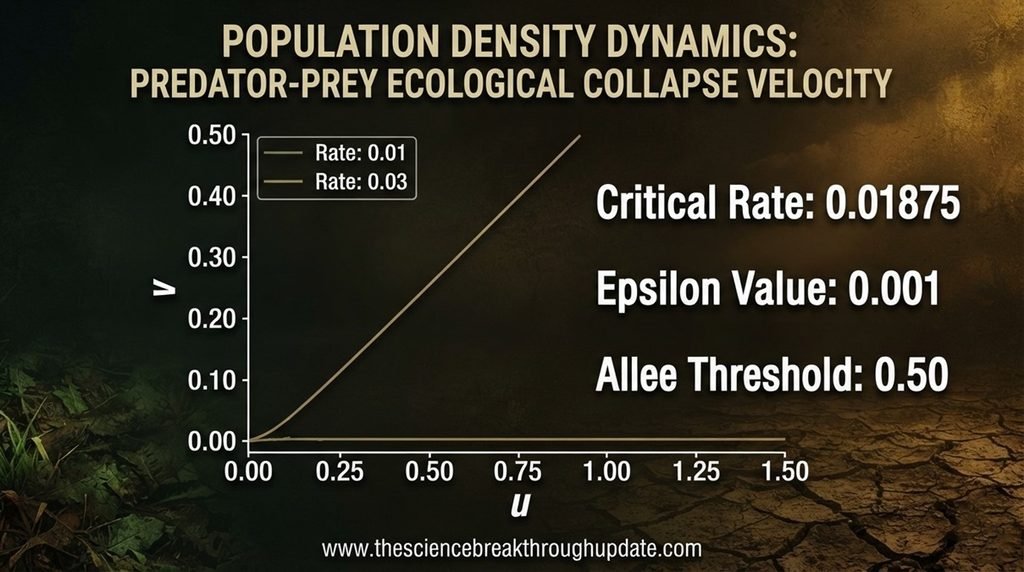
Their latest mathematical research reveals that when environmental shifts outpace nature, species do not just dwindle slowly. Instead, they hit a sudden rate-induced tipping point that instantly fast-tracks entire wild populations into absolute, permanent extinction overnight.
📉 The Invisible Trap Speeding Up Global Species Extinction
- Fast-moving resource declines trap wildlife in a deadly race against time where ecosystems collapse long before crossing traditional bifurcation thresholds.
- Traditional ecological models can completely miss this hazard because they fail to account for how the velocity of change triggers tipping.
- Dwindling habitat quality and falling resource levels give species no time to adapt, forcing animal populations down to dangerously low levels.
- When a population drops below a critical density, a brutal ecological loop triggers and guarantees permanent population collapse without recovery.
🧮 How Mathematicians Finally Cracked the Tipping Point Formula
- Scientists Brian Hennessy, Nikola Popović, and Zak Sattar built an analytically tractable mathematical model to map out these sudden collapses.
- The team integrated the biological mechanics of the strong Allee effect into standard equations to simulate real-world wildlife survival challenges.
- By upgrading classic Lotka-Volterra predator-prey dynamics, this new framework successfully calculates the precise critical rate of change an ecosystem can handle.
- This equations-based breakthrough allows researchers to spot hidden tipping zones and predict exactly when a system will plunge into sudden extinction.
🛡️ Why This New Math Saves the Future of Conservation
- Global conservationists can now deploy targeted strategies to protect vulnerable habitats before they hit the point of no return.
- This analytical framework empowers researchers to study open systems and prioritize managing the speed of environmental degradation.
- Wildlife protection agencies can use these predictive tools to identify at-risk regions and prevent irreversible biodiversity loss.
- Shifting focus toward environmental stability allows scientists to design smarter, metrics-driven defense plans that safeguard the planet’s fragile predator-prey ecosystems.
My Take: This math proves we are tracking the wrong climate metrics. Focusing entirely on temperature thresholds ignores the deadly speed of destruction, changing how we must predict and prevent ecological collapse.
❓ Reader Doubts: Core Questions Answered
- What exactly is rate-induced tipping in simple terms?
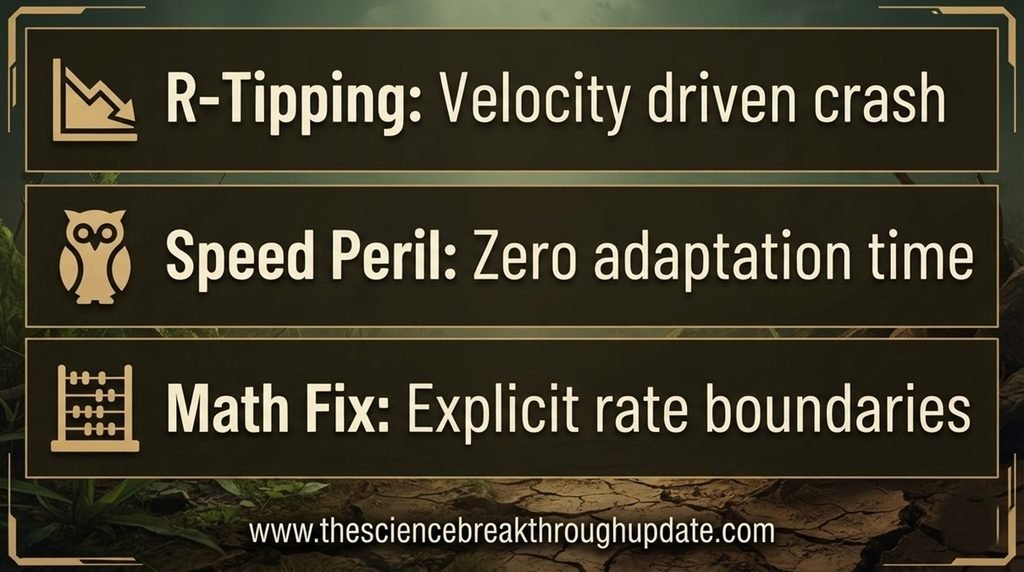
It happens when an environmental parameter changes too fast for a population to track it. Even if the parameter value itself isn’t critical, the sheer speed of the shift forces the ecosystem to crash. - Why is this discovery considered a warning for current climate models?
Most classical models focus on thresholds where a parameter crosses a critical value. This research proves that rapid change alone can destroy ecosystems even if no traditional threshold value is reached. - Can we use this new mathematical data to prevent future animal extinctions?
Yes, scientists can use this formula to calculate the explicit critical rate limits of different habitats. By tracking these velocity thresholds, teams can step in with protective measures before population tipping begins.
Source Document Link: arXiv.org
Share this useful knowledge with your friends now!”
Disclaimer: This content is based on preliminary scientific research (Preprints) from arXiv.org and current global findings. It is shared strictly for educational and informational purposes and does not constitute professional, legal. Readers are encouraged to verify facts independently and consult relevant experts before making any decisions.