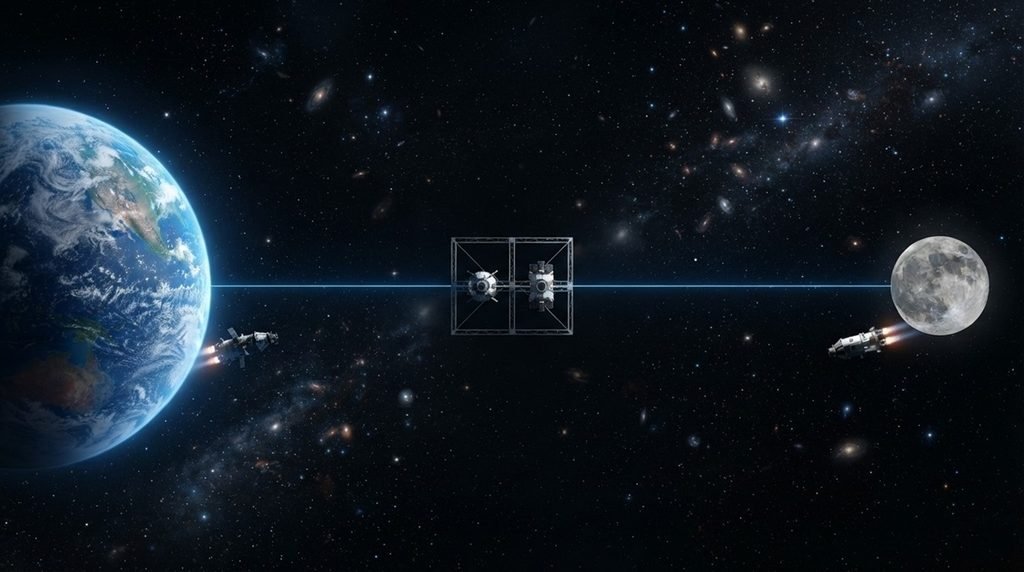
🚀 Scientists have successfully tamed the chaotic forces between Earth and the moon, opening up stable deep-space highways for permanent parking spots.
Establishing permanent human bases requires spacecraft to hover in complex Earth-Moon vertical orbits. However, chaotic gravitational forces constantly pull these transit vehicles off course. Without precise navigation, missions risk catastrophic failure or burning all propellant just to stay in position.
To solve this, aerospace engineers developed a high-fidelity station-keeping framework utilizing receding-horizon model predictive control. Their system simulates realistic deep-space disturbances to keep spacecraft perfectly balanced. This breakthrough ensures cargo vessels maintain positions with high mathematical precision while saving fuel.
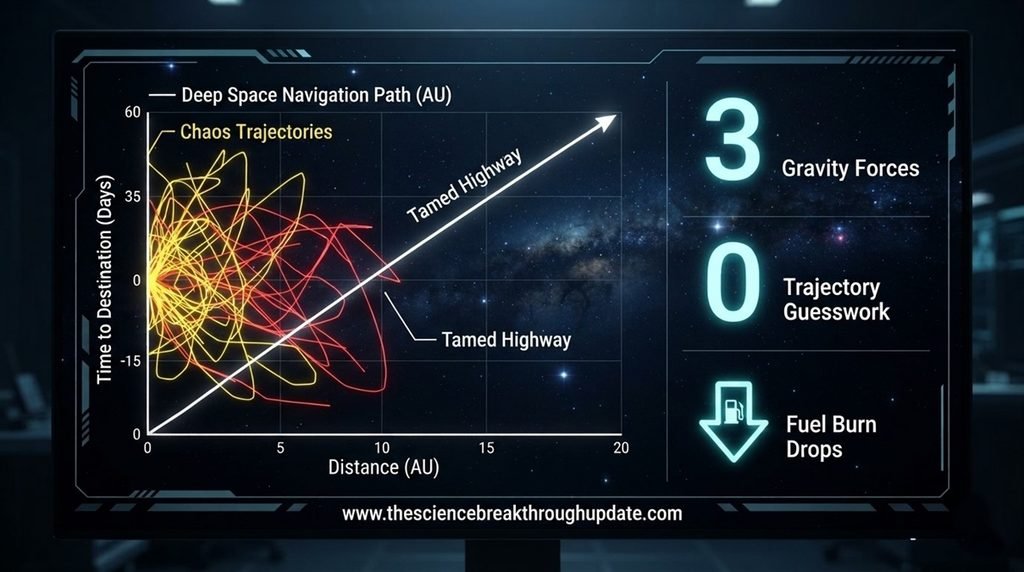
🌌 The Chaos of Deep Space Gravity
- Spacecraft trying to maintain stable vertical orbits around the moon face constant gravitational disruptions from the Earth, Moon, and Sun.
- Traditional orbital models often ignore smaller forces like solar radiation pressure, causing actual spacecraft to drift dangerously off course.
- Constantly firing thrusters to correct these unpredictable drifts rapidly depletes the limited fuel supply needed for the return journey.
- Failing to maintain these precise orbital pathways risks losing communication with ground control or drifting into deep space.
🛠️ Calculated Precision in a Three-Body System
- Researchers Derek Phung and Yuri Shimane designed a high-fidelity simulation that maps complex gravitational fields with extreme precision.
- The system utilizes sophisticated targeter algorithms to calculate the exact minimum thrust needed to correct orbital deviations.
- By factoring in real-world space environment disruptions, the framework eliminates the guesswork from long-term flight trajectory planning.
- The engineers successfully tested this method across multiple vertical orbit scenarios to prove its reliability for future lunar missions.
🌕 The Blueprint for Sustainable Lunar Colonization
- This navigation breakthrough slashes the fuel required for lunar station-keeping, allowing spacecraft to carry heavier scientific payloads instead.
- Reliable vertical orbits will serve as permanent, safe staging zones for future human missions landing on the lunar surface.
- The research provides a verified predictive model that space agencies can use to plan highly predictable, multi-year robotic deployments.
- Mastering these orbital dynamics brings humanity one step closer to building sustainable infrastructure in the deep space ecosystem.
My Take: This clean-sheet approach to space flight dynamics proves that software, not just heavier engines, will build our lunar future. It turns unpredictable cosmic crosswinds into a manageable parking science.
❓ Reader Doubts: Core Questions Answered
1. What is lunar station-keeping?
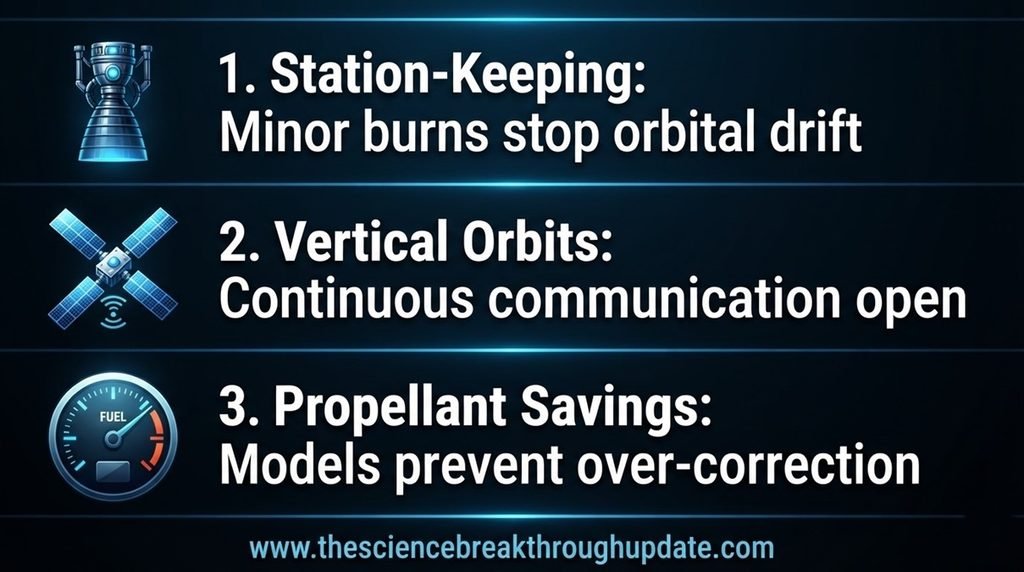
Lunar station-keeping is the process of using tiny, calculated thruster burns to keep a spacecraft from drifting out of its specific orbit. Without these minor corrections, the competing gravity of the Earth and Moon would pull the vehicle off course.
2. Why are vertical orbits important for moon missions?
Vertical orbits provide an excellent vantage point for continuous communication between Earth and the lunar south pole. They act as ideal parking spots for fuel depots and transit stations supporting long-term surface habitats.
3. How does this new research save spacecraft fuel?
By using highly accurate computer models that predict solar radiation and planetary gravity, navigation systems can plan corrections ahead of time. This prevents over-correction and drastically reduces the amount of propellant a spacecraft needs to burn.
Source Document Link: arXiv.org
Share this useful knowledge with your friends now!”
Disclaimer: This content is based on preliminary scientific research (Preprints) from arXiv.org and current global findings. It is shared strictly for educational and informational purposes and does not constitute professional, legal. Readers are encouraged to verify facts independently and consult relevant experts before making any decisions.