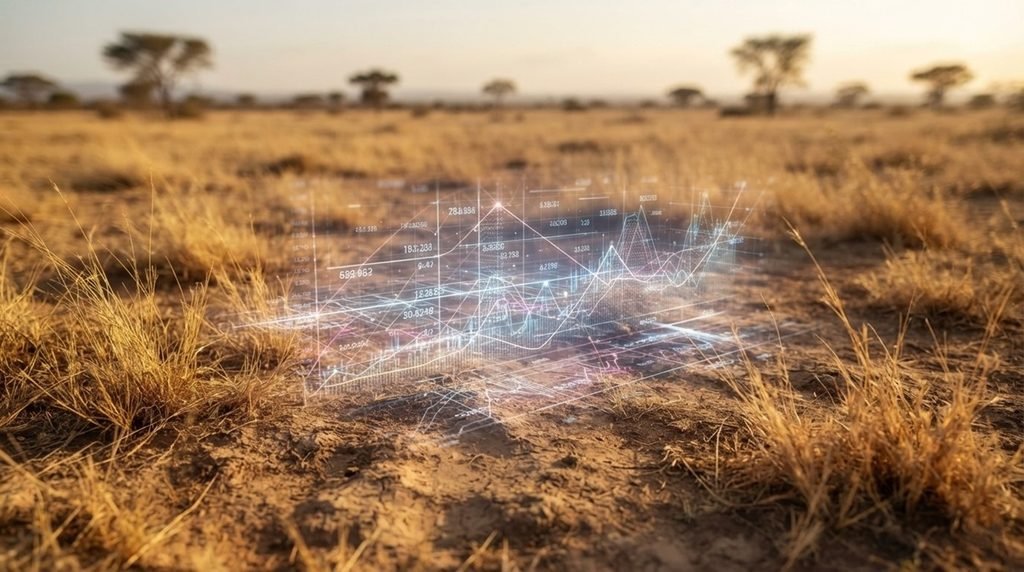
📈 Wall Street’s famous option pricing formula is now tracking the survival of African rangelands.
Wall Street financial models are cracking the code of how fragile ecosystems survive severe weather changes. By using mathematical options pricing principles, researchers are now mapping planet health with unprecedented precision. This approach successfully bridges the gap between high-finance mathematics and environmental conservation worldwide.
A new study by researcher Tom Pitts from the University of Technology Sydney demonstrates how the Black-Scholes framework decodes complex vegetation patterns. Utilizing MODIS satellite imagery, this automated model helps experts separate human land management impacts from natural weather variations completely cleanly.
📉 The Failure of Standard Ecological Metrics in Dry Rangelands
- Traditional carbon baseline methodologies like the Verra VM0032 framework completely fail because they ignore how grassland pastures respond to rainfall variables over time.
- Standard tracking systems assume a simple annual linear relationship, completely overlooking that actual vegetation greenness lags behind local CHIRPS rain records significantly.
- Current operational measurement baselines cannot cleanly split a single pixel’s history into the rain’s true share versus intense human livestock grazing impacts.
- This critical tracking uncertainty has caused massive public disputes, forcing carbon registries to temporarily suspend credit issuances for major soil carbon projects.
🧮 Applying the Black-Scholes Formula to Satellite Vegetation Data
- The automated framework conditions MODIS satellite greenness anomalies on antecedent rain indexes using a highly advanced, learned temporal world model named M2.
- Inverting this mathematical model on observed satellite data extracts an implied residual representing everything the land did that rain cannot physically explain.
- The system calculates financial style sensitivity derivatives like Delta and Theta to accurately quantify localized rain exposure and vegetation anomaly decay rates.
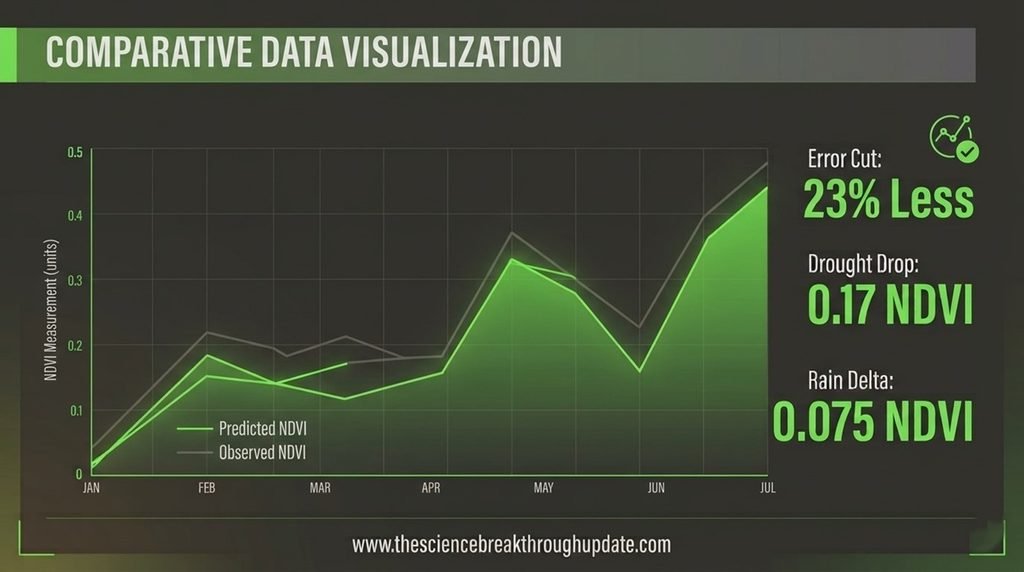
- Testing on unseen years in Laikipia, Kenya proved this innovative methodology reduces 3-month rollout predictive errors by 23% against history-only baselines.
🌍 Revolutionizing Index Insurance and Carbon Credit Attribution
- During the devastating drought, the model successfully proved that failed seasonal rainfall explained roughly only half of the 0.17 NDVI degradation.
- Livestock index insurance corporations can now easily distinguish forage lost to severe weather events from long-term land degradation caused by overgrazing.
- The model computes a precise Delta value for every single pixel, allowing environmental financial institutions to design and price rain-hedging contracts efficiently.
- This strict mathematical partition provides a totally objective baseline for validating soil carbon credits without relying on flawed historical ecosystem assumptions.
My Take: Using market math to parse ecosystem health cuts straight through greenwashing. It gives atmospheric and financial institutions a foolproof toolkit to fund actual conservation while protecting vulnerable pastoralists.
❓ Reader Doubts: Core Questions Answered
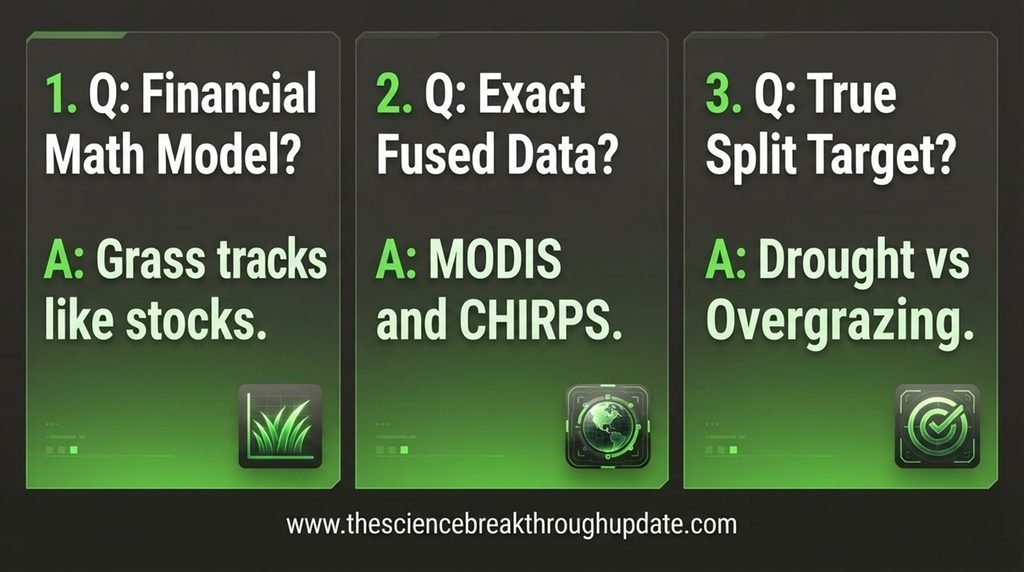
- How does a financial formula predict grass growth?
The model treats soil moisture states like fluctuating underlying stock prices and satellite greenness as dependent derivative options. By adapting this classical equation, it successfully isolates how external weather shocks affect plant life over time. This offers a radical new way to look at ecology through economics. - What specific datasets does this world model utilize?
The system combines MODIS satellite greenness data at 250m resolution with CHIRPS daily rainfall records on a single calendar grid. It tracks these data variables over 2 distinct 45km boxes located in Laikipia, Kenya. These specific datasets ensure the model remains grounded in real-world observations. - Why is separating the rain’s impact so important?
It avoids massive measurement errors by distinguishing natural climate droughts from human land management choices like overgrazing or controlled fire disturbances. This mathematical transparency protects carbon credit buyers and ensures vulnerable livestock farmers receive fair insurance payouts. Ultimately, it builds deep trust in global environmental markets.
Source Document Link: arXiv.org
Share this useful knowledge with your friends now!”
Disclaimer: This content is based on preliminary scientific research (Preprints) from arXiv.org and current global findings. It is shared strictly for educational and informational purposes and does not constitute professional, legal. Readers are encouraged to verify facts independently and consult relevant experts before making any decisions.