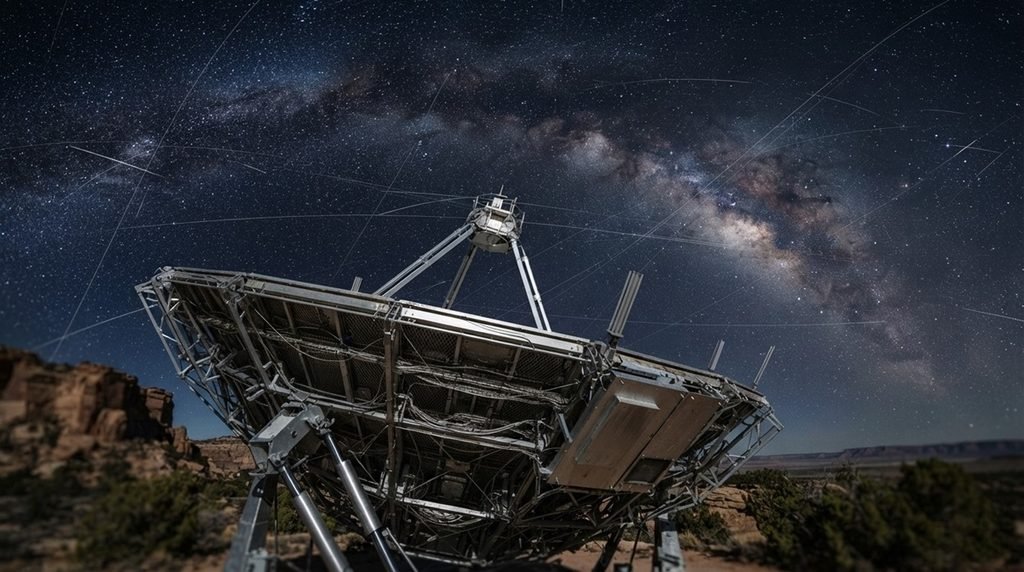
📡 We are closer than ever to discovering intelligent life in the universe, but our own technology is creating a wall of silence that might hide them forever.
For over five decades, humanity has actively scanned the deep cosmos for faint technological whispers from alien civilisations. However, a massive crisis is now unfolding as our night skies rapidly fill with thousands of man-made broadband communication satellites and global mega-constellations.
This dramatic rise in orbital hardware creates severe radio pollution that directly mimics candidate technosignatures like narrow bandwidths and Doppler drifts. This crowding makes it incredibly difficult for ground-based observatories to isolate authentic extraterrestrial messages from human-made noise.
🛰️ The Growing Wall of Human Noise in the Cosmos
- A research team led by scientist Steve Prabu from the University of Oxford reveals that orbiting hardware is rapidly blinding our terrestrial telescopes.
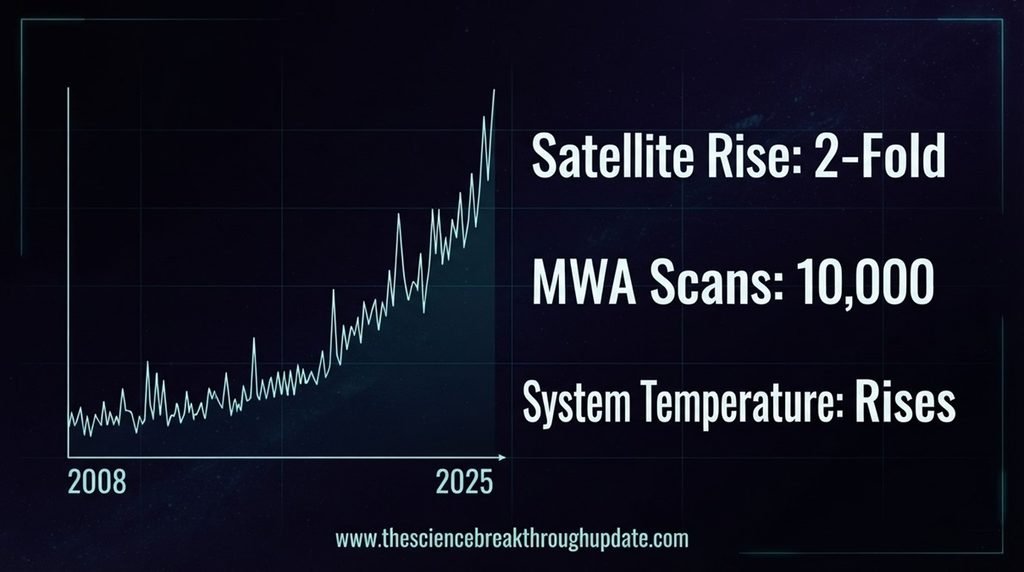
- Detailed analysis of 10,000 archival observations from the Murchison Widefield Array shows a massive spike in data corrupted by satellite interference.
- Low-elevation telescope pointings face an approximate 2-fold increase in satellite occupancy because they intersect dense orbital zones like the geostationary belt.
- Faint, unintended radiation from multi-satellite networks raises the system noise floor, creating a severe volume lost effect for deep space searches.
🌍 Escaping Earthly Static to Uncover Alien Signals
- Researchers are developing a strict metric framework to track opportunity lost and map out the cleanest remaining windows on Earth.
- Pointing sensitive instruments like the Murchison Widefield Array strictly toward the zenith offers the lowest statistical path of satellite contamination.
- The scientific community is actively advocating for the absolute protection of pristine, uniquely quiet zones located away from the terrestrial grid.
- Astronomers are designing advanced, widely spaced coherent detector arrays to verify space signals across different geographical baselines simultaneously.
🚀 Why Protecting Celestial Silence Shapes Our Galactic Future
- Shifting observations to the lunar farside provides a natural shield against the massive sea of radio noise surrounding modern Earth.
- Establishing systems like the Lunar Farside Transients and Technology Telescope allows humanity to regain the ability to execute unambiguous searches.
- Mitigating orbital interference ensures that multi-million dollar international assets like the SKA-Low array achieve their full scientific capability.
- Preserving these quiet windows allows us to detect persistent, unintended leakages from distant worlds instead of just brief, powerful beacons.
My Take: We are blindly trading cosmic discovery for global internet convenience. If we do not legally protect lunar radio silence now, humanity might accidentally lock itself inside an unbreakable bubble of planetary isolation.
❓ Reader Doubts: Core Questions Answered
1. How do human satellites interfere with alien hunting?
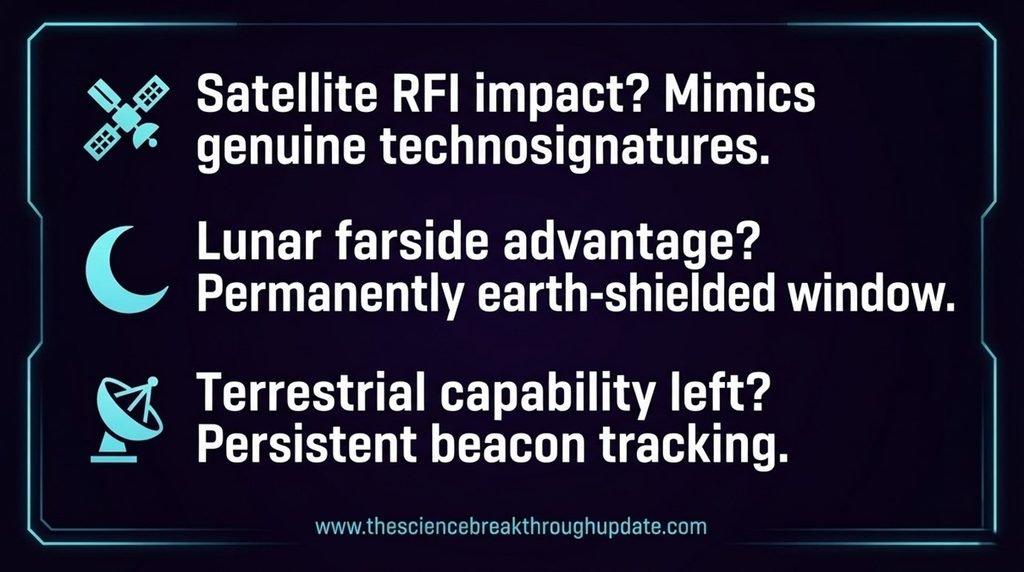
Satellites emit radio signals that mimic the exact narrow-bandwidth and time-dependent behaviors scientists look for in alien tech. This structural similarity creates extreme ambiguity during data analysis.
2. Why is the far side of the Moon the best solution?
The Moon is tidally locked, meaning its far side permanently faces away from Earth. This positioning completely blocks out the planet’s noisy television, radar, and satellite chatter.
3. Can we still find extraterrestrial signals from Earth?
Yes, but the window is narrowing. Scientists must focus on highly persistent signals and use widely separated detectors to cross-verify that a signal is truly cosmic.
Source Document Link: arXiv.org
Share this useful knowledge with your friends now!”
Disclaimer: This content is based on preliminary scientific research (Preprints) from arXiv.org and current global findings. It is shared strictly for educational and informational purposes and does not constitute professional, legal. Readers are encouraged to verify facts independently and consult relevant experts before making any decisions.