
🪐 Astronomers hunting for extraterrestrial life found a wild chemical clue hidden inside the frozen plumes of Saturn’s active moon.
Scientists tracking Saturn’s icy moon Enceladus always look for signs of life inside its hidden subsurface ocean. Erupting space plumes contain large amounts of hydrogen and methane gas, which usually suggests active water-rock chemistry or alien microbes down below.
However, a new study reveals that a microbial process called fermentation heterotrophy could easily generate these exact gas signatures. Researchers discovered that purely heterotrophic communities might simply eat primordial organic substrates like amino acids to survive inside this dark environment.
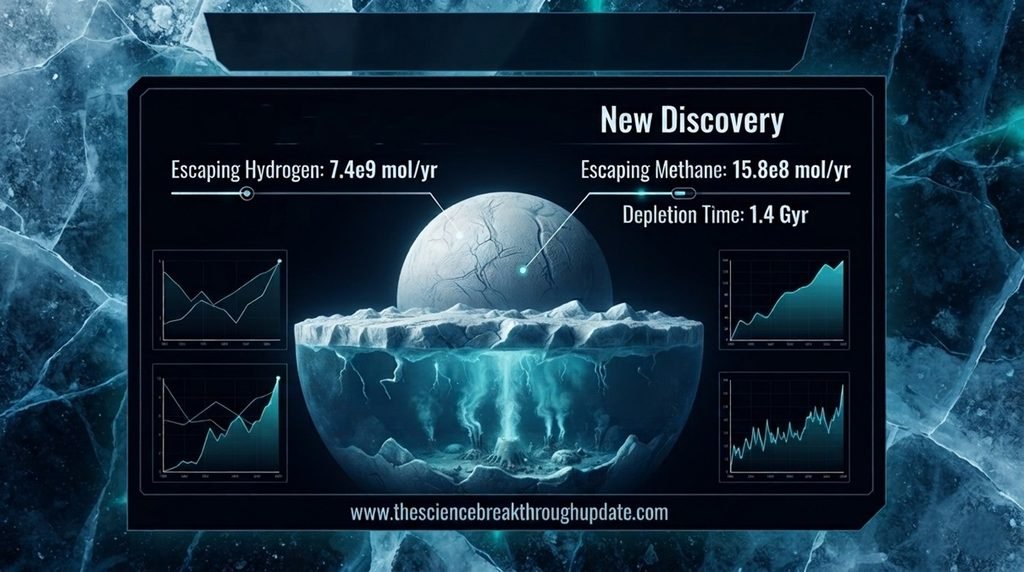
🌋 The Geological Limits of Saturn’s Frozen Moon
- Sustained core-wide molecular hydrogen production driven by long-lived serpentinization remains highly uncertain according to recent thermo-permeability models of the planetary core.
- The finite budget of weatherable minerals contained within the rocky interior tends to exhaust rapidly on relatively short chemical and geological alteration timescales.
- This intense global water-rock mineral alteration clashes sharply with the prolonged timescales expected for tidal dissipative heating inside the small icy moon.
- Relying exclusively on autotrophic hydrogenotrophic methanogenesis to explain high methane concentrations becomes problematic when the necessary hydrogen supply faces severe exhaustion limits.
🧪 How Fermenting Microbes Recreate Space Gases
- A research team featuring scientist Sam Nasreldine successfully developed a coupled ecosystem model combining biological fermentation and methanogenesis inside a hydrothermal framework.
- The mathematical simulation utilized glycine as a strategic proxy for amino-acid-like fermentable organic compounds expected within the core materials of icy bodies.
- Purely heterotrophic microbial communities containing anaerobic fermenters and methanogens successfully reproduced both of the Cassini-derived volatile gas escape fluxes at equilibrium.
- The bioenergetic simulations show that the estimated initial organic inventory can easily sustain the required hydrogen production across extensive gigayear timescales.
🛰️ Reimagining the Search for Alien Oceans
- The research successfully identifies fermentation heterotrophy as a highly testable alternative explanation to purely hydrogenotrophic, serpentinization-dominated biological interpretations of planetary data.
- Detailed ecological community assembly pathways demonstrate that fermentation effectively enables additional vent-scale habitat for acetoclastic methanogens by releasing vital intermediate substrates.
- Future space missions can actively prioritize searching for co-exported biological products like acetate and ammonium to validate these complex ecological models.
- Measuring distinct methane carbon isotopes will help future planetary exploration probes to clearly distinguish active living systems from spontaneous abiotic organic degradation.
My Take: This completely shifts the alien hunt. Finding space gases isn’t a guaranteed jackpot anymore, but proving microbes can live on ancient core dust makes the universe feel way more crowded.
❓ Reader Doubts: Core Questions Answered
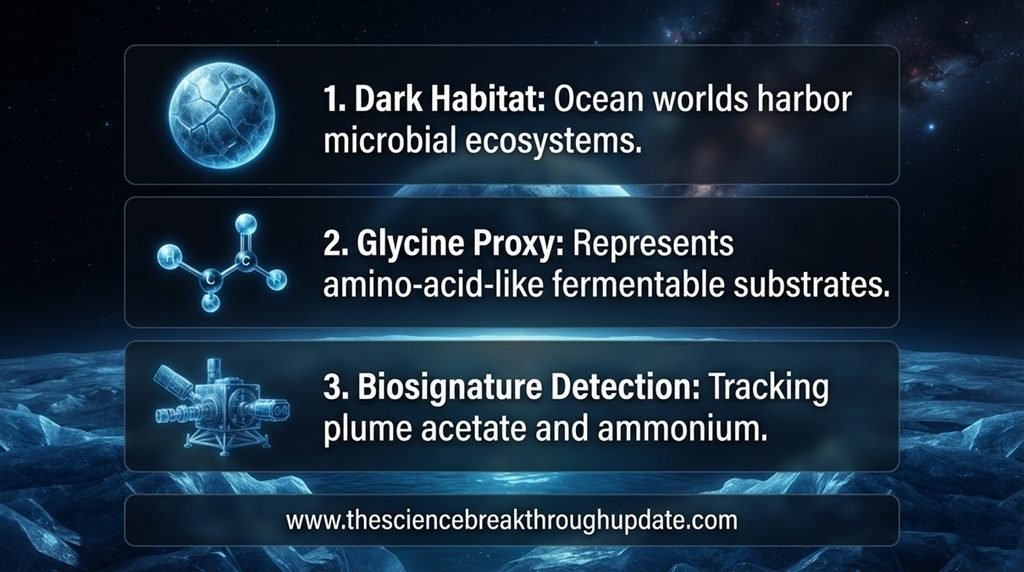
- Can microbial life really survive inside the dark subsurface ocean of Enceladus?
Yes, microbial life can easily survive in total darkness by utilizing chemical energy harvested directly from seafloor hydrothermal vent systems. The global liquid water ocean hidden beneath the ice shell remains continuously heated by tidal dissipative forces operating within the core. These active environments create permissive habitats for diverse anaerobic communities that rely entirely on chemical synthesis rather than solar radiation. - What role does glycine play in these planetary habitability models?
Glycine serves as an excellent stoichiometric proxy for the wide range of amino-acid-like fermentable organic molecules found in space. Pristine samples returned from carbonaceous asteroids like Bennu and Ryugu show that accretionary materials are highly rich in these soluble organic substrates. Putative microbial communities can ferment these primordial organic inventories to generate metabolic energy without needing external terminal electron acceptors. - How will future space exploration missions test for these specific alien microbes?
Future space exploration missions will utilize advanced mass spectrometers to analyze the chemical composition of the erupting south-polar space plumes. Spacecraft will specifically search for the presence of co-exported biological fermentation products such as dissolved organic acetate and ammonium. Furthermore, precise measurements of methane carbon isotopes will allow researchers to distinguish true biological signatures from spontaneous water-rock chemistry.
Source Document Link: arXiv.org
Share this useful knowledge with your friends now!”
Disclaimer: This content is based on preliminary scientific research (Preprints) from arXiv.org and current global findings. It is shared strictly for educational and informational purposes and does not constitute professional, legal. Readers are encouraged to verify facts independently and consult relevant experts before making any decisions.