
💡 We might be miscalculating how fast the human body ages because of a hidden mathematical error embedded deep inside global lifespan statistics.
Demographers frequently struggle to separate biological senescence from random background risks like sudden infections. To solve this problem, global scientists rely on a mathematical constant called the Makeham term. However, a hidden boundary flaw in software packages often distorts these critical lifespan calculations completely.
A new study by researcher Silvio C. Patricio reveals that traditional tests obscure true aging patterns. By correcting this statistical calibration error, scientists protect research integrity. This crucial adjustment fundamentally transforms how medical teams calculate our absolute maximum lifespan limits safely.
📊 Why Standard Lifespan Equations Miscalculate How We Age
- Standard statistical models routinely use a conventional chi-squared distribution that mistakenly assumes human mortality parameters can freely shift into impossible negative values.
- Because physical background mortality risks cannot drop below zero, the baseline parameter sits permanently on a strict and unyielding statistical boundary constraint.
- This rigid boundary placement completely invalidates conventional testing metrics and forces standard demographic software packages to utilize an inaccurate critical cutoff value.
- Consequently, researchers accidentally reject real data about external hazards, which subsequently flattens the calculated mathematical rate of human biological aging over time.
🛠️ Fixing the Mathematical Glitch in Mortality Data
- Working at the University of Southern Denmark, researcher Silvio C. Patricio mathematically recalibrated the traditional likelihood-ratio testing system for global demographers.
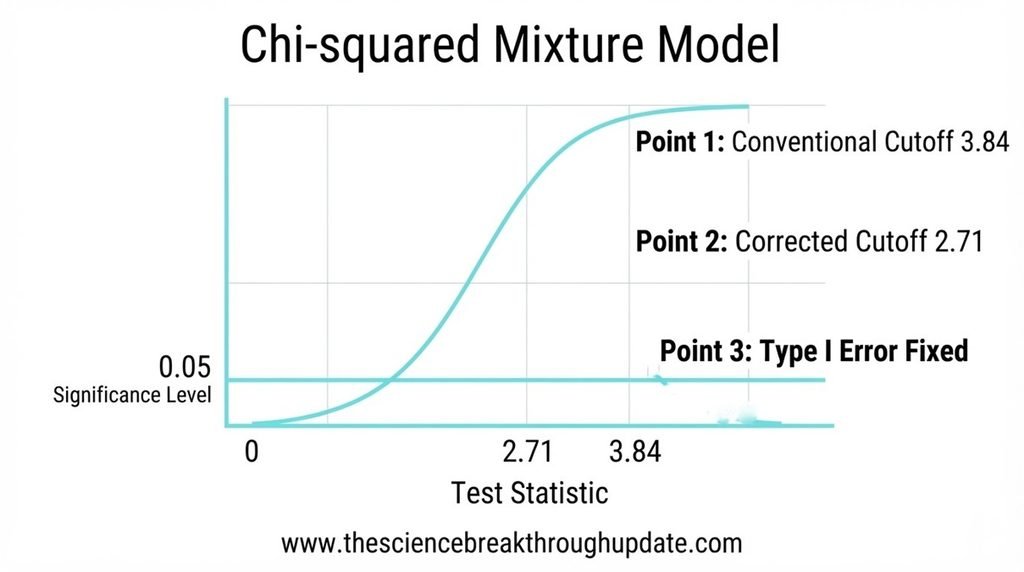
- The new calculation uses a precise equal mixture model that perfectly combines a zero point mass with a single-degree chi-squared distribution.
- This innovative statistical adjustment successfully lowers the required 5% significance threshold benchmark from the traditional 3.84 down to exactly 2.71.
- The updated mathematical calculation accurately isolates extrinsic background hazards from the natural, age-dependent exponential decay of living human body cells.
📈 How Correcting the Lifespan Math Changes Modern Medicine
- Actuaries and global medical researchers can now determine the true biological rate of aging without experiencing severe distortions from the young end of the fitted range.
- The accurate model prevents health organizations from missing critical background risk parameters that silently spike regional adult mortality rates over time.
- Precise statistical calculations help statistical modeling teams accurately measure whether the estimated gamma-frailty variance alters the true Gompertz rate of aging.
- Global insurance providers gain a highly reliable tool to assess independent Poisson death counts across diverse geographic regions and changing demographics.
My Take: For years, flawed demographic tools quietly skewed how we understand aging. Fixing this math means we finally get real, uncompromised longevity data to build better future healthcare systems.
❓ Reader Doubts: Core Questions Answered
- What is background mortality in human lifespan tracking?
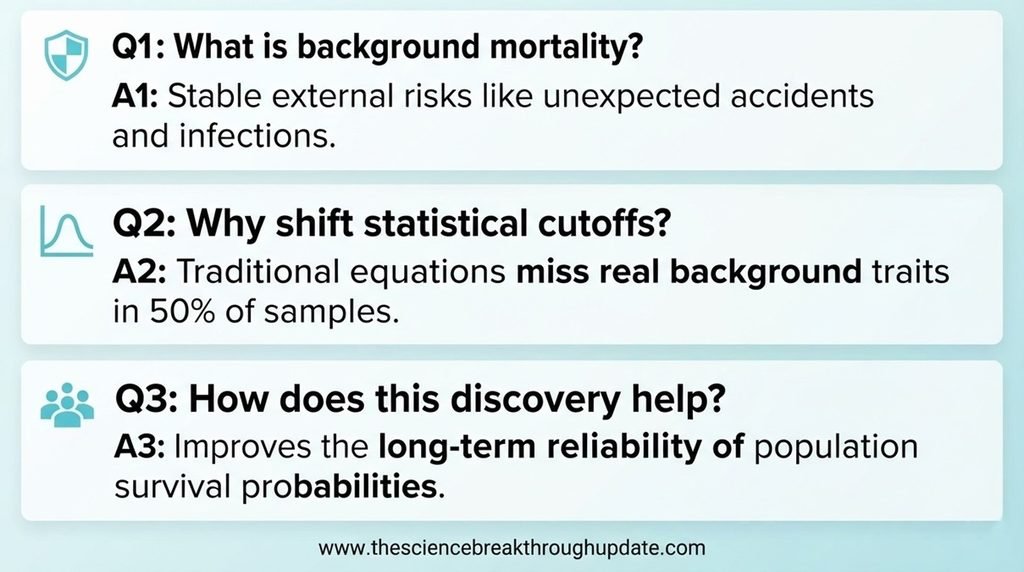
Background mortality represents civilian deaths caused by constant external factors like unpredictable accidents, severe infections, or sudden environmental hazards. This specific baseline risk stays completely stable across different age groups instead of climbing as time goes on. Biological aging, conversely, always increases at a rapid exponential rate as human body cells naturally degrade over the decades. This core distinction helps global researchers understand life expectancies clearly and dynamically. - Why does a minor statistical shift from 3.84 to 2.71 matter for science?
The old threshold of 3.84 is mathematically too strict because it completely ignores how physical boundary limits affect standard probability distributions. This systematic error causes demographic software to miss real background patterns in at least 50% of positive test samples. Lowering the critical value to 2.71 immediately fixes this calculation error and stops scientists from using flawed lifespan baselines permanently. This baseline correction ensures much higher research accuracy. - How does this demographic discovery help the average person?
This mathematical correction dramatically improves the long-term reliability of population survival probabilities and cohort mortality analyses worldwide. It ensures that medical researchers evaluate experimental mortality deceleration using flawless biological metrics rather than heavily distorted baseline data. Ultimately, this precision helps modern scientists design better public safety policies, fairer life insurance premiums, and smarter healthcare systems for rapidly aging populations everywhere. Citizens everywhere receive more reliable financial and medical planning tools.
Source Document Link: arXiv.org
Share this useful knowledge with your friends now!”
Disclaimer: The information on this website is for educational and informational purposes only and is not intended as medical advice. Always consult a qualified healthcare professional before making any medical decisions or changes to your treatment plan.