🦠 Every single time you catch a common seasonal cold, your body quietly rewrites its internal defenses, but global health trackers remain completely blind to your personal medical history.
Your immune system carefully remembers every single infection, yet classic public health models completely ignore this crucial personal history. Standard simulations treat all seasonal outbreaks as independent events, which heavily distorts our true understanding of how community immunity actually builds up over time.
This massive biological blind spot makes it incredibly difficult for healthcare officials to accurately predict real-world disease spreads. Without tracking individual reinfection numbers over a full human lifetime, charting long-term viral behavior feels like navigating a sprawling city completely without maps.
⚠️ Why Current Pandemic Forecasts Routinely Fail Mobile Readers
- Traditional epidemic tracking systems completely overlook personal history by assuming that every person faces the exact same infection risk during a seasonal outbreak.
- Ignoring individual clinical histories creates major calculation errors when public health experts try to plan long-term vaccine distribution campaigns for diverse age groups.
- Pathogens like the common cold infect the same human host multiple times, creating a highly complex web of heterogeneous susceptibility across the country.
- Highly complex clinical models require massive amounts of computing power, leaving local hospital boards with analytically intractable equations during critical winter sickness surges.
🧮 The Elegant Mathematical Solution Cracking The Immunity Code
- Dedicated researchers Piergiorgio Castioni, Chiara Poletto, and Alex Arenas successfully built a lightweight mathematical framework called the innovative chain SIR model to track histories.
- This elegant system directly indexes distinct population groups by their exact reinfection count instead of mixing healthy and previously exposed individuals together randomly.
- The new model treats a human lifetime as a continuous reinfection ladder where individuals gradually climb higher through subsequent seasonal viral exposures.
- The brilliant research team from Universitat Rovira i Virgili and the University of Padova mathematically proved that lifetime reinfections travel like organized traveling waves.
🏥 How Wave Mechanics Will Transform Future Hospital Planning
- Public health teams can now easily and accurately calculate how fast immunological protection decays across an entire living population over several decades.
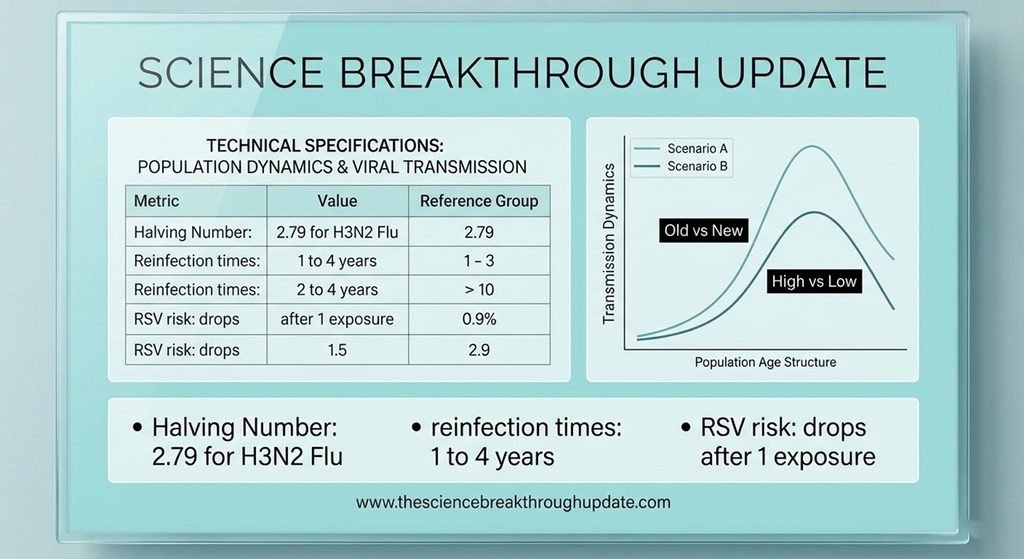
- The mathematical formula successfully quantified the exact drop in reinfection rates for the dangerous respiratory syncytial virus right after a single early exposure.
- Clear clinical data shows that childhood viruses trigger a rapid drop in susceptibility, while influenza A/H3N2 requires roughly 2.79 infections to halve risk.
- Medical planners can use these precise wave calculations to design highly targeted immunization schedules without wasting any valuable community healthcare resources.
My Take: By turning messy immune histories into clean wave physics, this framework finally forces rigid health models to respect individual biology, completely changing how cities will map future winter outbreaks.
❓ Reader Doubts: Core Questions Answered
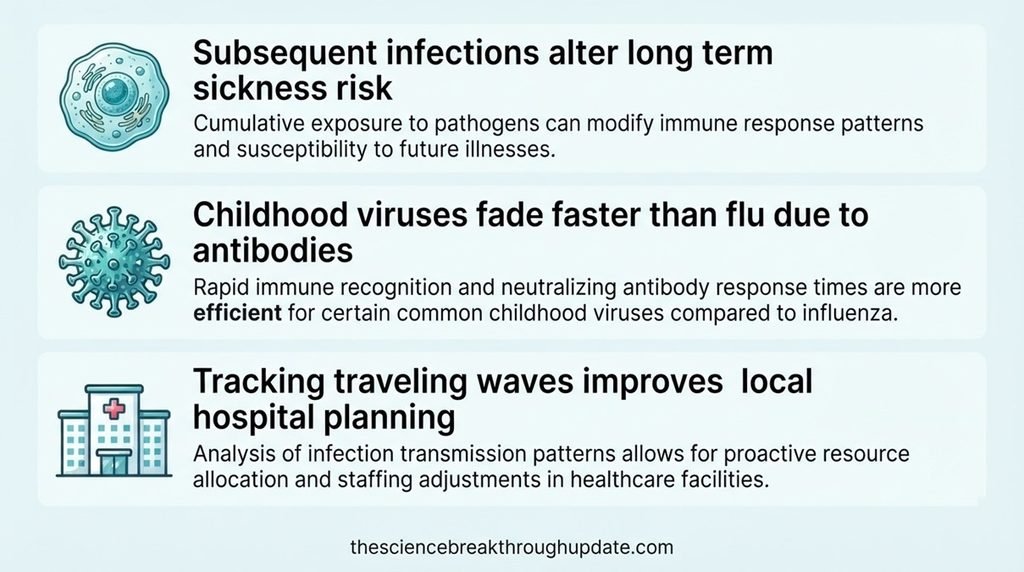
- How do subsequent infections alter your long term sickness risk?
Each viral exposure continuously upgrades your immune memory, which gradually reshapes how fast a specific pathogen can spread through your age bracket. This compounding natural defense causes your personal infection risk to decline significantly as you grow older, shielding you from severe symptoms during later outbreaks. Over a whole life course, this mechanism generates a predictable wave pattern that shifts the highest burden of disease onto younger, immunologically naive populations. - Why do common childhood viruses fade faster than the seasonal flu?
Viruses like respiratory syncytial virus trigger powerful antibody responses that rapidly cut your biological susceptibility right after an early infection. The seasonal influenza A/H3N2 virus mutates or features a gentler decay, meaning your body requires roughly 2.79 exposures to achieve that same level of halved risk. Consequently, older adults retain strong defense against childhood bugs like RSV while remaining relatively more vulnerable to newly encountered strains of seasonal influenza. - How does tracking traveling waves improve local hospital planning?
By mapping out exactly how these complex immunity waves move through different age cohorts, city hospitals can easily anticipate sudden spikes in patient admissions. This clear mathematical data allows healthcare managers to understand long-term prevalence patterns and the emergence of age-structured endemicity. Ultimately, this approach removes the guesswork from public health preparedness, ensuring that critical medical assets are positioned exactly where the wave hits hardest.
Source Document Link: arXiv.org
Share this useful knowledge with your friends now!”
Disclaimer: The information on this website is for educational and informational purposes only and is not intended as medical advice. Always consult a qualified healthcare professional before making any medical decisions or changes to your treatment plan.