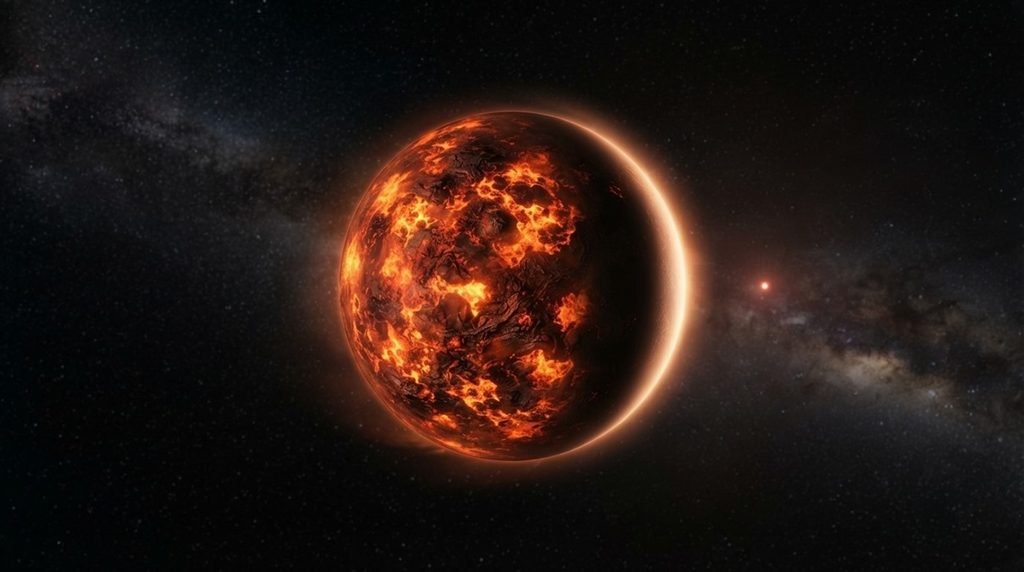
🌋 Imagine a world where the ground is a vast, bubbling ocean of liquid rock, and a single year flies by in just a few hours.
Astronomers historically struggled to study the scorched surfaces of rocky alien worlds orbiting deep space stars. These extreme planets sit too close to their host stars, making them nearly invisible against the blinding glare of intense stellar radiation.
Now, an international research team successfully used space telescopes to isolate the faint light signals reflecting off a hellish super-Earth. This critical milestone provides a brand new blueprint for analyzing the mysterious environments of distant lava worlds.
🪐 The Massive Challenge of Seeing Blindingly Hot Alien Planets
- Extreme space radiation completely blinds traditional optical instruments when they attempt to view small, rocky planets located outside our solar system.
- These intensely irradiated planets are tidally locked, meaning they possess permanently scorched daysides that sustain massive oceans of liquid magma.
- High substellar temperatures exceeding 1500 K cause molten rock to evaporate, which generates a thick, masking atmosphere of silicate vapor.
- Astronomers find it incredibly difficult to isolate true planetary heat signatures from ordinary reflected starlight at short optical wavelengths.
🔭 Peering Through the Stellar Glare with Combined Space Telescopes
- Lead astronomer Sebastian Zieba and a team of researchers combined deep space data from the Hubble Space Telescope and TESS.
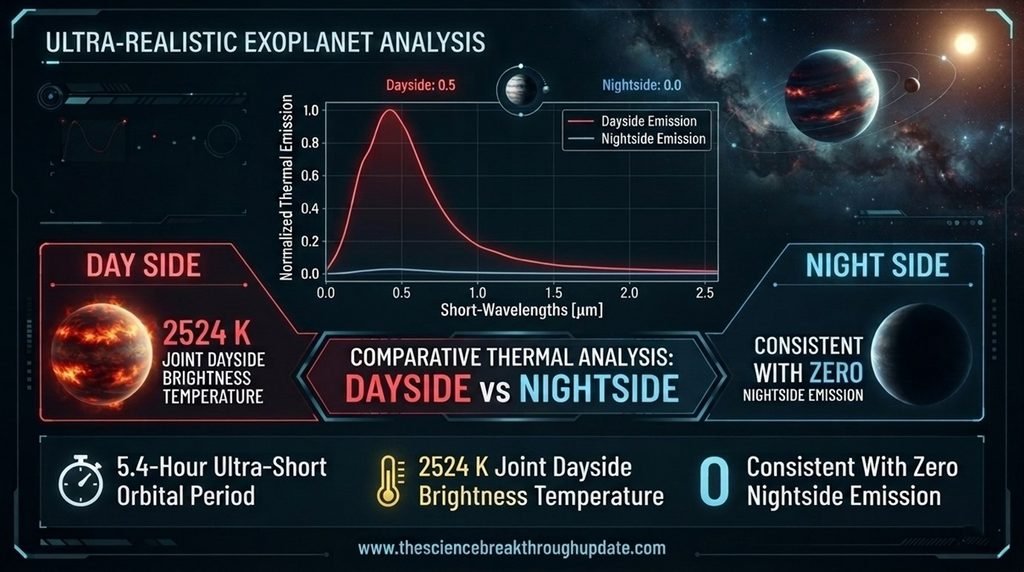
- The team tracked the ultra-short-period planet TOI-2431 b, a massive rocky world orbiting a nearby dwarf star every 5.4 hours.
- Hubble successfully detected a secondary eclipse in the near-infrared spectrum, measuring a tiny planet-to-star flux ratio of 69 parts per million.
- This combined multiwavelength approach allowed scientists to estimate the planet’s dayside brightness temperature at a staggering 2524 K.
🚀 How This New Discovery Rewrites Our Basic Understanding of Planetary Physics
- The measurements reveal that TOI-2431 b is consistent with zero nightside emission, proving that daytime heat redistribution is highly inefficient.
- This world challenges previous observations of cooler planets because its environment matches the absolute thermodynamic limit of zero albedo.
- Future observations using the James Webb Space Telescope will soon scan the planet at longer mid-infrared wavelengths between 5 and 12 microns.
- These upcoming space missions will definitively map the chemical fingerprint of the underlying melt and confirm the presence of a silicate atmosphere.
My Take: Isolating a magma world’s heat footprint proves our telescopes can bypass blinding stellar glare. It transitions exoplanet science from basic detection to mapping raw, molten surface geology across deep space.
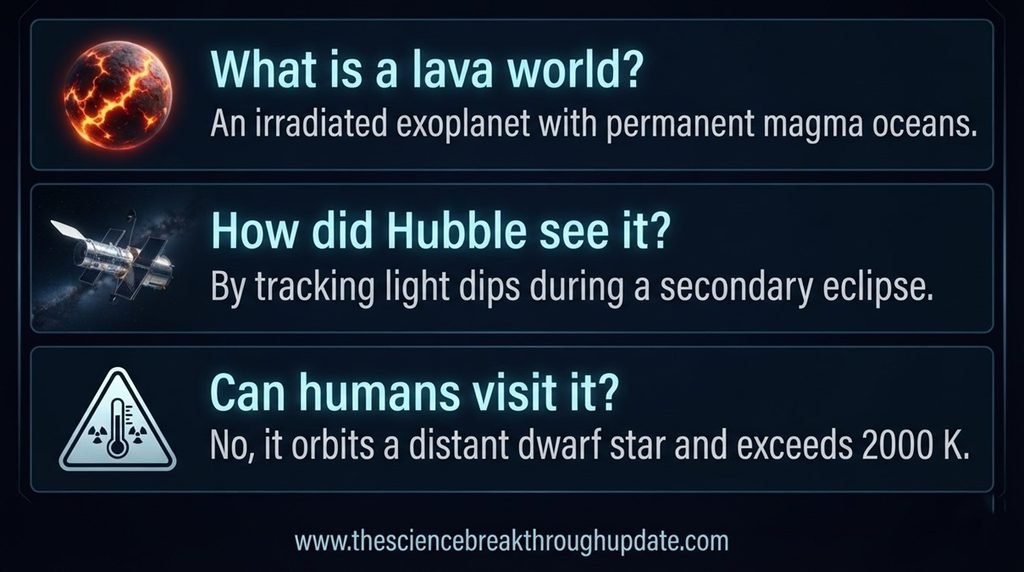
❓ Reader Doubts: Core Questions Answered
1. What exactly is a lava world?
A lava world is a heavily irradiated rocky exoplanet with a radius smaller than 1.9 times that of Earth. Because they orbit incredibly close to their parent stars, their surface temperatures stay hot enough to keep large portions of the planet completely molten.
2. How did the Hubble Space Telescope detect this planet’s light?
Hubble used its Wide Field Camera 3 instrument to observe the planet as it passed directly behind its host star. By measuring the tiny drop in total infrared light during this secondary eclipse, scientists isolated the planet’s individual thermal footprint.
3. Will humans ever be able to visit TOI-2431 b?
No, humanity cannot visit this planet because it orbits a distant late-K dwarf star. Furthermore, the extreme surface temperature of over 2000 K and the constant rain of vaporized rock would instantly destroy any human-made spacecraft.
Source Document Link: arXiv.org
Share this useful knowledge with your friends now!”
Disclaimer: This content is based on preliminary scientific research (Preprints) from arXiv.org and current global findings. It is shared strictly for educational and informational purposes and does not constitute professional, legal. Readers are encouraged to verify facts independently and consult relevant experts before making any decisions.