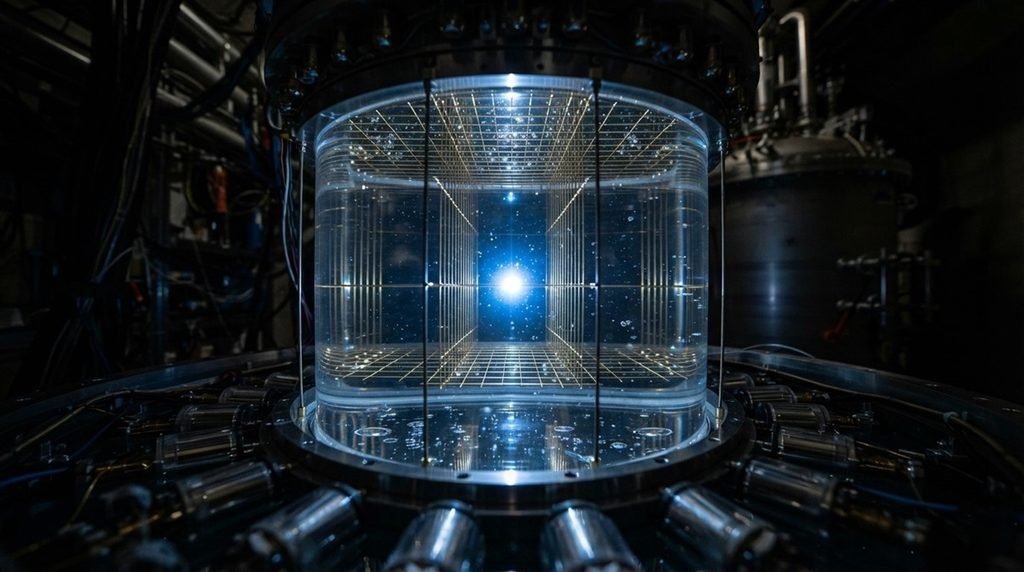
🌌 Deep beneath the earth, a lone atomic particle just collided with a detector, leaving physicists scrambling to explain a cosmic phantom.
Deep underground, modern scientists are hunting for Weakly Interacting Massive Particles to solve the universe’s biggest spatial mystery. A strange, completely unexpected collision inside the LUX-ZEPLIN detector recently triggered intense excitement across the global particle physics community by finally hinting at elusive dark matter.
However, verifying this solitary event creates a massive roadblock because it seemingly contradicts independent data from the IceCube neutrino telescope. If this phantom particle is actually real, it must somehow explain its sudden visibility here without triggering sensors deep inside the intense solar core.
🕵️♂️ The Hidden Conflict in Solar Neutrino Subterranean Data
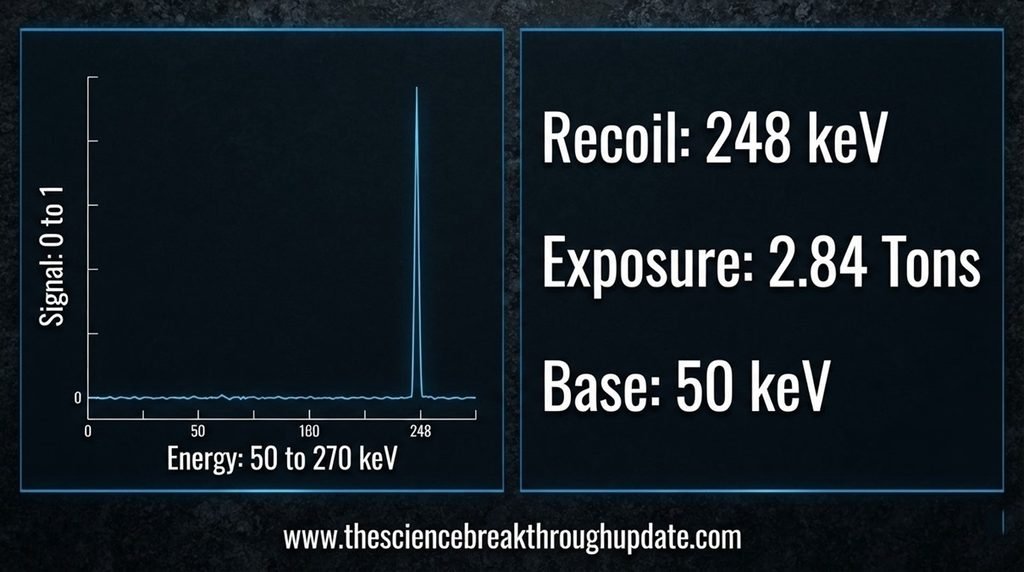
- Deep underground laboratories securely trap rare cosmic signals, but standard particle models fail to explain high-energy nuclear recoils above 50 keV without breaking established astrophysical boundaries.
- The elusive dark matter phantom must cross the Sun to become gravitationally captured, yet its expected core annihilation should inevitably trigger IceCube telescope data alarms.
- Severe theoretical uncertainties surrounding spin-independent elastic scattering make it incredibly difficult for scientists to project exactly how dark matter behaves inside heavy solar elements.
- Ignoring uncalibrated high-energy sidebands during data collection risks misinterpreting solitary signals, leaving physics teams completely unable to confirm true cosmic particle discoveries.
🚀 How Heavy Higgsinos Evade Solar Capture Detection
- Renowned physicists Katherine Freese and Dionysios P. Theodosopoulos analyzed advanced likelihood models to find parameter regions where both space instruments perfectly align without conflicts.
- By safely expanding mass ranges way beyond the standard 1.1 TeV thermal benchmark, the researchers discovered that heavier particles naturally weaken solar capture rates.
- Incorporating the complex gravitational pull of the Large Magellanic Cloud enhances high-speed particle tails, perfectly explaining the energetic flash without overloading solar interiors.
- Tracking precise mass splittings between 350 and 525 keV allows these pseudo-Dirac neutral Majorana fermions to match data across all operational global experiments.
🧲 The Massive Shift in Hunting Invisible Universes
- Shifting research focus toward heavier particle masses allows global physics teams to keep hunting for WIMP candidates without violating tight solar constraint parameters.
- Future mineral-based paleodetectors will scan ancient subterranean rocks for historical track records left behind by these specific high-energy inelastic dark matter collisions.
- Refining our cosmic maps to include neighboring satellite galactic systems drastically improves how direct detection software predicts local dark matter velocity components.
- Solving this particle puzzle successfully protects advanced space models while guiding next-generation hardware upgrades for the LUX-ZEPLIN collaboration and neutrino observatories worldwide.
My Take: By shifting our focus toward heavier particles, this brilliant analysis cleverly saves WIMP theories from structural collapse, keeping the thrilling multi-billion dollar hunt for our universe’s missing mass alive.
💡 Reader Doubts: Core Questions Answered
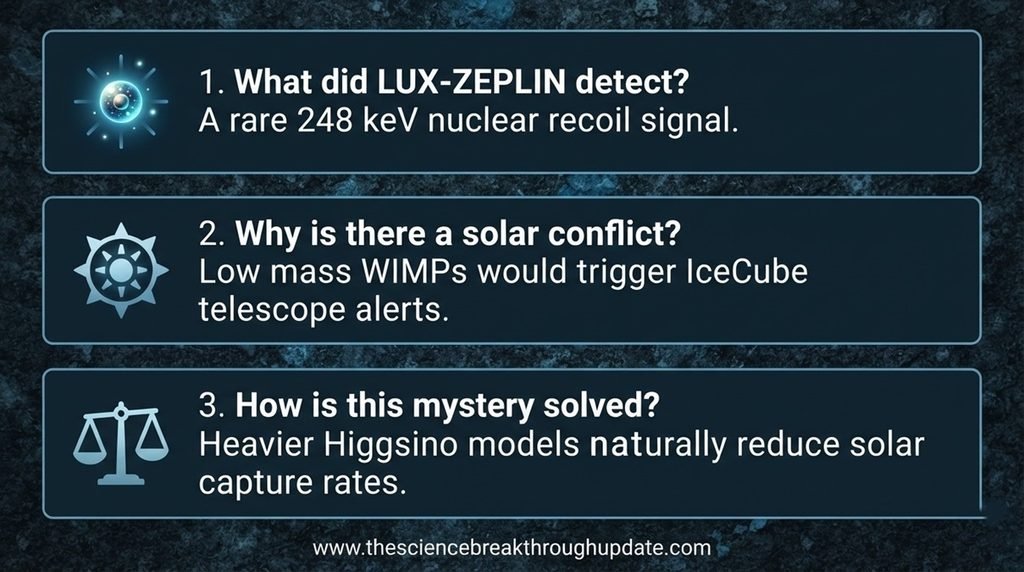
- What exactly did the LUX-ZEPLIN experiment discover underground?
The detector recorded a single, unexplained nuclear recoil event at 248 keV. This rare signal sits well outside the normal background noise, strongly hinting at a potential dark matter particle collision. Scientists are now rushing to calibrate the instrument to confirm whether this anomaly represents a true cosmic breakthrough or a minor tracking glitch. This ongoing research is crucial for mapping dark matter. - Why does the IceCube telescope create a conflict with this discovery?
If dark matter particles exist at low masses, the Sun should capture them easily. Their subsequent annihilation inside the solar core would release a wave of high-energy neutrinos that IceCube would have detected. The total lack of these solar neutrino signals effectively rules out conventional light dark matter models within this spectrum. Understanding these clean particle patterns helps validate new theories. - How do heavier particles solve this specific scientific contradiction?
Heavier dark matter states reduce the efficiency of solar capture because their interaction cross-section drops significantly. This allows them to cause the rare underground event on Earth while remaining completely invisible inside the Sun. This clever mechanism perfectly satisfies both terrestrial and space-based observational limits without breaking any core physical laws. Consequently, this research marks a massive step forward for physics.
Source Document Link: arXiv.org
Share this useful knowledge with your friends now!”
Disclaimer: This content is based on preliminary scientific research (Preprints) from arXiv.org and current global findings. It is shared strictly for educational and informational purposes and does not constitute professional, legal. Readers are encouraged to verify facts independently and consult relevant experts before making any decisions.