🧬 Advanced mathematical structures are now merging with deep learning networks to decode hidden genomic organization and classify diverse virus families with absolute precision.
Modern public health mapping systems face a severe technical challenge when analyzing highly diverse viral genomes that completely lack universally shared genetic sequence markers. When tracking complex microbial evolution, traditional sequence alignment computational methods often fail to capture the higher-order structural organization of recurring nucleotide sequences.
Conventional feature frequency profile tools merely calculate simple nucleotide word counts but entirely miss how these spatial patterns are organized across multiple distance scales. Now, a robust mathematical model integrates persistent commutative-algebraic sequence descriptors with supervised deep learning to achieve unprecedented family-level taxonomic classification accuracy.
🦠 The Structural Deficiencies Found in Conventional Alignment-Free Genomic Profiling Frameworks
- Metagenomic sequencing creates an exceptional challenge for computational taxonomy because diverse viral genomes exhibit extraordinary variation in length, segmentation, and gene content.
- Traditional cellular organism classification relies heavily on universally conserved marker genes like ribosomal RNA, which viruses completely lack across all taxonomic groups.
- Existing feature frequency profile methods simply measure pattern abundance while failing to explicitly encode how recurring nucleotide sequences are spatially organized along genomes.
- Standard alignment-free algorithms perform poorly when differentiating closely related groups, making it difficult to detect subtle evolutionary variations in viral data.
🧬 How Commutative Algebra Neural Networks Mathematically Decode Multiscale Genomic Architecture
- Researchers Mushal Zia, Faisal Suwayyid, and Guo-Wei Wei developed an alignment-free classification framework named CANN to bridge biology and algebra.
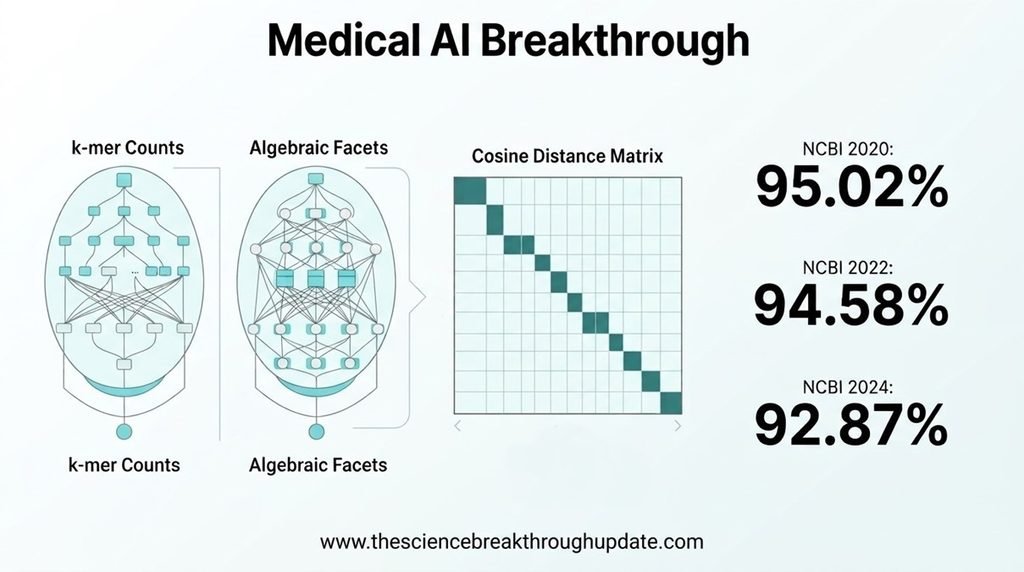
- The system records exact nucleotide occurrence positions and applies Stanley-Reisner theory to construct multiscale persistent facet-number descriptors for deep learning.
- These algebraic descriptors are fed into independent Convolutional Neural Networks and self-attention Transformer encoders to map local and global sequence features.
- By averaging the cosine distances from both embedding spaces, this combined approach achieves 95.02% accuracy on the NCBI 2020 reference collection.
🚀 The Long-Term Impact on Taxonomic Prediction Accuracy and Data-Driven Medical Intelligence
- This framework consistently outperforms older tools like the natural vector method and feature frequency profiles across highly imbalanced biological datasets.
- Evaluation on the 2026 NCBI collection proves that the system successfully generalizes to previously unseen members of represented viral families.
- Integrating multiscale mathematical representations with neural encoders provides a reliable paradigm for linking algebraic genomic descriptions with data-driven classification.
- This research, supported by NIH Grant R01AI164266 and the Georgia Research Alliance, significantly improves accuracy metrics for modern genomic analysis.
My Take: By turning complex genetic geometry into pure algebra, this software realistically strips away the guesswork from pathogen tracking. It gives global lab networks an immediate, baseline defense against evolving biological outbreaks.
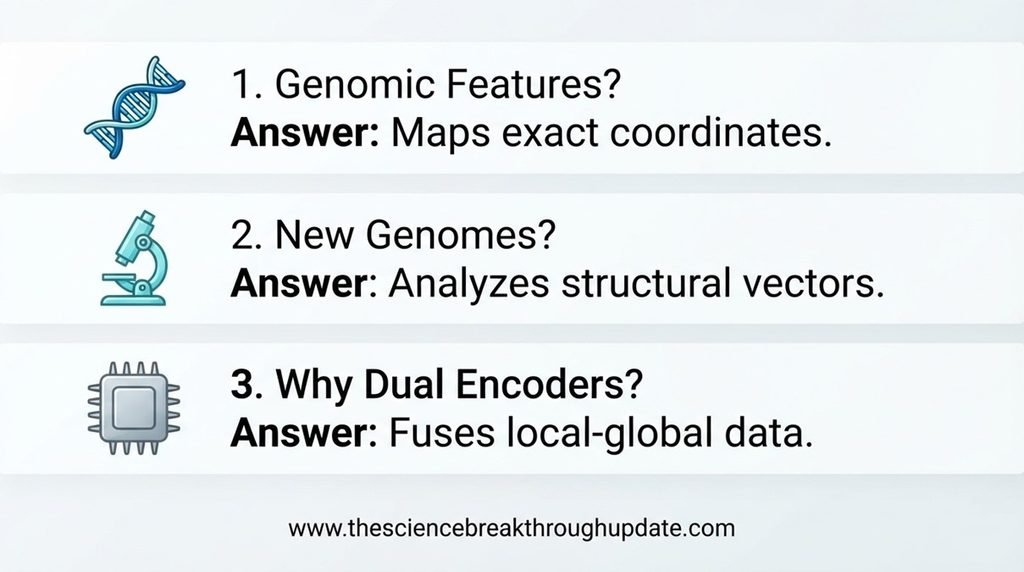
❓ Reader Doubts: Core Questions Answered
- How does this framework calculate genomic features differently from older alignment-free sequence tools?
Older tools only count the frequency of nucleotide words without tracking their physical positions along the genome. This new framework records exact occurrence coordinates and uses mathematical filtrations to extract multiscale facet descriptors. This process captures the higher-order geometric arrangement of patterns rather than simple abundance metrics. - Can this mathematical system accurately classify completely new genomes that were absent from training data?
Yes, the system demonstrates strong generalization capabilities when tested on unindexed genomes from recent biological repositories. It successfully maps unseen sequences to their correct categories by analyzing core structural similarities rather than relying on exact matching strings. This ensures robust predictive performance even when dealing with evolving viral families. - Why does this model utilize both Convolutional Neural Networks and Transformer encoders simultaneously?
The Convolutional Neural Network is structurally optimized to learn local combinations of neighboring entries within the genomic feature array. Simultaneously, the Transformer utilizes self-attention mechanisms to discover broader relational features across the entire sequence matrix. Fusing their embedding distances creates a consensus metric that maximizes overall accuracy.
Source Document Link: arXiv.org
Share this useful knowledge with your friends now!”
Disclaimer: This content is based on preliminary scientific research (Preprints) from arXiv.org and current global findings. It is shared strictly for educational and informational purposes and does not constitute professional, legal. Readers are encouraged to verify facts independently and consult relevant experts before making any decisions.