🧠 Scientists just discovered that human logic changes constantly, meaning your brain handles the exact same problem differently every single day.
Most people firmly believe their daily choices rely entirely on stable, predictable logic. However, cognitive scientists at TU Chemnitz recently proved that human reasoning fluctuates wildly, showing that internal response variability governs our brains far more than consistent, rational thinking.
By carefully analyzing how normal individuals solve complex logic puzzles over time, these researchers successfully mapped the hidden instability inside our minds. This fascinating study clearly reveals the exact reason why you easily solve a difficult workplace challenge today but fail the exact same problem next week.
🔍 Why Our Brains Fail to Maintain Consistent Logic
- Traditional cognitive models always assume that keeping the specific logical task and surrounding context completely constant forces the human mind to produce a highly predictable response.
- New empirical data explicitly reveals that common everyday factors like unexpected attention drift and severe mental fatigue inject massive amounts of random noise into human judgments.
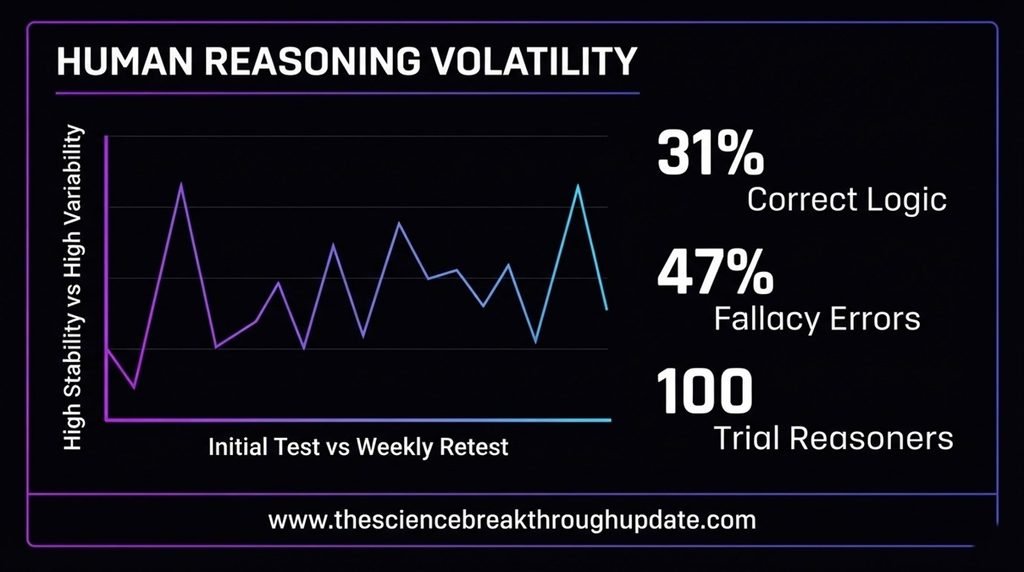
- During standard logical testing, only 31% of ordinary individuals correctly identify flawed logic, while 47% easily succumb to highly confusing, deceptive surface-level patterns.
- Most existing frameworks completely ignore this shifting nature of reason, mistakenly treating human decision-making processes as entirely static, unmoving, and rigid daily mental systems.
🛠️ How Scientists Measured the Shifting Nature of Reason
- Lead researchers Clemens Bombach, Rajmadan Lakshmanan, and Marco Ragni successfully built a unique geometric framework to calculate the precise distance between distinct reasoning patterns.
- The dedicated research team tracked 100 separate participants across multiple weekly testing sessions, measuring how their answers changed without providing any external performance feedback prompts.
- This practical mathematical method successfully converted abstract thoughts into binary feature vectors, mapping local response changes directly onto a clear, low-dimensional digital graph.
- Advanced mathematical modeling successfully separated genuine learning trends from temporary mental slip-ups, ultimately exposing the true structural stability of human logic systems over time.
🚀 What This Means for Your Future Choices
- The recorded data explicitly proves that an unstable incorrect response actually predicts a massive, highly noticeable performance jump during subsequent logic tests quite reliably.
- Conversely, ordinary individuals who consistently rely on stable but deeply flawed logic rarely improve their overall cognitive performance levels over a long period.
- Knowing that your logic shifts daily allows you to structure critical business decisions around your peak mental consistency windows very easily every single week.
- This unique framework actively helps modern AI software developers build systems that mirror human flexibility instead of relying on rigid, deterministic coding rules entirely.
My Take: Accepting that logic shifts daily shatters the myth of human consistency. This reality forces us to build smarter workplaces and design flexible AI that mirrors our messy mental fluctuations.
❓ Reader Doubts: Core Questions Answered
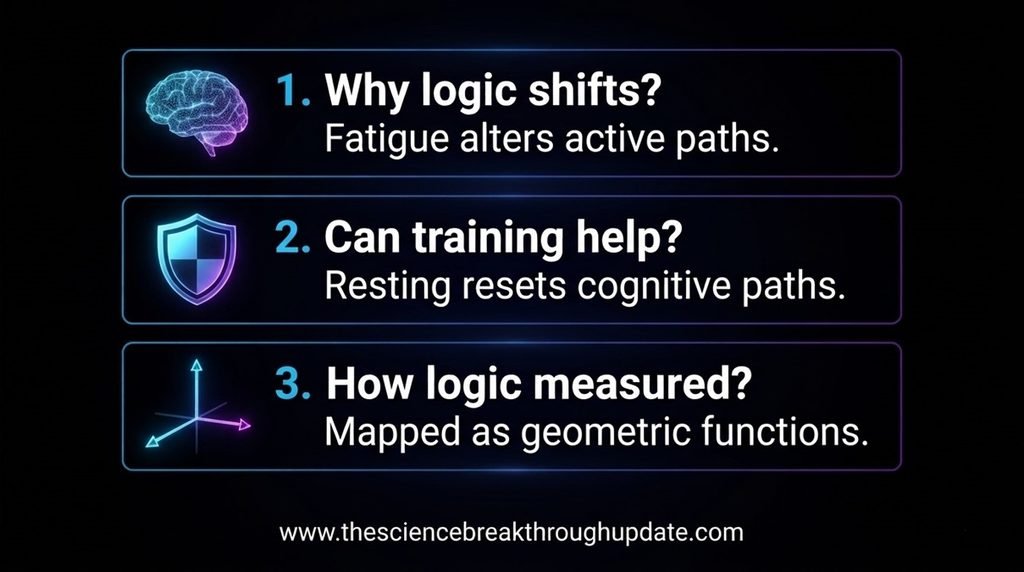
1. Why do I make completely different choices when facing the exact same logical problem over time?
Your complex human brain does not function like a rigid, entirely predictable computer program at all in real-world scenarios. Interacting daily variables like severe mental exhaustion, shifting individual attention spans, and subtle emotional changes constantly alter your active neural pathways. Consequently, your mind naturally produces highly variable answers to completely identical logic problems during different times of the week.
2. Can I actively train my own brain to maintain better logical consistency during important decisions?
You can definitely train your brain to achieve steadier, more dependable cognitive performance quite easily over a long period. The new research explicitly indicates that identifying your own mistakes helps the human mind reset its core reasoning strategies effectively. Additionally, taking regular structured rest breaks throughout your busy workday reduces accumulated decision fatigue dramatically.
3. How did the university researchers successfully measure these subtle changes in human logic?
The brilliant scientific team from the Cognitive Science Society analyzed participant test data using a highly unique geometric method. They mapped individual answers as distinct mathematical functions to see exactly how much logic shifts between weekly testing sessions. This allowed them to separate random mental noise from actual cognitive learning processes successfully.
Source Document Link: arXiv.org
Share this useful knowledge with your friends now!”
Disclaimer: The information on this website is for educational and informational purposes only and is not intended as medical advice. Always consult a qualified healthcare professional before making any medical decisions or changes to your treatment plan.