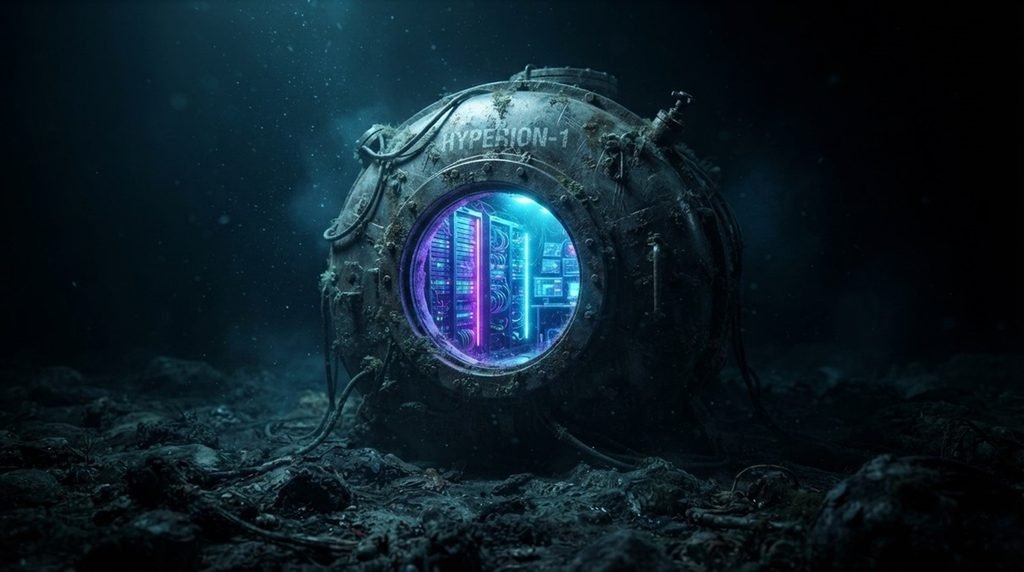
🌊 Tech companies are quietly dropping massive data servers directly into the deep ocean to let natural sea currents run the future of artificial intelligence.
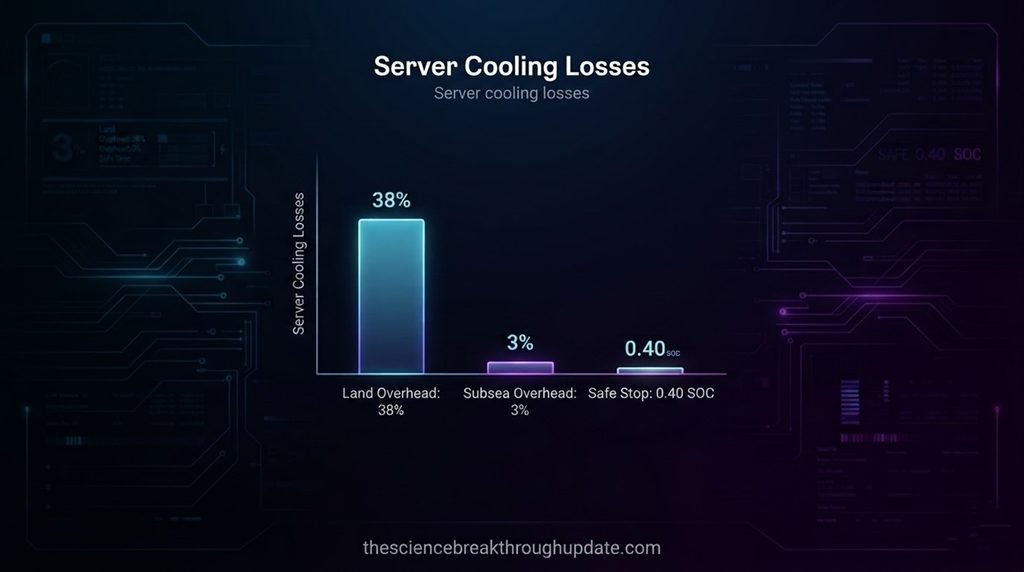
The rapid global expansion of artificial general intelligence strains modern electrical grids due to increasingly heavy computational demands. Running high-density AI servers generates extreme thermal heat, forcing data center operators to expend up to 38% of their entire electricity budget exclusively on cooling systems.
To eliminate this massive financial overhead, engineering researchers at Oakland University have designed an integrated system that submerges complete computing nodes inside the ocean. Utilizing freezing seawater as a natural heat sink minimizes electricity demands while drawing clean power harvested from wave energy converters.
⚠️ Why High-Density Artificial Intelligence Infrastructure Overheats Land Networks
- Terrestrial computer facilities route 52% of their incoming electricity directly into processing chips, while allocating 38% to infrastructure dedicated to thermal extraction equipment.
- Power distribution networks and uninterruptible supply configurations consume the remaining 10% of facility energy, adding severe stress to standard regional electrical architecture.
- High-density server hardware running advanced processing configurations like Intel Xeon Gold 6248 components creates massive thermal loads during periods of continuous operation.
- Standard land installations rely heavily on evaporative chillers that expend significant volumes of fresh water, which creates critical environmental sustainability issues in dry regions.
⚓ Deploying Pressurized Capsules to the Freezing Seawater Floor
- Academic researchers Wanqun Yang and Jun Chen formulated a three-node lumped-parameter thermal model to calculate heat transfer among subsea computing components.
- The system utilizes a specialized predictive optimization method called Nonlinear Model Predictive Control to balance real-time computing demands with automated cooling adjustments.
- Sealed underwater pods contain internal circulation loops equipped with specialized Delta FFB0412SHN cooling fans that transfer heat away from active servers continuously.
- Variable-speed Calpeda BNMS pump systems actively draw external ocean water through industrial heat exchangers to prevent temperature violations without wasting power.
🔋 Maximizing Processing Efficiency with Renewable Ocean Waves
- Sinking server pods under the ocean replicates the practical design elements of Microsoft Project Natick, which successfully lowered cooling overheads to 3%.
- The controller dynamically coordinates delay-tolerant workloads by checking historical data within the MIT Supercloud dataset to execute tasks during peak energy hours.
- Deep-water energy converters calculate real-time wave power flux by processing significant wave height metrics derived from historical ERA5 reanalysis records.
- The system channels surplus marine electricity into integrated battery storage units to sustain critical server operations when ocean wave generation drops down.
My Take: Sinking servers offshore is a beautifully pragmatic fix for tech’s energy crisis. It keeps our cities from going dark while forcing the ocean to pick up AI’s massive electric bill.
❓ Reader Doubts: Core Questions Answered
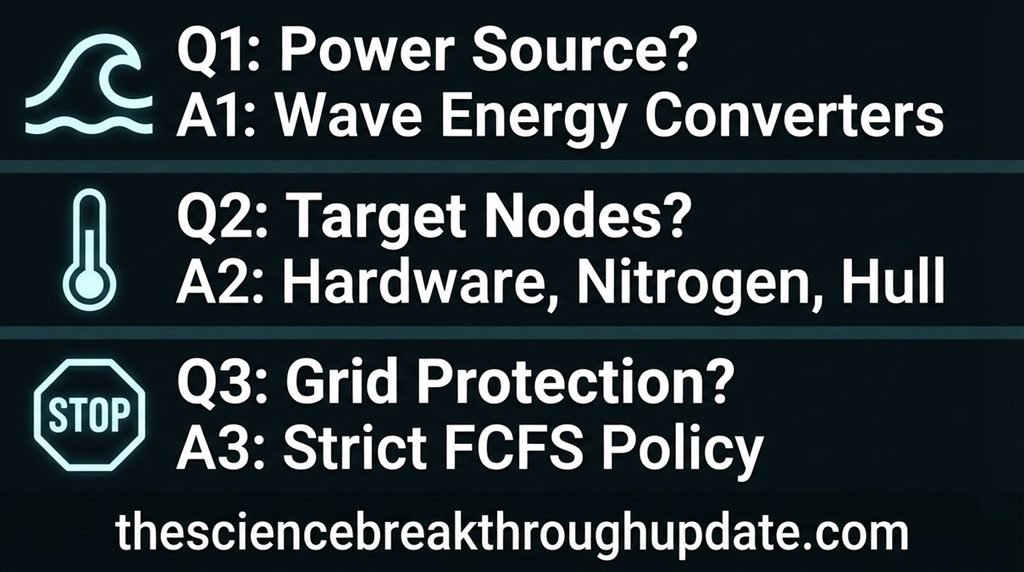
- How do underwater data centers manage energy imbalances?
The maritime architecture routes captured wave power into integrated battery storage systems to maintain balanced electrical networks. The control algorithm tracks battery state-of-charge metrics between 0.10 and 1.00 thresholds to balance clean generation with facility load. This mechanism keeps the computing cluster running safely during calm surface weather. - What parameters govern the thermal performance of these subsea capsules?
The mathematical model monitors the precise temperatures of the active computing hardware, the circulating internal nitrogen gas, and the pressure hull. Freezing ocean water absorbs thermal energy passively from the outer surface of the structural hull. Active internal fans and external pumps manage the remaining heat removal. - How does the system prevent computational tasks from overloading the marine grid?
The framework schedules flexible processing jobs by assessing real-time wave power flux and the scale of current queue accumulation. It applies a strict first-come-first-served job admission policy that stops launching new tasks if the battery drops to 0.40 state-of-charge. This safety constraint preserves remaining energy for previously committed workflows.
Source Document Link: arXiv.org
Share this useful knowledge with your friends now!”
Disclaimer: This content is based on preliminary scientific research (Preprints) from arXiv.org and current global findings. It is shared strictly for educational and informational purposes and does not constitute professional, legal. Readers are encouraged to verify facts independently and consult relevant experts before making any decisions.