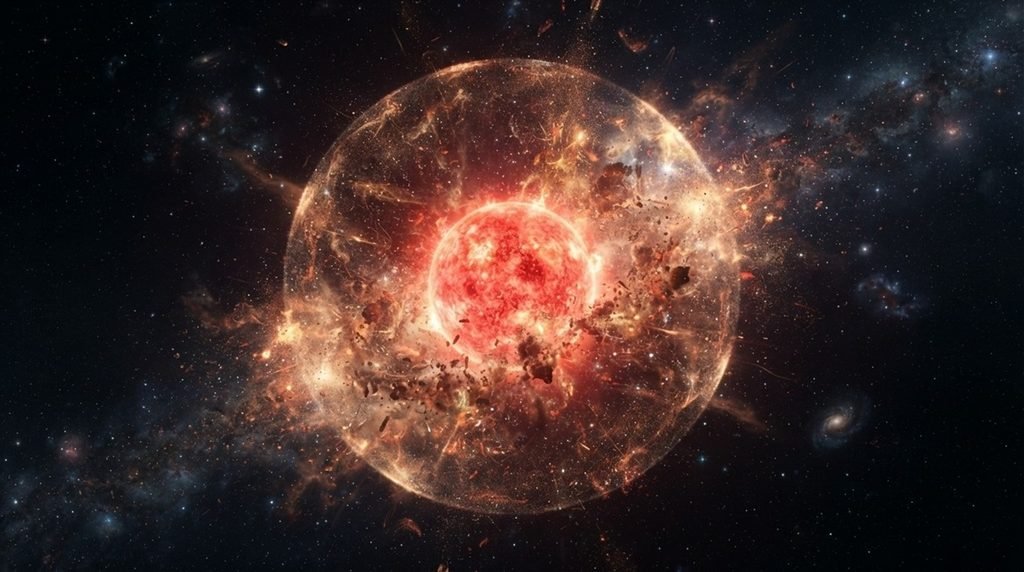
Two stars slammed into each other with unimaginable violence, but what happened after the dust settled has completely shocked astronomers.
🌌 Astronomers just got a rare look at the stellar merger M101 OT2015-1, a cosmic cataclysm where two massive stars collided. While most space news focuses entirely on the initial flash, a new study reveals the bizarre late-time evolution of this explosive stellar wreckage.
🔭 A team led by astronomer Marco A. Gómez-Muñoz used advanced telescopes to track the glowing remnants over several years. Their findings, submitted to the journal Astronomy & Astrophysics, show that the aftermath of a cosmic collision is far more complex than anyone predicted.
Why Tracking Deep Space Collisions Fails So Quickly
- 🛑 Traditional telescopes usually stop tracking stellar mergers after a few months because the initial blinding explosion fades away rapidly.
- 🌫️ Thick clouds of cosmic dust quickly wrap around the dying stars, hiding the crucial physical changes from standard optical view.
- 📉 Scientists lacked long-term data to understand how these merged stellar giants actually stabilize or if they collapse into black holes.
How Infrared Eyes Pierced Through The Cosmic Smoke
- 📡 The research team bypassed the thick dust shields by using deep infrared observations to capture the heat leaking from the wreckage.
- 🧪 Researchers combined data from multiple observatories to map the exact molecular composition of the cooling gas clouds.
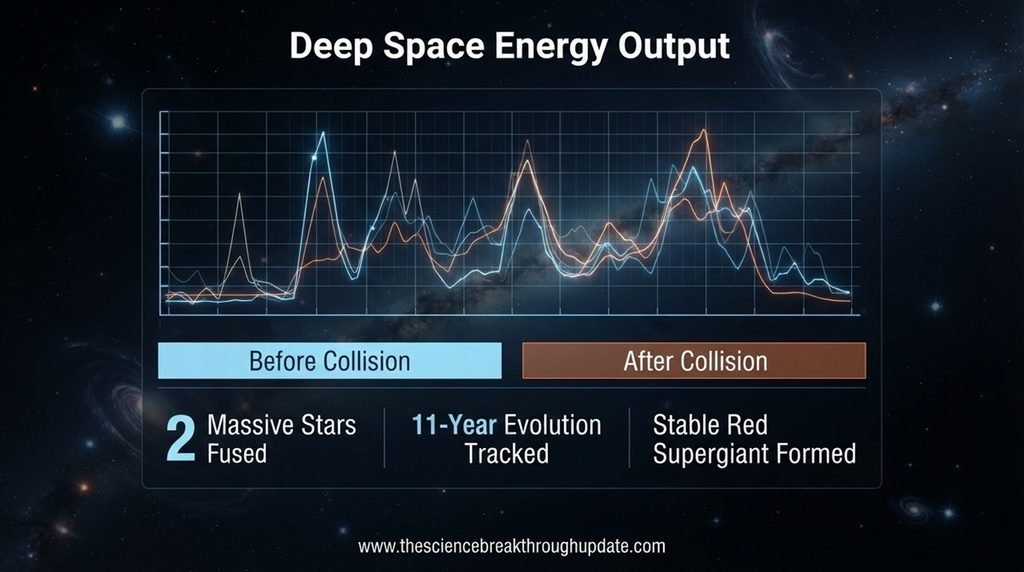
- 📈 They successfully traced the energy output fluctuations over a span of several years to build a complete evolutionary timeline.
What This Tells Us About The Future Of Dying Stars
- 🔴 The data proves that the merged star is surviving as a bloated red supergiant surrounded by a massive, expanding shell of dust.
- 🗺️ This discovery gives astronomers a reliable blueprint to predict how massive binary star systems behave during their final death throes.
- 💥 The team proved that 2 dying stars can fuse into a stable monster instead of triggering an immediate supernova explosion.
My Take: Watching these massive stellar remnants survive a violent smashup proves cosmic chemistry is surprisingly resilient, completely resetting how we accurately track and understand long-term stellar evolution.
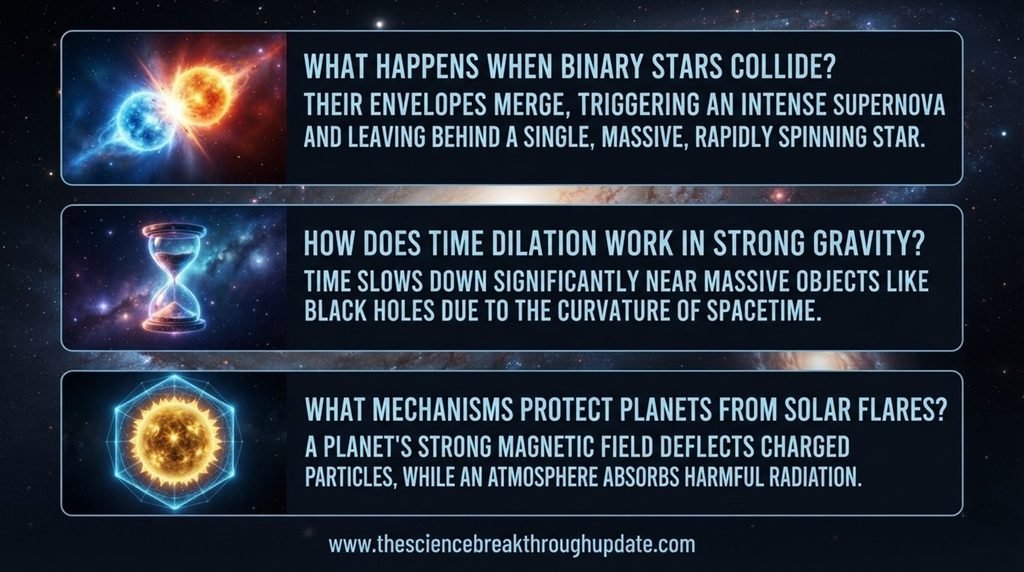
Reader Doubts: Core Questions Answered
1. What exactly happens when two stars collide in deep space?
- 💥 When two stars merge, they release a massive burst of energy and throw out huge clouds of gas. Over time, the two stellar cores fuse together to create a single, much larger star surrounded by a thick shell of dust.
2. Why did scientists need years to study the M101 OT2015-1 merger?
- ⏳ The initial flash of a stellar merger disappears very quickly, but the actual physical changes take years to develop. Monitoring the remnant over a long period allowed scientists to see how the new star stabilizes and cools down.
3. Can our Sun ever collide with another star?
- 🛡️ No, our Sun is completely safe from stellar collisions. Stars in our region of the Milky Way galaxy are separated by trillions of miles of empty space, making a solar collision practically impossible.
News source link: arXiv:2609.12981
Share this useful knowledge with your friends now!
Disclaimer: This content is for educational and informational purposes only.