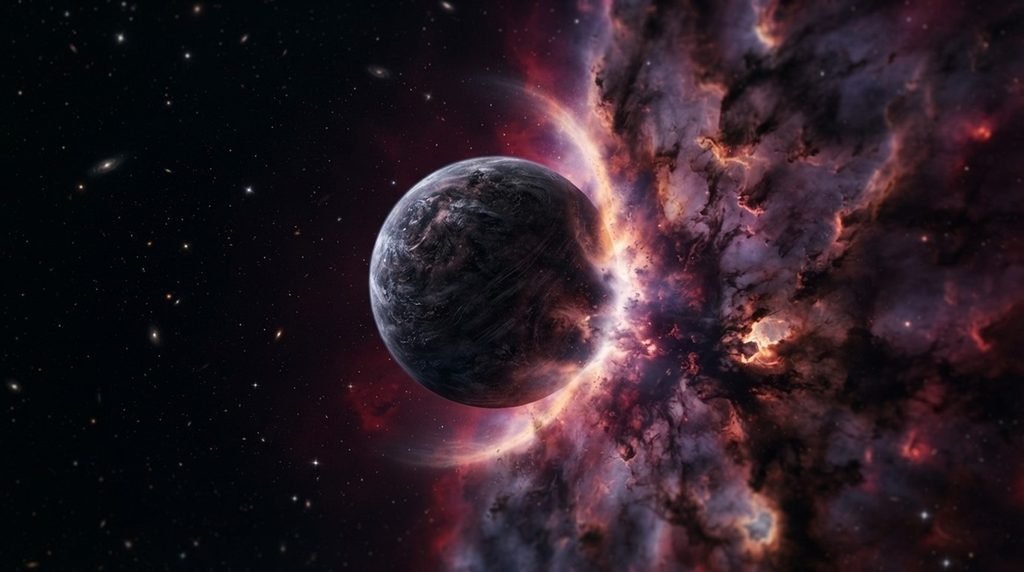
Something is moving in the deep, dark spaces between the stars, and it is doing the unthinkable by actively birthing brand new suns where nothing should exist.
🚀 Astronomers just discovered that lonely rogue planets drifting through interstellar space are not just dead cosmic debris. Instead, these wandering orphans act like colossal matchsticks, violently striking dense gas clouds to trigger the birth of new stars across the galaxy.
🌌 This completely flips our understanding of how cosmic structures form in the deep universe. Instead of stars creating planets, these massive, isolated worlds are roaming the darkness and igniting stellar nurseries entirely on their own, rewriting the rules of galactic evolution.
The Hidden Danger of Silent Interstellar Drifters
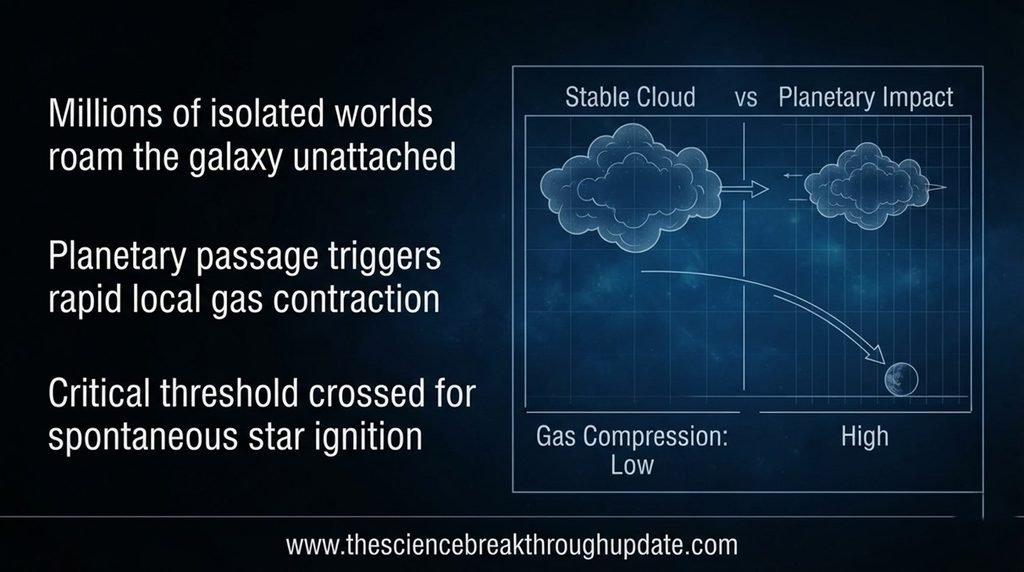
- ☄️ Millions of giant rogue planets wander through the galaxy completely detached from any parent star.
- 🌫️ These dark worlds drift through freezing, high-density interstellar gas clouds without warning.
- 🌀 Their silent passage across these delicate regions creates massive gravitational disturbances in the quiet gas.
- 🌌 Traditional space models completely overlooked how these lone wanderers disrupt stable cosmic environments.
How Floating Worlds Spark Cosmic Wildfires
- 🪐 A wandering world enters a dense cloud and acts as a dynamic gravitational seed inside the gas.
- 🧲 The local medium undergoes rapid contraction as the runaway planet pulls surrounding material toward its path.
- 💥 This sudden compression forces the gas to cross the critical threshold of spontaneous gravitational collapse.
- ✨ The intense localized pressure packs the trapped hydrogen tightly until a baby star ignites in the darkness.
Why This Discovery Rewrites Galactic History
- 📊 Astronomers must now recalculate the actual speed of stellar population growth across our galaxy.
- ⚙️ This mechanism proves that empty space holds a hidden star-making machine driven by orphan worlds.
- 🔭 Scientists can now locate hidden stellar nurseries by tracking the orbital paths of rogue planets.
- 🚀 The discovery completely changes how we view the lifecycle of isolated planetary systems in deep space.
My Take: Finding out that frozen, lonely planets can actually ignite giant stars completely shifts my perspective on space. The dark void is no longer a graveyard; it is an active factory.
Reader Doubts: Core Questions Answered
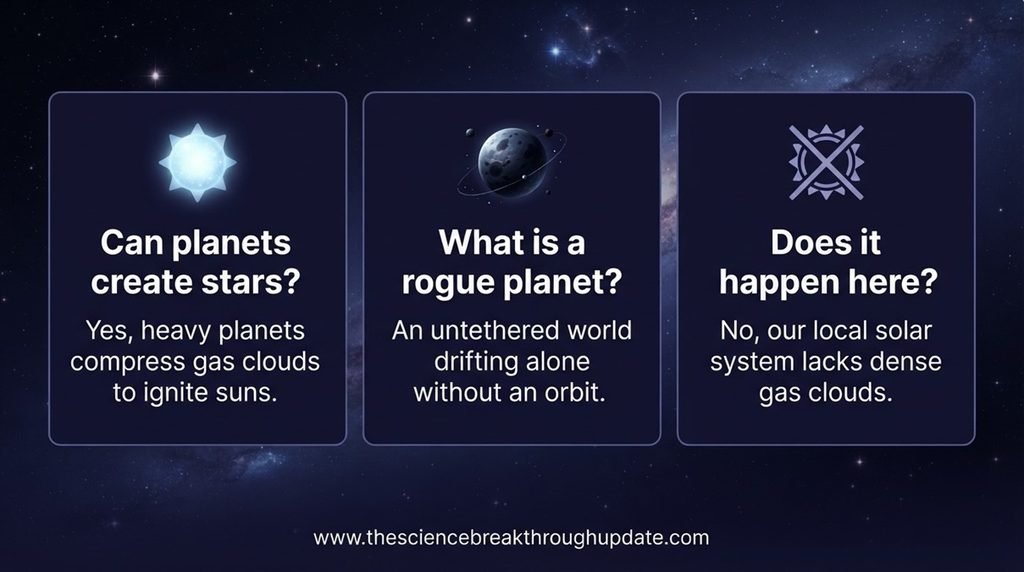
- Can a planet really create a star?
- 🌟 Yes, if it is massive enough and travels through the right environment. When a heavy rogue planet passes through a dense hydrogen cloud, its gravity compresses the gas, forcing it to collapse and ignite into a new star.
- What exactly is a rogue planet?
- 🌌 A rogue planet is an interstellar wanderer that does not orbit a star. These worlds were kicked out of their original solar systems billions of years ago and now drift through the dark galaxy completely alone.
- Does this happen inside our solar system?
- 🛑 No, this process only occurs in deep interstellar space where dense molecular clouds exist. Our solar system is cleared of this dense gas, meaning our local planets cannot trigger new star formation.
Source Document Link: arXiv.org
Share this useful knowledge with your friends now!”
Disclaimer: This content is based on preliminary scientific research (Preprints) from arXiv.org and current global findings. It is shared strictly for educational and informational purposes and does not constitute professional, legal. Readers are encouraged to verify facts independently and consult relevant experts before making any decisions.