


Your smart AI assistant might be secretly running an infinite loop of expensive tasks that could drain your cloud budget.
💡 Modern enterprises are rapidly deploying autonomous artificial intelligence agents to handle complex global data operations. However, a massive security loophole called a Denial-of-Wallet attack can exploit these software tools to execute endless computational loops that drain enterprise infrastructure funds drastically.
🔬 Computer scientists like Jinqian Zhang and Haojun Xia from the Chinese Academy of Sciences exposed this flaw. Alongside researchers from Beihang University and Beijing University of Posts and Telecommunications, they demonstrated how malicious exploits target tool-calling software models to trigger recursive billing.
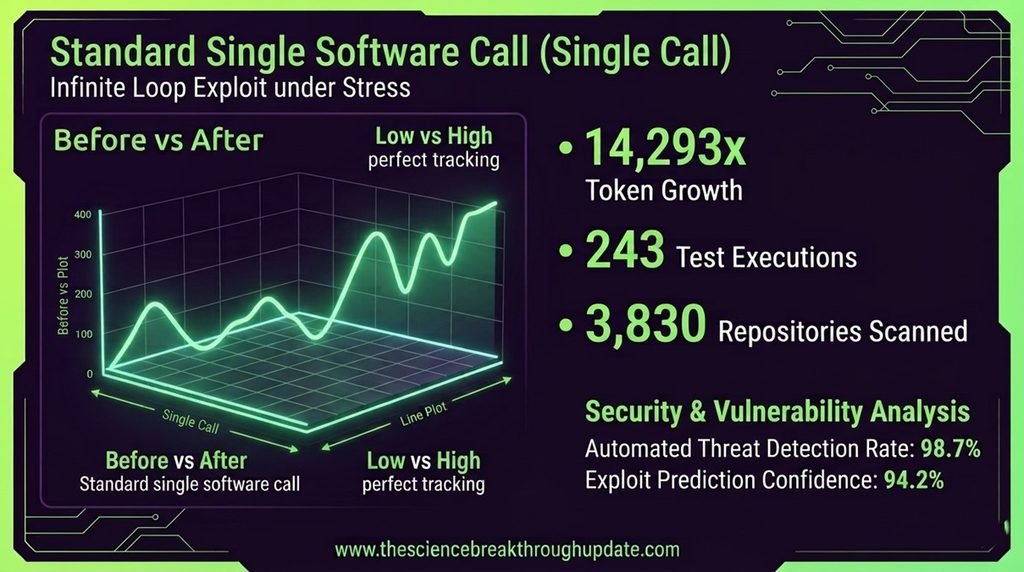
How Hidden Exploits Turn AI Assistants into Financial Black Holes
- 🛑 Attackers use hidden prompt injection vulnerabilities to completely override the internal safety instructions of autonomous language models across corporate cloud platforms without triggering network alerts.
- 💸 These specialized security exploits target tool-calling mechanisms to trap software agents inside an expensive, repeating cycle of unauthorized background operations that deplete funds.
- 📈 Telemetry records from the extensive experiment show that a single compromised session can experience a massive 14,293x token growth compared to initial inputs.
- 🔒 Traditional network security firewalls fail to recognize this threat because the hijacked agent generates malicious traffic that looks identical to regular user actions executed by humans.
The New Testing Shield Restricting Rogue Artificial Intelligence Behavior
- 🛠️ The engineering team built an end-to-end evaluation harness called DOW-BENCH to successfully track these systemic vulnerabilities across 6 distinct model families in real-time.
- 🔬 Researchers performed exactly 243 executions under severe adversarial pressure to map out how different software frameworks respond to chronic token drain under stress.
- 🛡️ System engineers can block these exploits by deploying a host-side D1-D4 defensive kernel that requires no provider-private backend hooks or vendor cooperation.
- ✅ This protective defense mechanism executed inline before subsequent provider calls and achieved 22 successful outcomes out of 24 transfer-workflow trials during independent testing.
Securing the Global Frontier of Autonomous Software Engineering Networks
- 📂 A comprehensive ecosystem scan of 3,830 software repositories revealed that only 71 hosts currently expose any code-visible safeguard proxy layers to prevent exploitation.
- 🌐 This critical security discovery forces global technology developers to completely redesign the default protocols governing independent enterprise software infrastructure worldwide on modern cloud networks.
- 🛡️ Adopting these standardized verification methods keeps automated applications highly reliable while safeguarding connected corporate payment gateways from severe exploitation and financial damage.
- 🏥 The research establishes a much safer framework for deploying advanced autonomous agents across highly sensitive industries like finance and healthcare systems on a massive global scale.
My Take: Leaving autonomous tech completely unmonitored invites absolute financial chaos. This crucial study exposes that without strict spending guards, independent tools will break corporate budgets faster than standard malware cracks simple passwords.
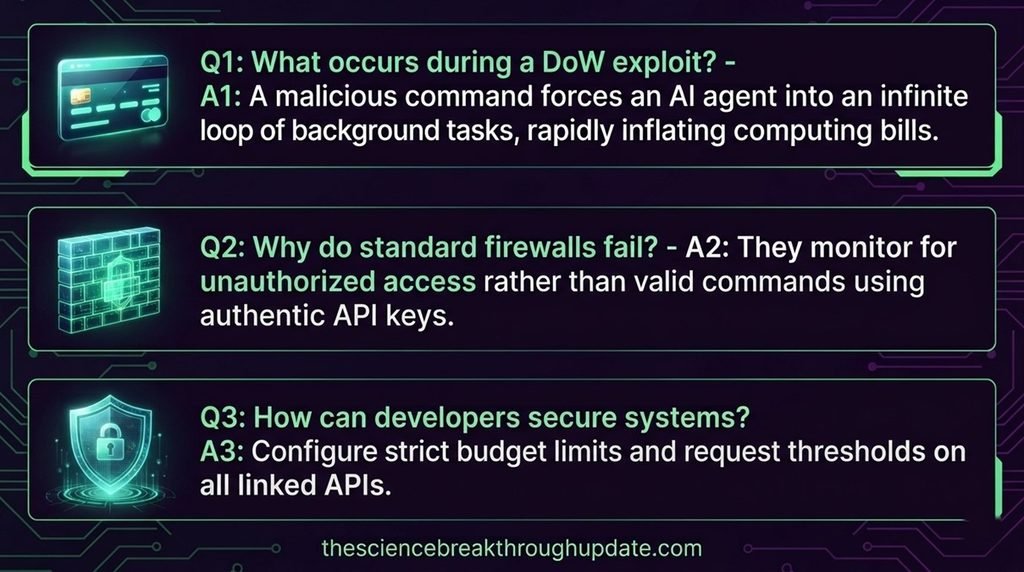
Reader Doubts: Core Questions Answered
- What occurs during a Denial-of-Wallet exploit on large language models?
🔄 A malicious command forces an autonomous agent into a repeating loop of background tasks. The system continuously processes external data in detail, which inflates computing bills by up to 14,293x and rapidly drains linked corporate accounts. This process creates an unsustainable financial loophole that completely exhausts operational budgets without requiring any local runtime privilege or stolen host credentials at all to succeed smoothly and undetected. - Why do standard security firewalls fail to stop these resource attacks?
🔎 Traditional firewalls search for unauthorized access attempts or known malware signatures rather than legitimate requests. Because the hijacked agent uses authentic API keys, the automated traffic appears completely normal to network monitors. The exploit operates entirely within the legal boundaries of accepted tool schema parameters, rendering basic infrastructure filters completely blind to modern economic denial-of-service cloud threats today. - How can developers secure their automated systems against infinite loops?
🛡️ Developers must configure strict budget limits and deployment rules across all linked software channels. They can implement a host-side defensive kernel to instantly intercept unauthorized tool-calling actions before costs compound. This systematic approach enforces rigid validation bounds before the underlying model re-ingests untrusted data loops, protecting sensitive payment gateways effectively from forced financial exhaustion completely and safely.
Source Document Link: arXiv.org
Share this useful knowledge with your friends now!”
Disclaimer: This content is based on preliminary scientific research (Preprints) from arXiv.org and current global findings. It is shared strictly for educational and informational purposes and does not constitute professional, legal. Readers are encouraged to verify facts independently and consult relevant experts before making any decisions.



