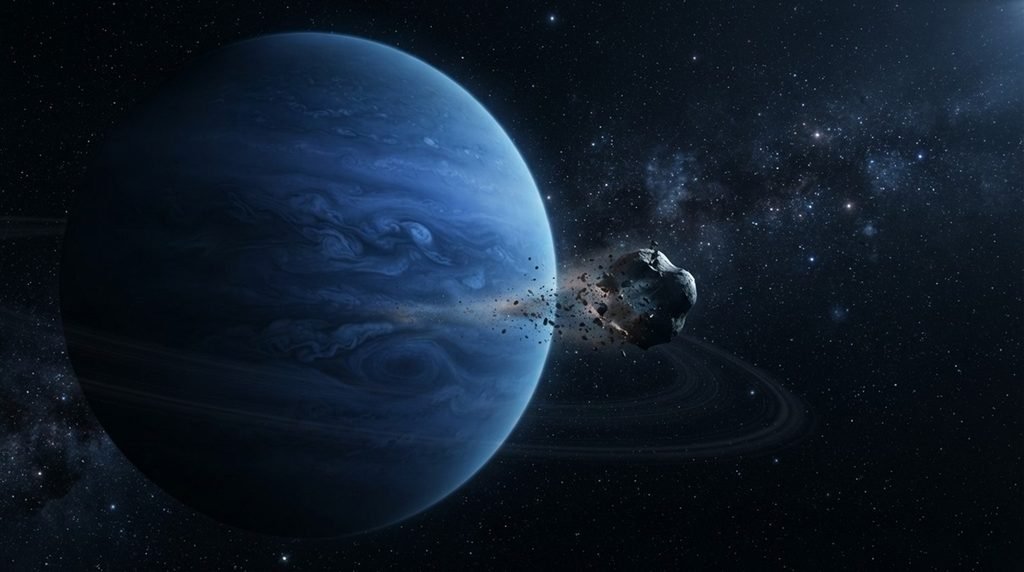
Astronomers have detected warning signs that Neptune is slowly destroying its closest companion planet, and the tiny world might not survive the intense cosmic tug-of-war.
🪐 Neptune hosts a family of chaotic moons, but its innermost satellite, Naiad, faces an immediate crisis. Recent calculations show that orbital decay is pulling this tiny frozen world closer to the ice giant, triggering massive gravitational stress that threatens its survival.
🌌 Astronomers studying the system have identified severe orbital challenges that could break the moon apart. This relentless gravitational pull forces the moon into a death spiral, making it a critical case study for planet-moon interactions in deep space.
The Silent Gravitational Trap Pulling Naiad Inward
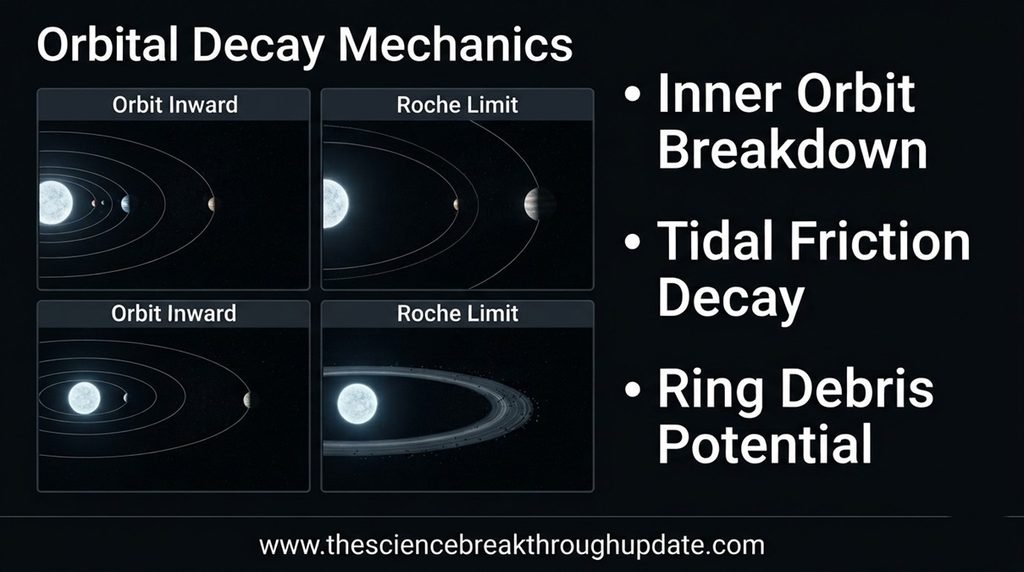
- 🛑 Neptune exerts intense tidal forces on its innermost companion due to the moon’s dangerously close orbit.
- ⚡ The tiny world travels faster than the planet’s own rotation, causing orbital energy to drain continuously.
- 📉 Tidal friction slowly drags the fragile satellite down into a terminal death spiral toward the atmosphere.
- 💥 Internal structural strain increases as the moon approaches the Roche limit where solid bodies disintegrate.
How Scientists Track the Invisible Death Spiral
- 💻 Researchers utilize advanced N-body simulations to model the long-term orbital path of the moon.
- 🔭 Space telescopes track precise orbital variations to measure how fast the orbital radius shrinks.
- 🌡️ Digital models calculate internal tidal heating to see if the ice-rock core is melting.
- 📊 Comparative data from other gas giant systems helps refine the mathematical models of orbital decay.
Why the Fate of Neptune’s Moon Changes Our View of Space
- 🗺️ Documenting this destruction reveals how outer solar systems continuously reshape their satellite networks over time.
- 🪐 The eventual breakup of the world will create a new, temporary planetary ring around Neptune.
- 🌟 Studying this process helps astronomers predict the lifespans of extreme exoplanets orbiting distant stars.
- 🔄 This discovery confirms that planetary systems remain dynamic environments where major cosmic changes occur.
My Take: Watching a moon face slow-motion structural collapse reminds us that our local cosmos isn’t static. It provides a rare, real-time laboratory window to map planetary death and ring creation.
Reader Doubts: Core Questions Answered
- Will Neptune’s moon crash directly into the planet?
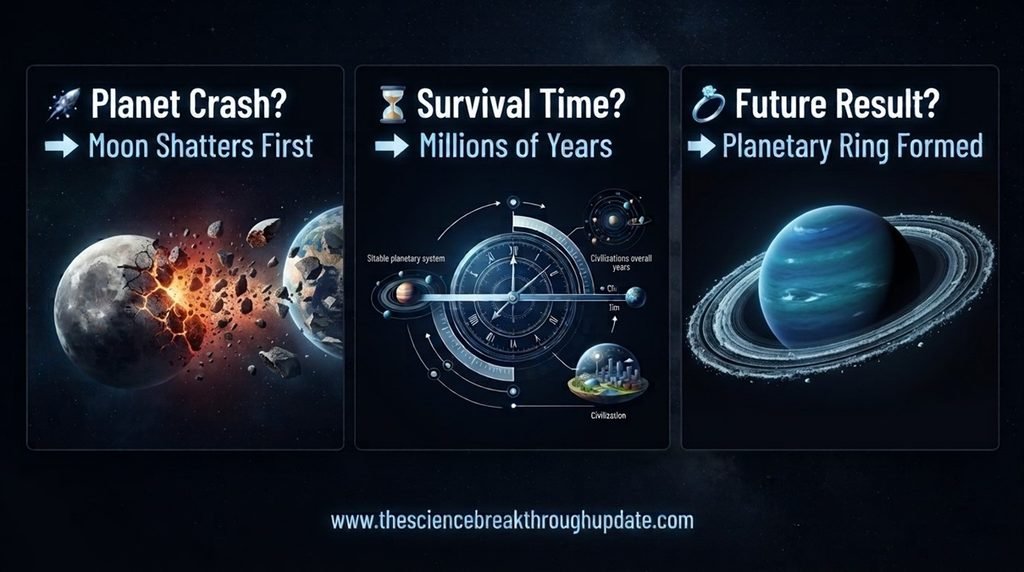
- ☄️ No, it will likely not hit the planet as a solid object because the immense gravitational pull will rip the moon apart before it impacts the atmosphere. This destruction happens once it crosses the planet’s structural breakup zone.
- How long do astronomers estimate the moon has left?
- ⏳ The orbital decay is a slow process that takes millions of years to complete. While the timeline is long, the downward trajectory is permanent, completely irreversible, and inescapable.
- What happens after the moon breaks apart?
- 💍 The shattered pieces of rock and ice will spread out along the orbit to form a bright, dense ring around Neptune. Over time, this debris material will gradually drift downward into the upper atmosphere.
News source link: arXiv.org
Share this useful knowledge with your friends now!”
Disclaimer: This content is based on preliminary scientific research (Preprints) from arXiv.org and current global findings. It is shared strictly for educational and informational purposes and does not constitute professional, legal. Readers are encouraged to verify facts independently and consult relevant experts before making any decisions.