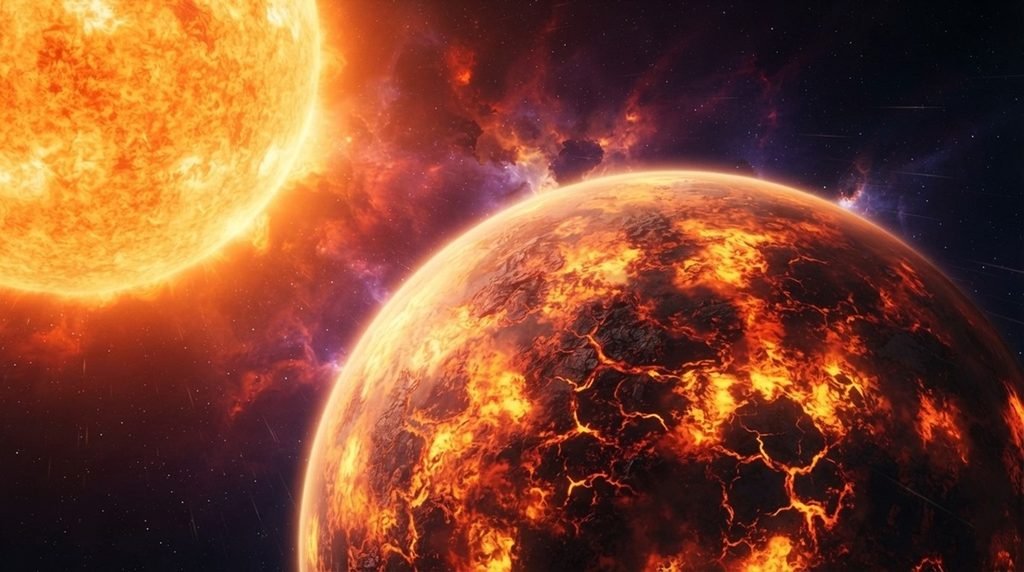
Deep space telescopes just unlocked the horrific secrets of alien worlds covered entirely in oceans of boiling lava.
🌌 Astronomers just mapped how extreme lava planets change across system ages, revealing how these molten worlds cool down over billions of years. This massive survey, known as the Hell of a Survey, tracks how extreme stellar radiation keeps these rocky planets in a permanent, melted state.
☄️ Understanding these nightmare worlds helps scientists decode how rocky planets form and evolve under intense stellar heat. By analyzing these magma oceans, researchers can look back in time to understand the early history of Earth when it was still a molten rock.
The Nightmare of Planets Trapped in Permanent Melting Cycles
- 🪐 Space telescopes struggle to see through the thick, toxic vapors evaporating directly from boiling planetary magma oceans.
- ☀️ Intense stellar radiation from nearby stars forces these rocky worlds into a permanent state of extreme thermal trapping.
- 📉 Scientists lacked a unified model to predict how planetary interiors cool down when their surfaces stay permanently molten.
- 🌀 Tidal forces and massive stellar heat constantly battle against the natural cooling systems of these highly irradiated exoplanets.
How the Hell of a Survey Decoded Magma Ocean Lifespans
- 👩🔬 Lead researcher Mariana Sastre and a global team of astronomers built a new thermal evolution framework for lava worlds.
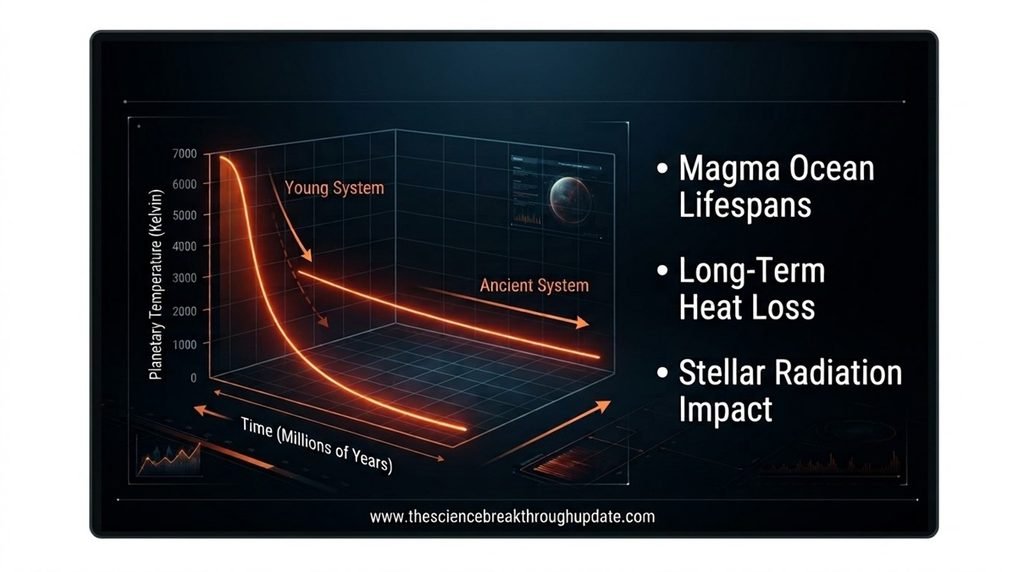
- 📊 The team tracked planetary cooling rates across different stellar system ages to map the lifespan of magma oceans.
- 💻 Researchers combined interior mantle dynamics with atmospheric evaporation models to simulate long-term planetary heat loss.
- 📖 This massive collaborative study will soon appear in the prestigious Astrophysical Journal to guide future telescope observations.
Why Mapping Molten Worlds Changes Our View of Earth
- 🔭 Knowing how lava planets cool helps astronomers identify which rocky planets might eventually develop habitable conditions.
- 🎯 This data allows the James Webb Space Telescope to target specific alien atmospheres with much higher precision.
- 🧪 The study proves that planet age directly dictates the chemical composition of atmospheres created by vaporized rock.
- 🌍 Geophysicists can now use these extreme alien worlds as a live laboratory to study Earth’s ancient mantle.
My Take: Watching these melting rocks helps us peer directly into our own past, giving scientists a live tracking map to decipher how planets genuinely build their very first crusts.

Reader Doubts: Core Questions Answered
1. What exactly is a lava planet?
🔥 A lava planet is a rocky world that orbits incredibly close to its host star. The intense heat melts the planet’s surface into a permanent, global ocean of molten rock.
2. How do scientists study these distant molten worlds?
📡 Astronomers use space telescopes to analyze the light passing through the planet’s vaporized atmosphere. They also use computer models to calculate how heat moves from the core to the surface.
3. Can a lava planet ever cool down and host life?
🛑 It depends entirely on its distance from the star. If the planet stays in a tight orbit, it will remain molten for its entire existence, making life impossible.
News source link: arXiv.org
Share this useful knowledge with your friends now!
Disclaimer: This content is based on preliminary scientific research (Preprints) from arXiv.org and current global findings. It is shared strictly for educational and informational purposes and does not constitute professional, legal. Readers are encouraged to verify facts independently and consult relevant experts before making any decisions.