

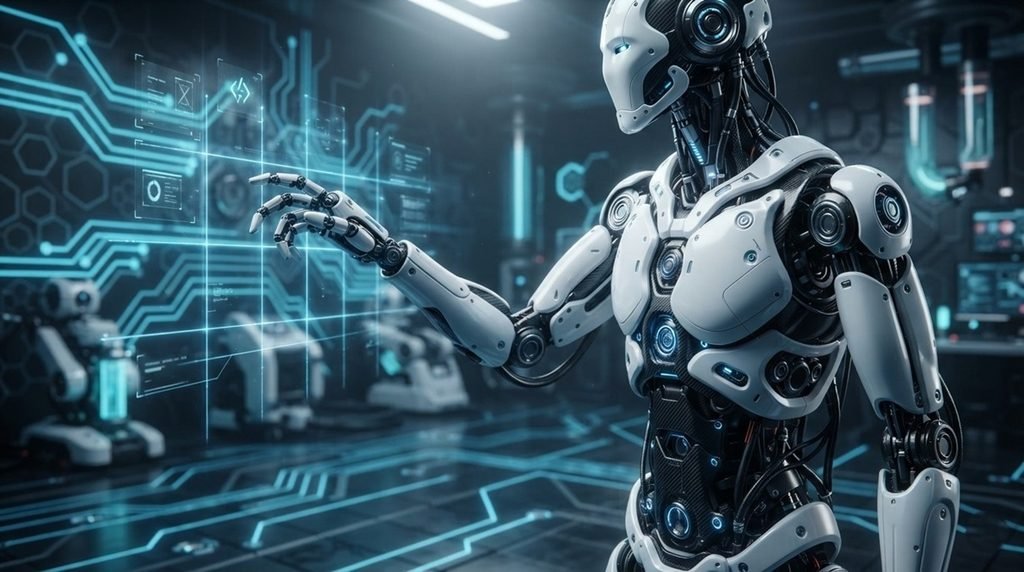
Modern humanoid robots look incredibly advanced, but a hidden digital lag forces them to hesitate before every single movement.
⚠️ Traditional foundational models require massive cloud computation, which introduces severe processing latency during complex real-world tasks. This reliance on heavy compute cores causes physical stuttering, makes robots slow, and drains their onboard battery packs rapidly.
🧠 Engineers Kaijun Zhou, Zhiyang Li, Le Chen, and Jinyu Gu designed a brilliant new architecture called rMuscle to solve this mechanical delay.
Why Artificial Intelligence Freezes When Facing Real-World Chaos
- 🖥️ Modern vision-language-action models overwhelm hardware edge systems because they require millions of constant cloud parameter calculations for simple actions.
- 🛑 This computational overload causes physical hesitation whenever a bipedal machine encounters unexpected obstacles or dynamic environmental changes in real time.
- 🔋 Heavy background data processing burns massive amounts of electricity, which severely limits the operational battery life of untethered humanoids.
- 🚨 Physical safety risks spike dramatically when heavy industrial machines cannot execute instant defensive reflexes around moving human workers.
The Neural Blueprint Copying Human Nerve Reflexes
- 🧬 The rMuscle system mimics biological muscle memory by connecting high-level foundational models with ultra-lightweight local action predictors at the edge.
- ⚡ This architecture allows the robot to handle split-second balancing adaptations locally without triggering heavy cloud computing routines every millisecond.
- 💾 The system saves vast amounts of computational power by prioritizing localized hardware execution for repetitive, low-level physical manipulations.
- 🦾 The machine builds a library of trained physical habits, enabling the limbs to react autonomously to environmental friction instantly.
How Muscle Memory Reinvents the Global Robotics Industry
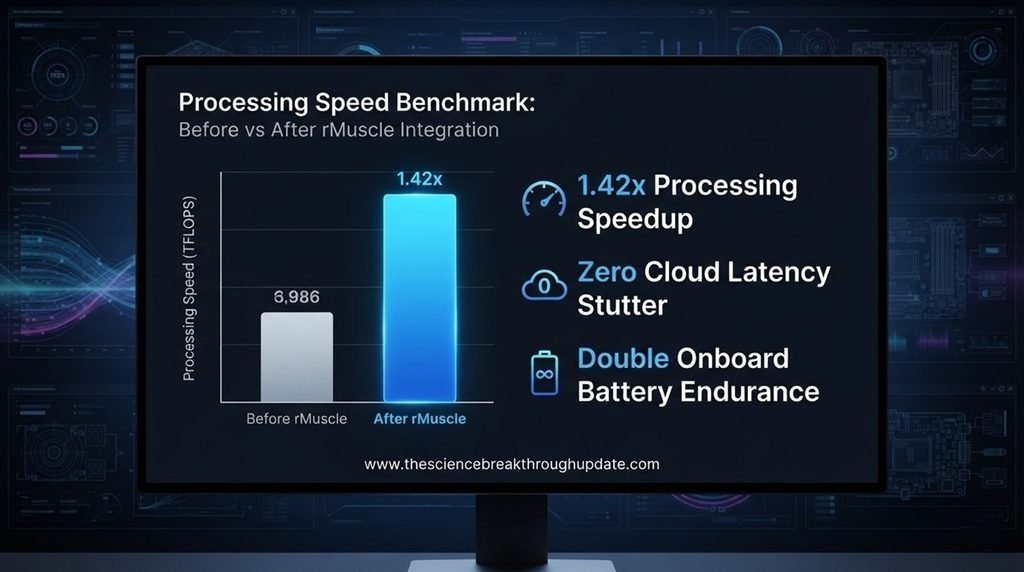
- 🚀 Bipedal humanoids achieve a 1.29 to 1.42 times processing speedup on advanced edge hardware platforms like the Jetson Thor system.
- 🤝 Factories can safely deploy fast heavy machinery next to human laborers due to instantaneous collision avoidance reflexes built into the hardware.
- 📉 Total production costs drop because machines utilizing rMuscle no longer require expensive onboard supercomputers to execute daily tasks.
- 🕒 Operational endurance doubles overnight, transforming basic prototypes into highly practical tools for long home caregiving shifts.
My Take: Giving robots muscle memory shifts AI from abstract computing into practical, fluid reality. If humanoids can finally react instantly without cloud lag, they will finally leave labs and safely enter our everyday homes.
Reader Doubts: Core Questions Answered
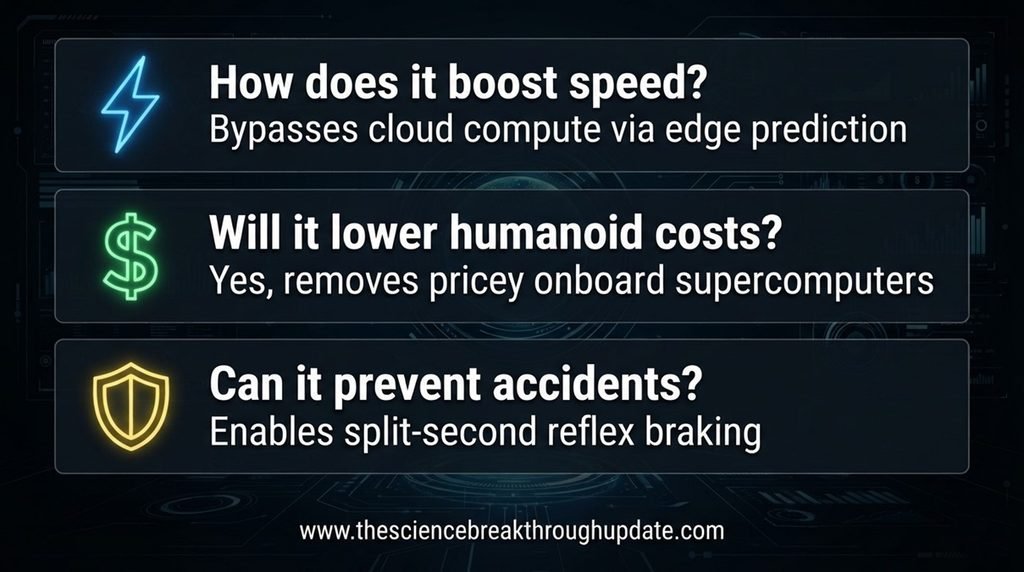
1. How does rMuscle make robots move faster?
- ⚡ It bypasses heavy cloud computation by using ultra-lightweight local action predictions directly at the hardware edge. This allows the machine to react instantly using pre-trained physical habits instead of waiting for data to process.
2. Will this technology reduce the price of home humanoids?
- 💰 Yes, it removes the need for multi-thousand-dollar onboard supercomputers. By offloading heavy thinking, future consumer robots can use cheaper edge processors while maintaining peak physical agility.
3. Can this system prevent workplace accidents?
- 🛡️ Absolutely. Because the local layer processes motion data instantly, a robot can execute immediate split-second braking or dodging maneuvers if a human suddenly crosses its physical path.
News source link: arXiv.org
Share this useful knowledge with your friends now!
Disclaimer: This content is based on preliminary scientific research (Preprints) from arXiv.org and current global findings. It is shared strictly for educational and informational purposes and does not constitute professional, legal, or medical advice. Readers are encouraged to verify facts independently and consult relevant experts before making any decisions.



