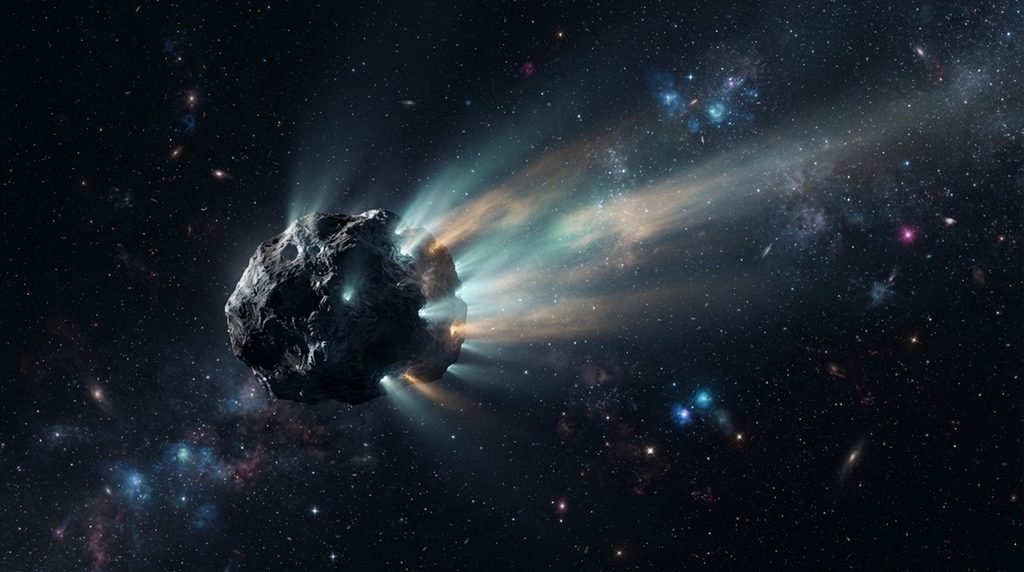
A strange wanderer from deep space is challenging everything we know about how alien worlds form.
🚀 Astronomers tracking a bizarre interstellar comet recently discovered an unexpected chemical mystery hiding deep beneath its frozen surface. The wandering object exhibited highly unusual outgassing behaviors that completely defied standard solar system models, leaving global researchers deeply puzzled about its true origin.
🔬 A new study by scientists Akshat Rawat and Kinsuk Acharyya from the prestigious Physical Research Laboratory provides the answers. Published on arXiv, this groundbreaking research reveals exactly how intense cosmic radiation alters alien comets during their multi-billion-year journeys across the dark interstellar void.
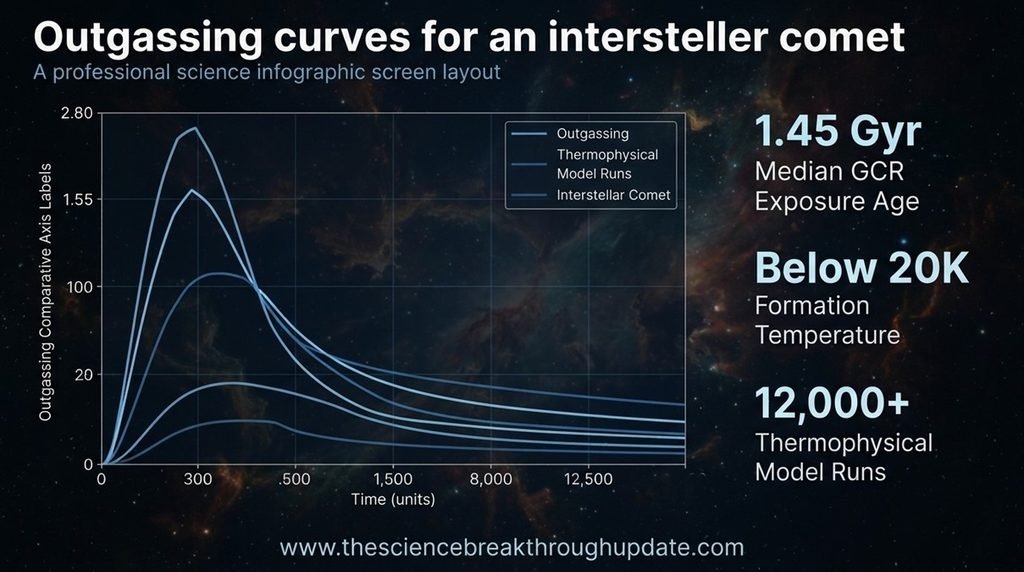
The Mystery of the Missing Methane Carbon
- ☄️ Global space telescopes monitoring the unique interstellar visitor 3I/ATLAS detected plenty of water but found absolutely zero traces of near-surface methane.
- 🛑 Traditional cometary models completely failed to explain why this essential hyper-volatile gas remained completely locked away during the initial observation phase.
- 🌡️ Scientists quickly realized that standard thermal heating patterns could not account for this strange chemical stratification observed inside the alien object.
- 🪐 The missing chemical signature threatened to severely undermine our core understanding of planetesimal assembly in distant, unmapped planetary systems.
Deep Space Radiation Creates a Cosmic Shield
- 💻 The research team built a highly sophisticated thermophysical nucleus model to track how Galactic Cosmic Rays bombard the porous comet matrix.
- 🛡️ Continuous radiation exposure over a median 1.45 Gyr drives a unique radiolytic chemistry that systematically destroys methane molecules near the exterior surface.
- ❄️ This intense bombardment converts a massive portion of the primary carbon monoxide reservoir into a highly insulated secondary carbon dioxide crust.
- 🔒 The remaining pristine methane successfully survives deep inside the nucleus, securely trapped within a dense network of amorphous water ice nanopores.
Unlocking the Secrets of Alien Solar Systems
- ☀️ As the visitor rounded the sun, deep subsurface heating triggered an amorphous-to-crystalline phase transition that finally unleashed the trapped methane gas.
- ⏱️ This delayed chemical release allows astronomers to precisely measure the effective GCR exposure age of dynamic interstellar travelers for the first time.
- 🥶 The presence of these heavy hyper-volatiles confirms the comet originated in an ultra-cold environment below 20 Kelvin, far beyond the CO snowline.
- 📊 Identifying these distinct structural regimes helps scientists compare this object against past visitors like the famously active interstellar comet 2I/Borisov.
My Take: Tracking interstellar intruders isn’t just about cataloging cold rocks. Analyzing their trapped gases offers a real-time chemical blueprint of alien solar systems, completely rewriting our understanding of galactic history.
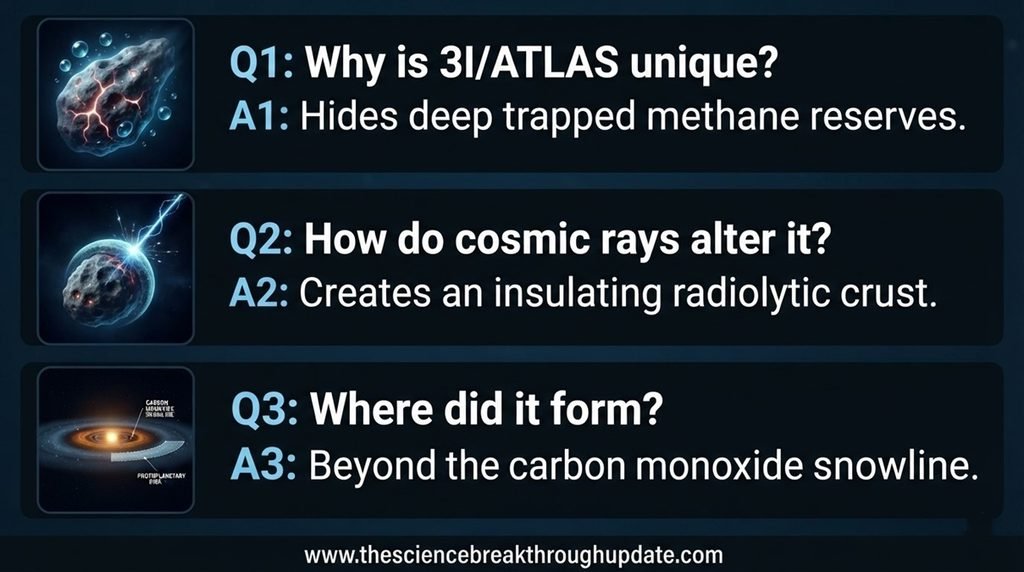
Reader Doubts: Core Questions Answered
- What makes this specific interstellar comet so unique?
🌌 Unlike local comets, this deep-space traveler 3I/ATLAS contains a highly modified outer crust shaped by billions of years of cosmic radiation. It systematically delayed its methane release until solar heat fully penetrated its protective organic layers. This creates a distinct chemical barrier that sets it apart from any object previously observed within our solar system. This dynamic evolution provides crucial clues about extreme environments beyond our sun. - How do cosmic rays alter objects moving through interstellar space?
⚡ Galactic cosmic rays trigger intense radiolytic reactions that deplete surface gases and compact the porous ice matrix. This creates a continuous depth-dependent compositional gradient, leaving a pristine interior surrounded by a devolatilized crust. The resulting outer crust serves as a powerful insulating shield that effectively delays the sublimation of volatile elements from escaping early. This processing completely alters how heat flows through the core. - What does this discovery tell us about other planetary systems?
🛸 It proves that distant planetary nurseries share the same fundamental chemical building blocks as our own solar system. The high abundance of hyper-volatile elements shows these objects form in ultra-cold environments below 20 Kelvin, far beyond distant snowlines. Understanding these cosmic travelers allows scientists to map the chemical environments of alien worlds without ever leaving Earth, expanding our astronomical horizons significantly.
News source line: arXiv.org
Share this useful knowledge with your friends now!”
Disclaimer: This content is based on preliminary scientific research (Preprints) from arXiv.org and current global findings. It is shared strictly for educational and informational purposes and does not constitute professional, legal. Readers are encouraged to verify facts independently and consult relevant experts before making any decisions.