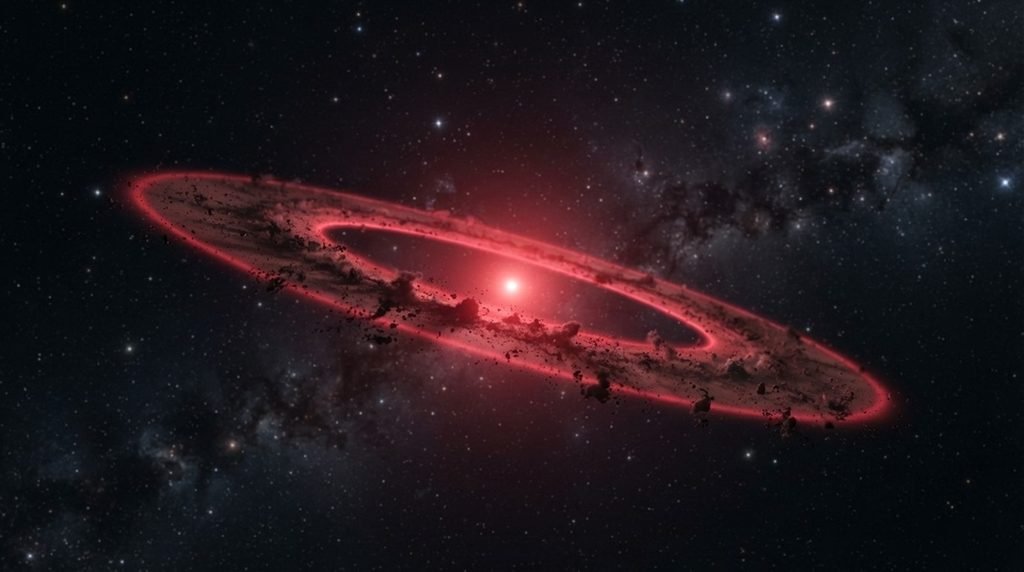
Astronomers have finally cracked the chemical code of the terrifying stellar ring that mimics the most infamous eye in pop culture.
🚨 Astrophysicists have uncovered the exact atomic composition of the massive debris disk surrounding HR 4796A, famously nicknamed the Eye of Sauron. By pairing direct telescope observations with rigorous laboratory experiments, researchers successfully mapped the stellar dust feeding this cosmic system.
🌌 The international team, including lead scientists from University Grenoble Alpes like M. Bonduelle, J. Milli, and O. Poch, discovered that the ring’s signature properties are driven by large iron sulfides. This fresh study provides crucial insights into how young planetary systems form out of chaotic, churning rings of space debris.
The Hidden Challenge of Mapping Distant Cosmic Dust
- 🔭 Astronomers struggled for years to determine the precise chemical makeup of the hyper-fine dust particles within the HR 4796A debris disk.
- 🌟 The blinding glare from the central binary star system consistently washed out the delicate light signatures reflected by the outer ring.
- 🔍 Standard space observations could only provide raw imagery without explaining why the dust behaved like a highly reflective cosmic mirror.
- 📉 Theoretical models routinely failed to replicate the unusually high linear polarization values measured at very small scattering angles.
Recreating the Void of Space Inside a Earth Lab
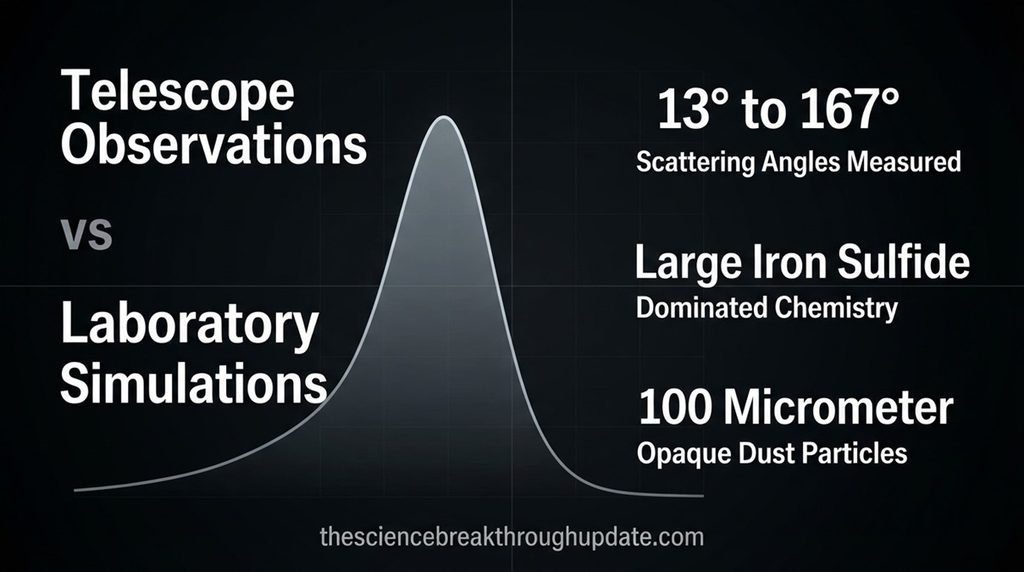
- 📊 Scientists gathered high-resolution light data from advanced observatories and analyzed the light scattering across a massive range spanning 13 to 167 degrees.
- ⚗️ The team synthesized specific mineral dust sheets containing mixtures of pyrrhotite and troilite to match the real space signatures.
- 🔬 Researchers blasted these custom materials with light beams to test how light reflects off different planetary building blocks in a vacuum.
- 📐 This dual approach allowed the team to discover that large absorbent particles measuring up to 100 micrometers are the main scatterers.
Why Decoding This Burning Stellar Ring Changes Astronomy
- 🪨 Proving the dominance of large iron sulfides tells scientists exactly what raw materials are available to form rocky planets and asteroids.
- ☄️ Finding dust that resembles highly processed near-Earth orbit asteroids indicates intense space weathering and melting occurring inside the disk.
- 💡 The laboratory data establishes a new baseline for how opaque minerals contribute to the low albedo of distant solar system bodies.
- 🏆 This breakthrough effectively turns a pop-culture curiosity into one of the most chemically understood stellar structures in our galactic neighborhood.
My Take: This discovery shifts space science from mere stargazing to hands-on chemistry, proving we can recreate deep-space mysteries in a lab to unlock how rocky worlds actually form.
Reader Doubts: Core Questions Answered
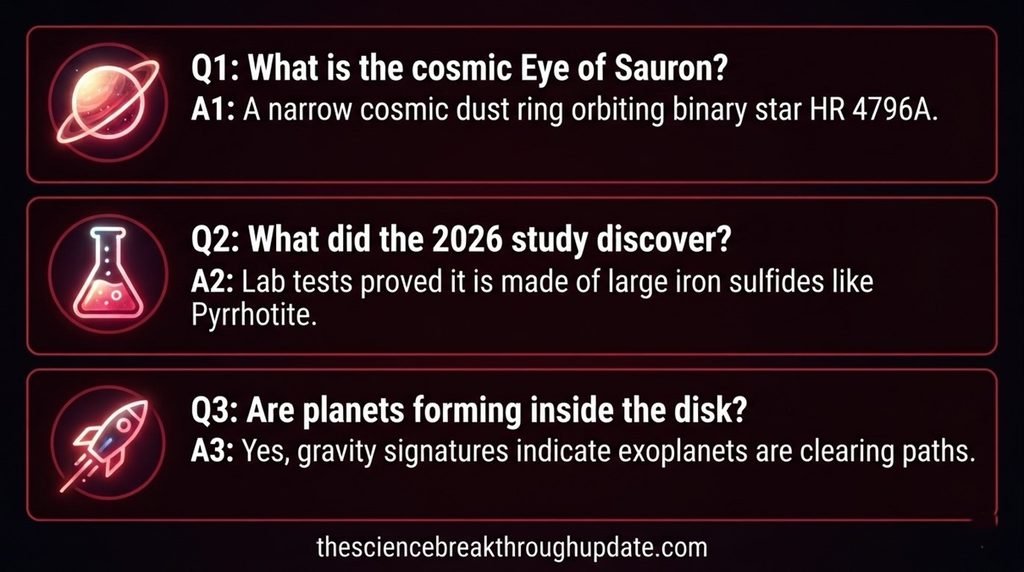
- What exactly is the Eye of Sauron in space?
🪐 It is a massive, bright, and narrow ring of cosmic dust and space debris orbiting a young binary star system named HR 4796A. The stellar ring sits in deep space and looks exactly like a giant burning eye. - What did scientists discover new about it?
🧪 Scientists combined telescope data with real laboratory experiments to prove the dust consists of large iron sulfides like pyrrhotite. This unique chemistry explains the ring’s high polarization and light-reflecting nature for the first time. - Are there planets forming inside this cosmic ring?
🚀 Yes, this debris disk functions as an active planetary nursery. The heavily sculpted nature of the dust ring strongly indicates the presence of unseen planets clearing paths within the system.
Source Document Link: arXiv.org
Share this useful knowledge with your friends now!”
Disclaimer: This content is based on preliminary scientific research (Preprints) from arXiv.org and current global findings. It is shared strictly for educational and informational purposes and does not constitute professional, legal. Readers are encouraged to verify facts independently and consult relevant experts before making any decisions.