
Scientists just spotted a bizarre chemical glow coming from a cold, dark world, challenging existing theories about how stars live and die.
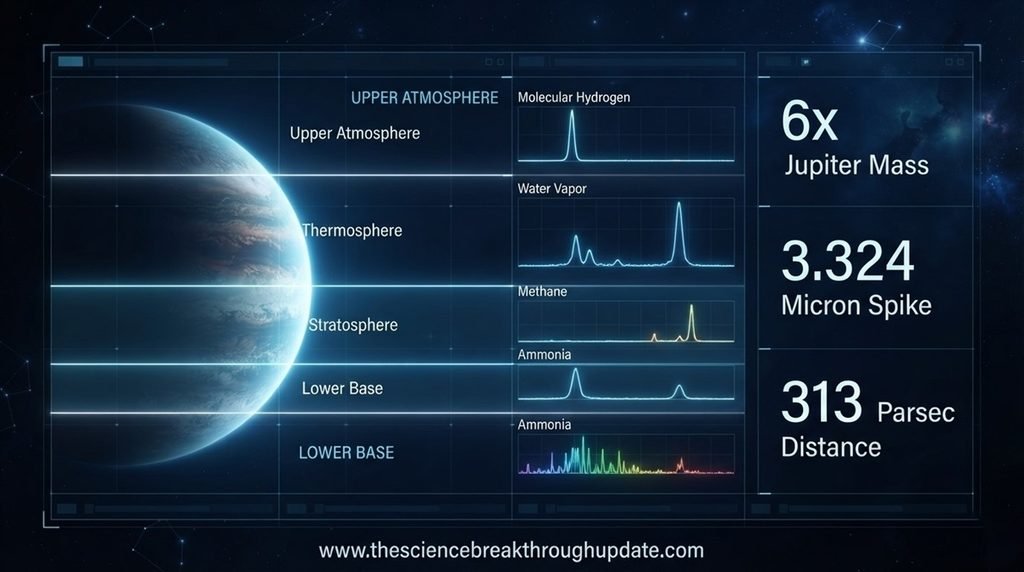
🚀 Astronomers using the highly advanced James Webb Space Telescope detected unexpected gaseous methane emissions from a young planetary-mass brown dwarf cataloged as LRL 11001. This strange celestial object sits inside the prominent IC 348 star cluster located exactly 313 parsecs away from Earth.
🪐 This specific cosmic entity weighs roughly 6 times the mass of Jupiter, classifying it perfectly as a failed star. These hidden bodies form like normal stars from collapsing molecular clouds but lack sufficient mass to trigger sustainable internal hydrogen nuclear fusion.
The Mystery of the Missing Methane and Hidden Gases
- 📉 Traditional space models predict that the coolest newborn brown dwarfs should show heavy methane absorption features inside their cold atmospheres.
- 🔍 Astrophysicists previously failed to detect these expected carbon signatures, finding a strange and unexplained 3.4-micron absorption band instead.
- 🧪 Standard atmospheric simulations never predicted this specific hydrocarbon band, leaving a massive gap in our understanding of planetary-mass objects.
- 📊 Researchers lacked the high-resolution spectroscopy data needed to identify the exact chemical carriers hiding inside these freezing stellar atmospheres.
Deep Space Infrared Vision Cracks the Code
- 🛰️ Lead researcher K. L. Luhman from The Pennsylvania State University targeted the object using the advanced NIRSpec instrument.
- 📏 The team gathered high-resolution data across a wide infrared spectrum spanning from exactly 1.7 to 5.1 microns.
- 💡 The powerful data revealed explicit emission lines at 3.324 and 3.333 microns, confirming a glowing methane atmospheric layer.
- 💻 Mathematical models matched the hydrocarbon signature to large alkanes like propane, proving that complex chemistry occurs on these worlds.
Rewriting the Rules of Alien Atmospheres
- 🌟 This important discovery represents the very first detection of a glowing methane hot band on a young brown dwarf.
- 🌌 The data proves that the glow originates directly from the stellar photosphere rather than a surrounding circumstellar debris disk.
- 🌪️ Violent atmospheric movements like vertical mixing likely push heavy gases upward while suppressing methane in the lower layers.
- 🗺️ This discovery provides a brand-new blueprint for tracking complex organic compounds across thousands of foreign solar systems.
My Take: This fascinating discovery proves that deep space objects are far more dynamic than our rigid textbooks suggest, reminding us that nature constantly and brilliantly defies human expectations.
Reader Doubts: Core Questions Answered
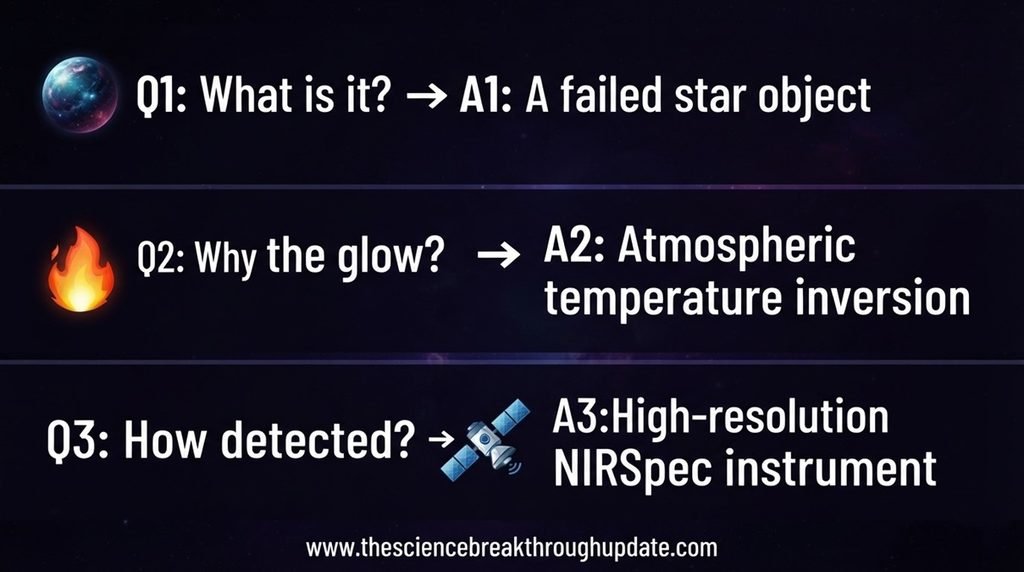
- What exactly is a brown dwarf?
🪐 A brown dwarf is an enigmatic cosmic object occupying the mass gap between planets and stars. They form from collapsing gas clouds but lack sufficient mass to trigger hydrogen nuclear fusion. They remain relatively cool throughout their lifespan compared to normal stars. - Why is finding glowing methane significant?
🔥 Methane typically absorbs light in cold stellar atmospheres rather than emitting it. Finding a distinct methane emission implies a temperature inversion in the upper atmosphere. The excitation mechanism could be driven by thermal accretion shocks or radiation pumping. - How did the space telescope detect this chemical signature?
📡 The telescope utilized its high-resolution NIRSpec instrument to collect infrared data. Scientists targeted the specific object LRL 11001 to resolve hidden emission lines at 3.324 microns. This effectively confirmed the survival of methane in the upper atmosphere.
Source Document Link: arXiv.org
Share this useful knowledge with your friends now!”
Disclaimer: This content is based on preliminary scientific research (Preprints) from arXiv.org and current global findings. It is shared strictly for educational and informational purposes and does not constitute professional, legal. Readers are encouraged to verify facts independently and consult relevant experts before making any decisions.