
🧠 Scientists have discovered a way to trace the hidden biological clock of the human brain, revealing exactly why some minds age much faster than others.
Neuroimaging models now calculate your brain age gap to show how fast your mind decays compared to your actual age. This computational metric acts as a vital biomarker for identifying early signs of severe cognitive decline and tracking overall mental health.
However, traditional medical models function as mysterious black boxes that completely fail to explain which specific neural changes trigger this rapid aging process. A new study finally solves this mystery by mapping the hidden structural coordinates inside the human brain.
🧠 Why Doctors Cannot Trust Standard Brain Scans
- Standard machine learning models easily calculate an abnormal brain age delta but completely hide the underlying structural patterns from trained medical professionals worldwide.
- Healthcare physicians cannot reliably trace these shifting health scores over time to specific cortical thickness changes during routine clinical checkups of aging patients.
- This complete lack of clear anatomical explanation severely limits clinical trust when predicting if mild cognitive impairment will eventually convert to devastating Alzheimer’s disease.
- Cross-sectional imaging data fails to capture the dynamic, long-term biological shifts that regularly occur across interconnected neural networks as human bodies grow older.
🛠️ Unlocking the Hidden Coordinates of the Human Mind
- Researchers Jason Scheffel and Saurabh Sihag from the University at Albany successfully developed a fresh mathematical framework using advanced covariance neural networks.
- This framework processes structural magnetic resonance imaging (MRI) scans by efficiently organizing complex cortical features into a shared, highly interpretable and robust latent coordinate system.
- The new algorithm utilizes a smart mathematical attribution mechanism called integrated gradients to split the total aging score among specific anatomical pathways.
- This reliable approach successfully maps out exactly how coordinated tissue patterns change over time instead of focusing heavily on localized, individual brain regions.
⚡ How Coordinated Neural Patterns Drive Rapid Aging
- Analyzing data from the Alzheimer’s Disease Neuroimaging Initiative clearly revealed structural variations between amyloid-positive and amyloid-negative subcohorts with mild cognitive impairment.
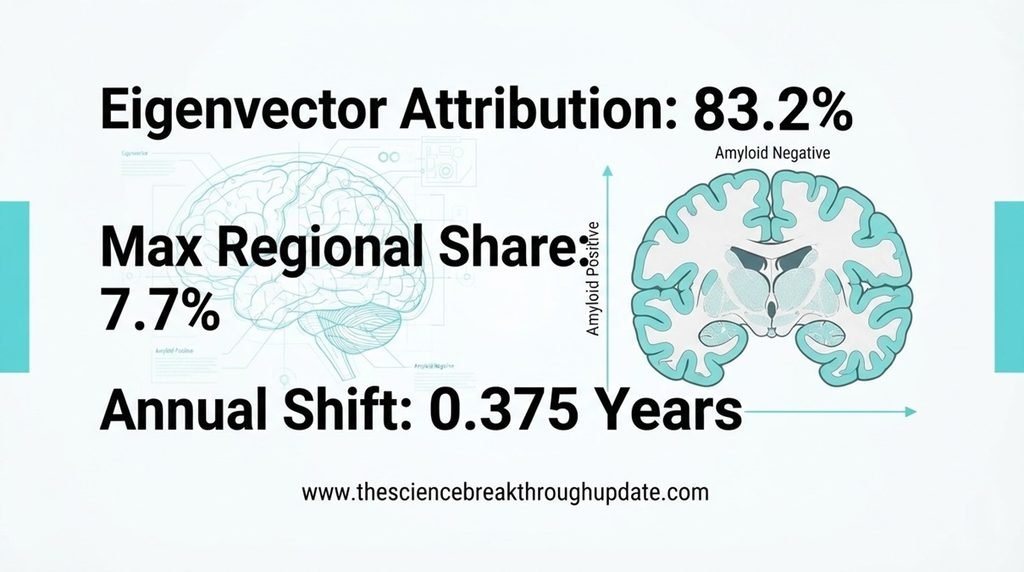
- The leading covariance eigenvector explains a staggering 83.2% of the adjusted longitudinal slope difference observed between these two distinct clinical subcohorts.
- Individual brain regions only account for a tiny maximum of 7.7% of the total measured and verified biological aging effect over time.
- These concrete findings prove that accelerated brain aging operates as a highly coordinated network phenomenon rather than localized, simple tissue decay.
My Take: Ditching black-box predictions for real network mapping changes everything. By proving dementia is a coordinated highway breakdown rather than localized potholes, doctors can finally spot mental decline before symptoms hit.
❓ Reader Doubts: Core Questions Answered
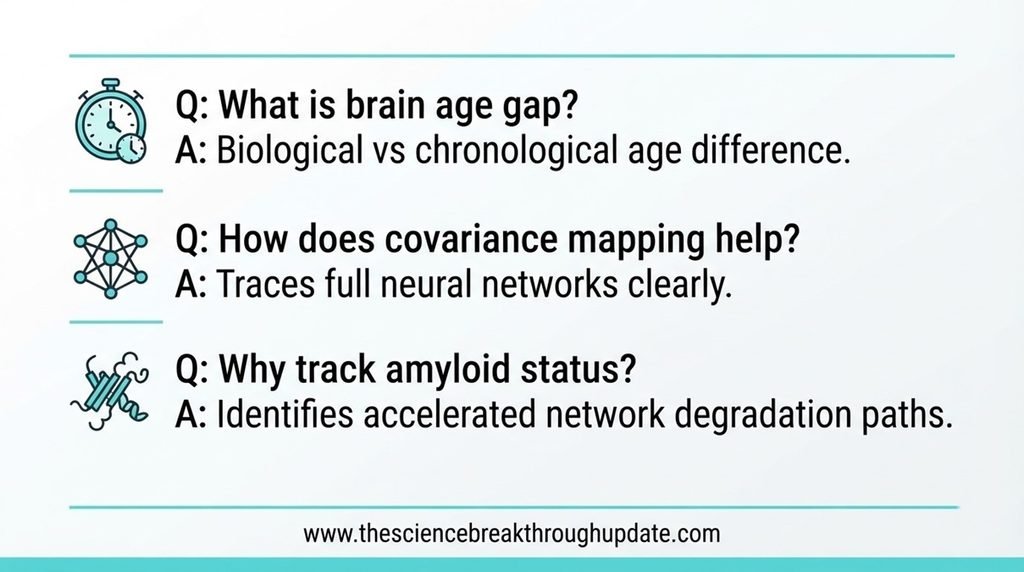
1. What exactly is the biological brain age gap parameter?
It measures the distinct discrepancy between your chronological age and the biological age of your actual brain tissue derived from structural scans. A higher gap directly indicates accelerated biological aging, which typically correlates with various neurodegenerative conditions or severe cognitive decline over time. Clinical doctors use these specific metrics to evaluate long-term patient health trajectories and treatment outcomes successfully and accurately.
2. How does this new covariance framework improve modern patient health diagnosis?
Traditional tools act as black boxes that only provide a final age score without ever explaining the underlying biological cause. This new approach successfully traces the aging score back to specific coordinated neural networks, helping physicians easily and quickly understand the exact structural changes occurring inside the mind. Consequently, modern medical teams can design highly targeted treatment plans much earlier for better survival rates.
3. Why are amyloid proteins highly important in tracking long-term brain aging?
The clear presence of toxic amyloid plaques signifies a remarkably high risk for eventually developing clinical Alzheimer’s disease. This neuroimaging study shows that amyloid-positive individuals experience an adjusted annual delta-age increase exactly 0.375 years per year greater than amyloid-negative individuals with mild cognitive impairment. Understanding this structural rate helps global researchers monitor dynamic disease progression across diverse human populations around the world.
Source Document Link: arXiv.org
Share this useful knowledge with your friends now!”
Disclaimer: The information on this website is for educational and informational purposes only and is not intended as medical advice. Always consult a qualified healthcare professional before making any medical decisions or changes to your treatment plan.