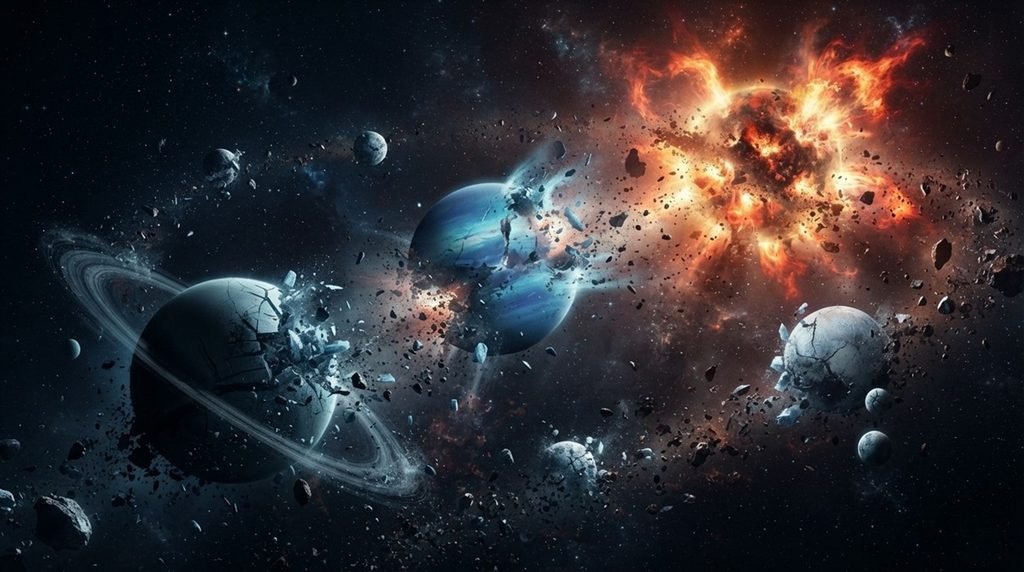
The stable future we once envisioned for our outer planetary neighbors might just be a comforting cosmic illusion.
🪐 For generations, astronomers assumed the outer Solar System was completely safe from violent disruptions for billions of years. However, fresh calculations demonstrate that the dying phase of our host star will trigger an unpredictable, abrupt orbital collapse much sooner than anticipated.
☀️ Standard models long presumed that as our Sun ages and sheds its massive envelope, the entire process remains completely smooth. Instead, new data reveals the dying Sun ejections happen in discrete, unevenly directed energetic bursts that destabilize everything around it.
The Structural Flaw in Eternal Cosmic Timelines
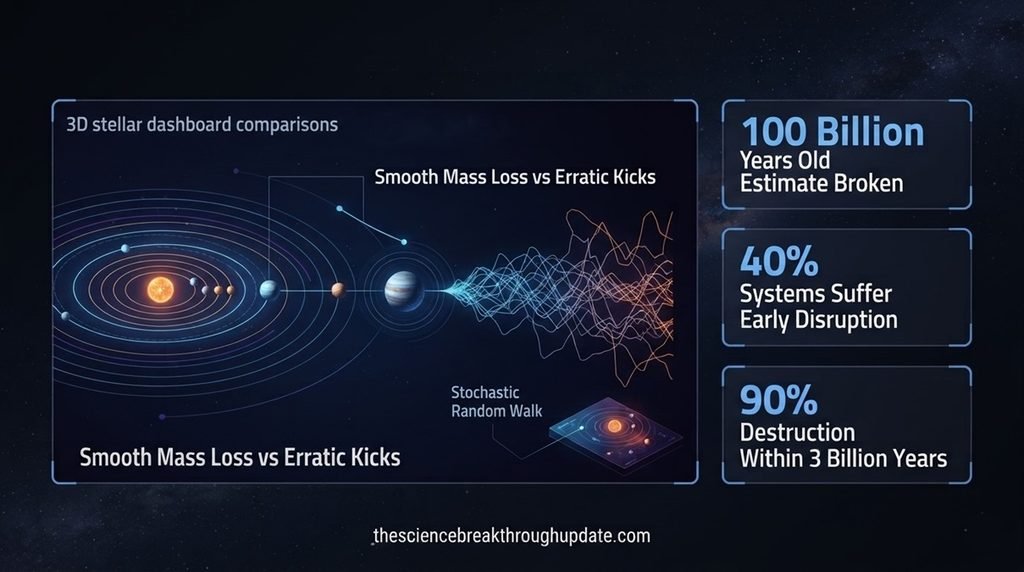
- 🔭 For many decades, mainstream planetary scientists firmly believed the giant outer planets would safely maintain their orbits for 100 billion years.
- 🌌 This classic calculation rested on the inaccurate assumption that solar mass loss during the final stellar phase is a uniform process.
- 💥 Recent white dwarf observations prove that dying stars experience strong asymmetric recoil kicks generated by abrupt localized mass ejections.
Simulating the Long-Term Path of Orbital Destruction
- 🧑🔬 Renowned astrophysicists Konstantin Batygin, Jim Fuller, and Fred C. Adams precisely modeled these random stellar impulses on planetary paths.
- 💻 Their rigorous numerical experiments show that independent solar jolts force the outer giant planets into a highly chaotic stochastic random walk.
- 🔄 This continuous irregular forcing systematically breaks the delicate gravitational resonance, causing the orbits of the giant planets to cross paths.
The Rapid Collapse of Our Outer Cosmic Boundaries
- 📰 This groundbreaking study accepted by Astrophysical Journal Letters proves that severe planetary scattering begins during the red giant branch phase.
- 📉 Their mathematical models reveal that roughly 40% of the systems experience massive structural disruption before the white dwarf phase fully forms.
- ☄️ Furthermore, nearly 90% of these planetary systems completely self-destruct within 3 billion years, crushing the previous survival estimates down significantly.
My Take: This discovery shatters our comforting illusions of cosmic permanence. It realistically reminds us that even the most stable architectures in the universe eventually succumb to chaotic, unpredictable ends.
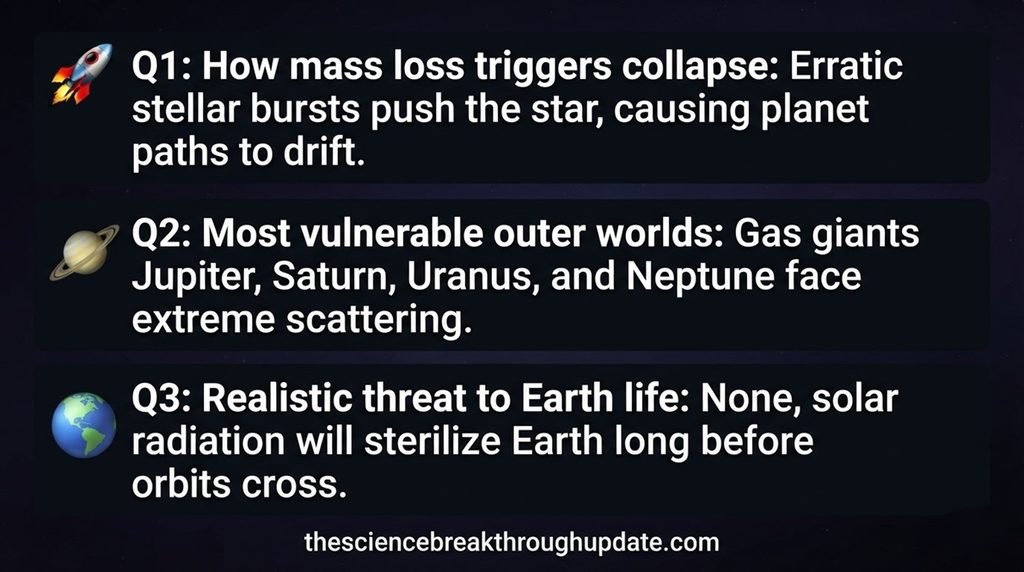
Reader Doubts: Core Questions Answered
- How exactly does erratic solar mass loss destabilize the orbits of large surrounding planetary bodies?
- 🚀 When a dying star like our Sun sheds its outer atmospheric envelope in highly uneven, discrete parcels rather than a smooth continuous stream, the stellar body experiences asymmetric localized recoil kicks. These erratic physical jolts act as an unpredictable stochastic forcing mechanism that continuously perturbs the gravitational stability of surrounding worlds over time. Eventually, this mechanical randomness causes the orbital pathways of massive outer planets to drift unpredictably from their original positions and collide with each other.
- Which specific planets face the absolute highest risk of violent gravitational scattering during this cosmic phase?
- 🪐 The massive outer gas giants within our stellar neighborhood, specifically Jupiter, Saturn, Uranus, and Neptune, remain the most vulnerable to these sudden dynamical shifts. As the central solar mass decreases, the overall gravitational binding energy of the entire system weakens, causing planetary paths to expand dramatically outward into unstable zones. This sudden expansion forces closely packed giant worlds into highly chaotic trajectories where their intense mutual gravitational forces trigger extreme scattering events and permanent ejections.
- Will these newly discovered chaotic planetary orbital crossings cause any direct catastrophic danger to potential life on Earth?
- 🌍 No, this severe orbital restructuring takes place far in the future, long after our host Sun has already evolved into a swollen red giant star. By the time these chaotic planetary disruptions begin to rearrange the outer worlds, intense solar radiation and extreme thermal energy will have already completely sterilized Earth’s surface. Consequently, all planetary oceans will have completely evaporated into deep space, ensuring that no biological life remains to experience this final orbital breakdown.
News source link: arXiv Astrophysics
Share this useful knowledge with your friends now!
Disclaimer: This content is for educational and informational purposes only.