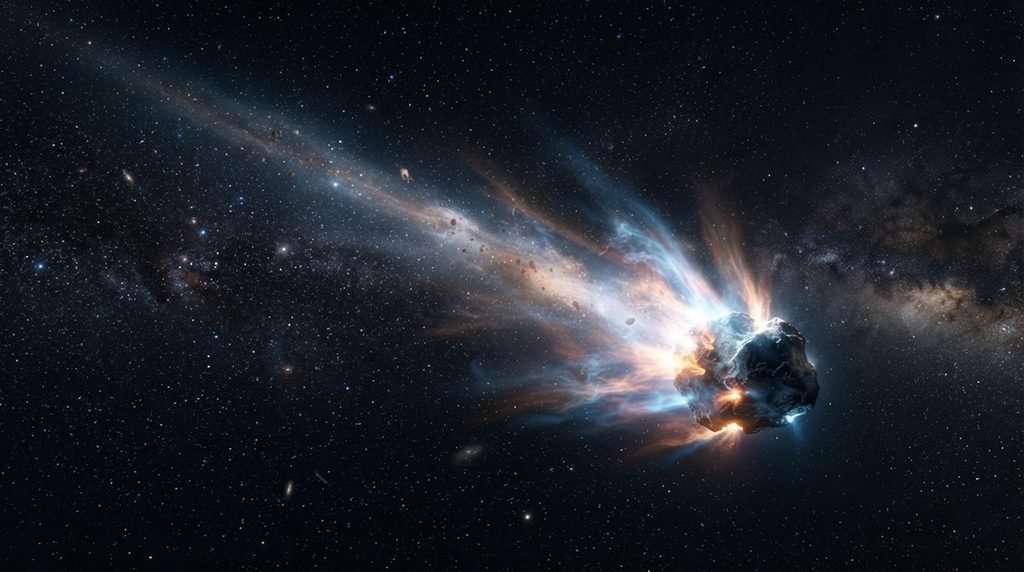
An alien visitor from another star system is currently hurtling through our cosmic backyard while spewing an unexpected, intoxicating chemical mixture into deep space.
☄️ Astronomers tracking the interstellar comet 3I/ATLAS just discovered an extraordinary chemical anomaly. This celestial wanderer is the third confirmed object to enter our solar system from the vast, freezing void of interstellar space.
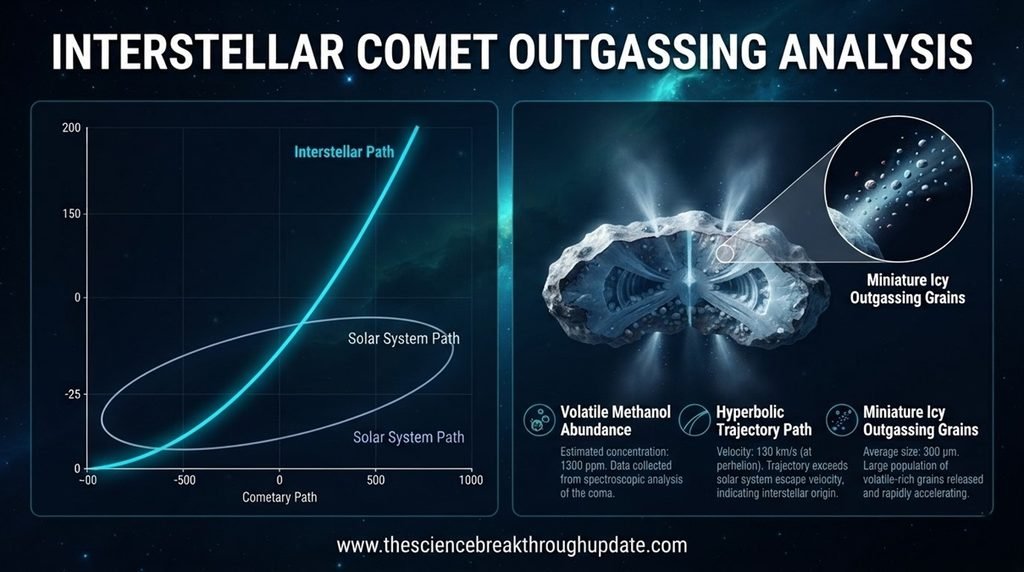
🔬 Recent deep-space observations reveal that this cosmic traveler is currently releasing an exceptionally high concentration of volatile methanol. This unique chemical signature provides scientists with a rare, pristine glimpse into the raw ingredients of a distant planetary system.
The Mystery of the Freezing Cosmic Wanderer
- 🌌 Astronomers face immense difficulties when attempting to study the exact chemical composition of objects that form outside our solar system.
- 🌑 Most interstellar travelers remain completely dark and frozen, making it nearly impossible to analyze their chemical fingerprints from Earth.
- 🔭 Traditional telescopes usually fail to capture the faint gas signatures of these fast-moving alien guests before they exit our neighborhood.
Decoding the Interstellar Comet’s Secret Chemistry
- 📡 An international team of scientists used the advanced ALMA telescope network to map the precise chemical emissions of Comet 3I/ATLAS.
- 🧪 The high-resolution data successfully detected massive plumes of gaseous methanol vaporizing under the heat of our distant Sun.
- 💻 Specialized computer models show that tiny, icy dust grains orbiting the nucleus act like miniature independent comets during this outgassing process.
How This Changes Our View of Alien Worlds
- 🪐 This discovery proves that methanol and volatile organic molecules are highly abundant in the freezing outskirts of other star systems.
- 🧬 The unique behavior of the icy grains helps astronomers understand how organic matter survives long journeys across interstellar voids.
- 🌌 Studying these pristine chemical signatures allows researchers to compare the building blocks of Earth with distant planetary nurseries.
Frequently Asked Questions
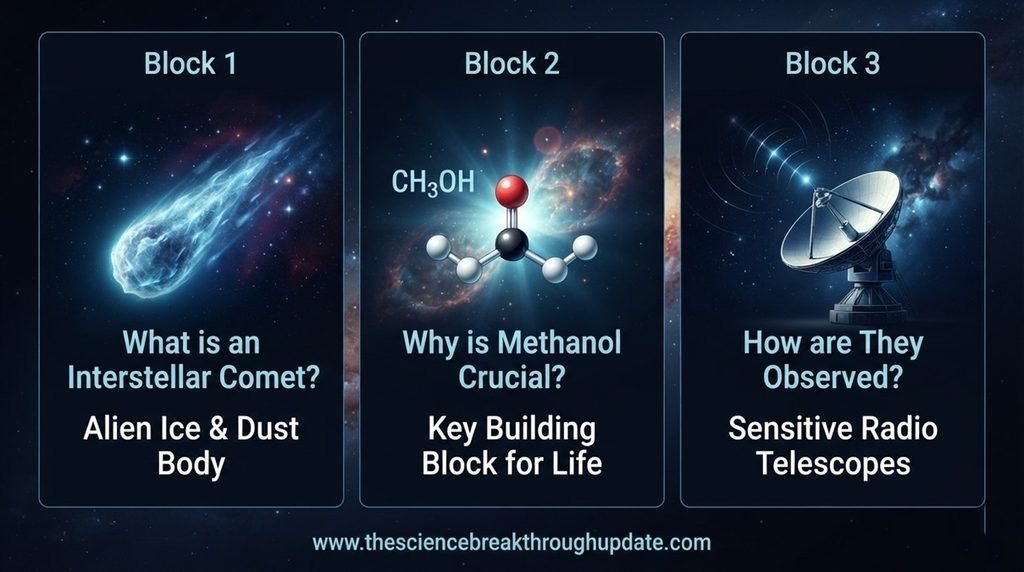
- What is an interstellar comet?
- ☄️ An interstellar comet is a cosmic body of ice and dust that formed around a distant star outside our solar system. Gravity eventually ejected it into deep space, allowing it to travel between different stellar systems over billions of years.
- Why is the presence of methanol so important?
- 🧪 Methanol is a complex organic molecule that serves as a crucial building block for life. Finding it in high quantities proves that the essential chemical ingredients for planetary systems are universal across the galaxy.
- How do scientists observe these distant objects?
- 📡 Astronomers use highly sensitive radio telescopes like the Atacama Large Millimeter/submillimeter Array to detect the unique faint energy signatures emitted by vaporizing gases. This cross-verification allows them to identify specific chemicals without physically visiting the comet.
My Take: This interstellar chemistry proves our universe shares a common genetic blueprint. Finding massive organic blocks in an alien visitor tells me life isn’t an earthly miracle, but a universal certainty.
News source link: universetoday.com
Share this useful knowledge with your friends now!
Disclaimer: This content is for educational and informational purposes only.