
⚠️ Your body might be harboring hidden viral hitchhikers right now, and scientists finally know how they secretly survive for decades.
Many pathogenic RNA viruses can successfully persist inside human host cells for several years, triggering long-term healthcare complications such as Long COVID. This chronic survival allows dangerous entities to evade host immunity, making it difficult for standard medical treatments to clear them.
To solve this mystery, researcher Oriol Llopis-Almela designed a predictive framework using a specialized mathematical model of viral persistence. This system incorporates specific metrics like replicative fitness to map out whether an infection stabilizes or faces complete viral clearance.
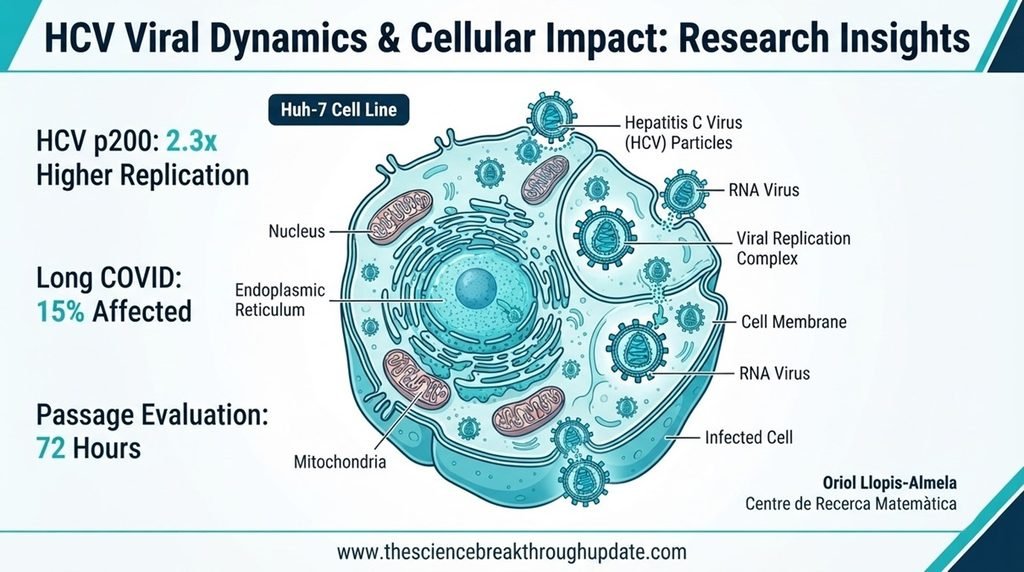
🦠 Why Stubborn RNA Mutants Evade Host Immunity
- Rapidly evolving RNA viruses rely heavily on exceptionally high mutation rates during replication to establish long-term within-cell persistence inside the human host.
- These pathogens form a diverse mutant cloud or quasispecies that effectively protects the population from being cleared by host neutralising antibodies.
- Chronic infections like hepatitis C virus can continuously alter their genetic traits to reduce cell killing and avoid triggering immune modulation.
- The remaining extracellular viral load frequently drops far below standard experimental detection limits, leaving host cell viability completely intact during persistent phases.
📊 Quantifying Cellular Interactions Through Partitioned Fitness Models
- Lead scientist Oriol Llopis-Almela from the Centre de Recerca Matemàtica split the classic fitness trait into three distinct biological components.
- This model separates viral capabilities into replicative fitness, infective fitness, and dispersal fitness to analyze cellular dynamics with much higher precision.
- The team used experimental data from Huh-7 cell lines derived from a human hepatocellular carcinoma to track long-term virus-host cell interactions.
- The equations follow multi-passage dynamics evaluated at 72-hour intervals to trace transient trajectories and calculate the precise duration a virus persists.
- The resulting equations successfully identified a critical saddle-node bifurcation threshold that strictly separates sustained viral persistence from absolute viral extinction.
💡 How Mathematical Transitions Shape Future Chronic Disease Therapies
- The predictive model tracks how a high-fitness variant like the lytic variant HCV p200 behaves differently compared to non-lytic strains.
- The equations demonstrate that HCV p200 exhibits a 2.3-fold higher replicative fitness and an enhanced capacity for massive cell killing.
- Computational simulations show that as fitness parameters approach the bifurcation value, the system experiences a distinct slowing down of the dynamics.
- This general computational framework provides vital tools to study viral population dynamics and develop better clinical interventions for Long COVID.
My Take: By turning invisible viral evasion into a predictable math equation, this research finally gives doctors a concrete map to trap and starve chronic pathogens before they cause lifelong damage.
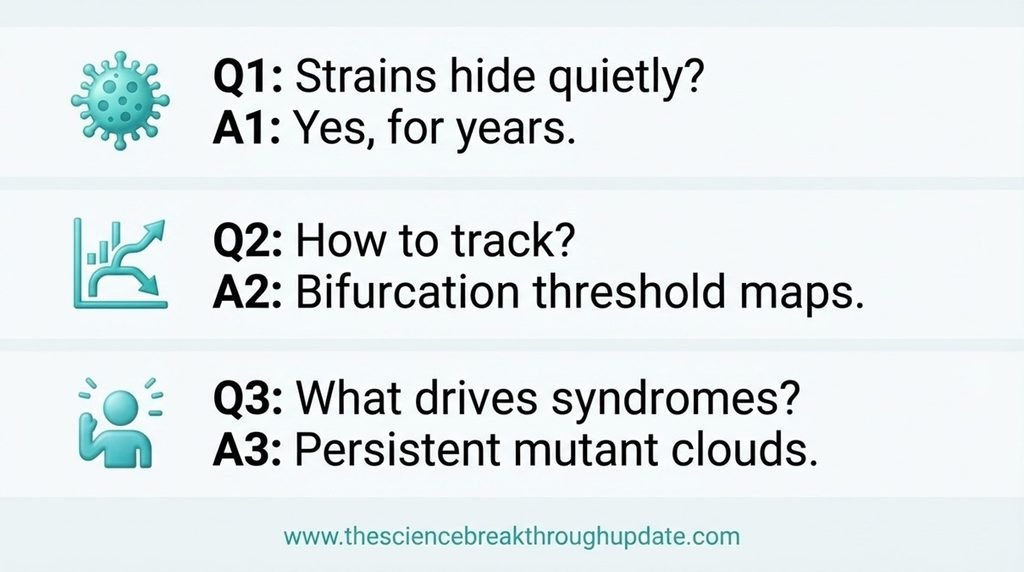
🙋♂️ Reader Doubts: Core Questions Answered
1. Can a virus stay in your body forever without making you feel sick?
Yes, chronic pathogens like the hepatitis C virus can stay inside your cells asymptomatically for years. These viral populations often reduce their replication rates or adopt a non-lytic budding mechanism to live in a quasi-symbiotic relationship with host cells. This low-level survival allows them to hide effectively without causing immediate, visible tissue damage, ensuring their long-term survival inside the host.
2. How do scientists track an infection that drops below standard detection limits?
Scientists use this newly developed mathematical model to track the interactions between uninfected cells, infected cells, and infectious virions. The framework monitors specific parameter boundaries, such as the saddle-node bifurcation value, to determine if a virus is truly cleared. Even when a viral load is completely undetectable, these equations can accurately calculate whether the pathogen is heading toward extinction by tracking the slowing down of system dynamics.
3. Why do some people experience long-term symptoms after an acute viral illness?
Long-term symptoms can occur because the virus continues to persist in modified forms within specific organ-specific viral reservoirs. This ongoing within-host persistence is exemplified by Long COVID Syndrome, which affects around 15% of patients after an acute episode. These lingering viral genomes continuously interact with host cellular effectors, causing a variety of prolonged atypical pathological manifestations.
Source Document Link: arXiv.org
Share this useful knowledge with your friends now!”
Disclaimer: This content is shared strictly for educational and informational purposes and does not constitute professional medical advice. Always consult a qualified healthcare professional or doctor before making any health decisions.