
💡 Your brain constructs a localized visual illusion by starving your peripheral surroundings of critical processing feedback.
Our eyes perceive a seamless world, creating the comforting illusion that we see our entire environment in uniform, high-definition detail. However, new neurological evidence shows that the visual system operates on a highly unbalanced resource budget that alters baseline sensory perception. The mind heavily prioritizes what lies directly in front of us while abandoning outer zones.
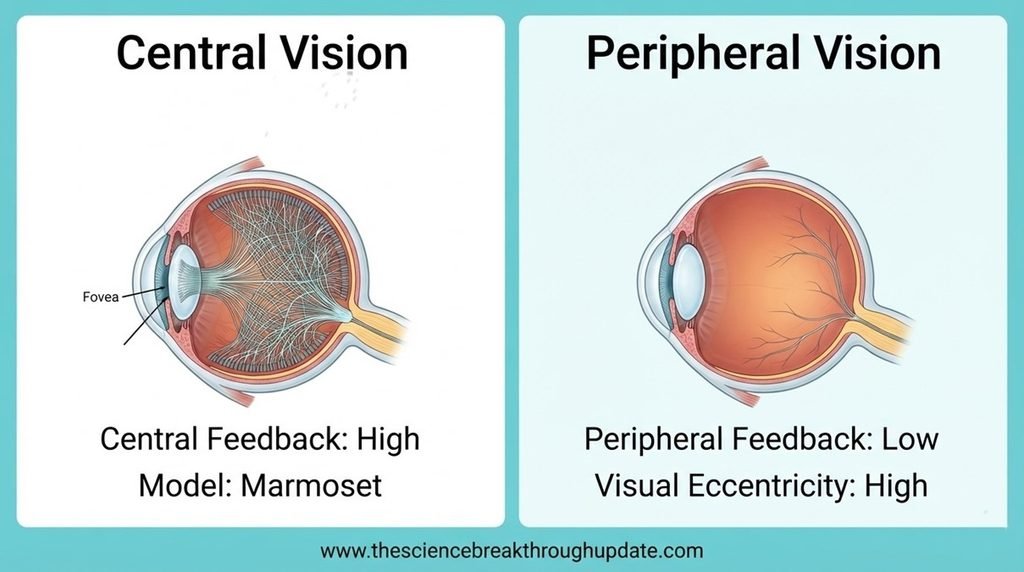
Neuroscientists studying the primary visual cortex have discovered a massive disparity in how backward neural feedback verifies incoming structural imagery. Surprisingly, this crucial loop concentrates its computational energy almost exclusively on the center, leaving the wider peripheral field largely isolated.
⚠️ The Structural Deficit in Outer Field Processing
- Visual systems face intense bandwidth limitations that prevent the simultaneous processing of high-resolution details across an entire field of view.
- The outer boundaries of sight receive surprisingly little architectural reinforcement from the higher executive centers of the brain.
- A severe lack of backward computational signals leaves peripheral vision highly vulnerable to optical illusions and spatial errors.
- Cortical networks actively downsample peripheral information to prevent the central processing units from experiencing catastrophic data overload.
🔬 How the Visual Cortex Segregates Core Feedback
- A research team including Piotr Majka and Li Zhaoping mapped the exact distribution of feedback connections within the primary visual cortex.
- Scientists utilized retrograde tracer injections in marmoset subjects to track the precise pathways of returning neural signals.
- The data revealed that the ratio of feedback neurons to feedforward neurons decreases dramatically as visual eccentricity increases.
- This anatomical architecture proves that backward connections focus their energy strictly on the central visual field representation.
🌎 The Real Impact of the Central Peripheral Dichotomy
- Sensory processing relies on the Central-Peripheral Dichotomy theory, where the center analyzes details and the periphery detects rapid motion.
- Neural networks conserve immense amounts of metabolic energy by ignoring the fine details of your wider surroundings.
- The brain seamlessly fills the blurry outer edges of sight using memory and sensory expectations rather than live data.
- Discovering this strict structural bias helps engineers design better foveated rendering systems for advanced virtual reality displays.
My Take: This completely upends how we look at human perception. We aren’t passive cameras; we are constant simulators. It proves our tech must adapt to our biological shortcuts to feel truly real.
❓ Reader Doubts: Core Questions Answered
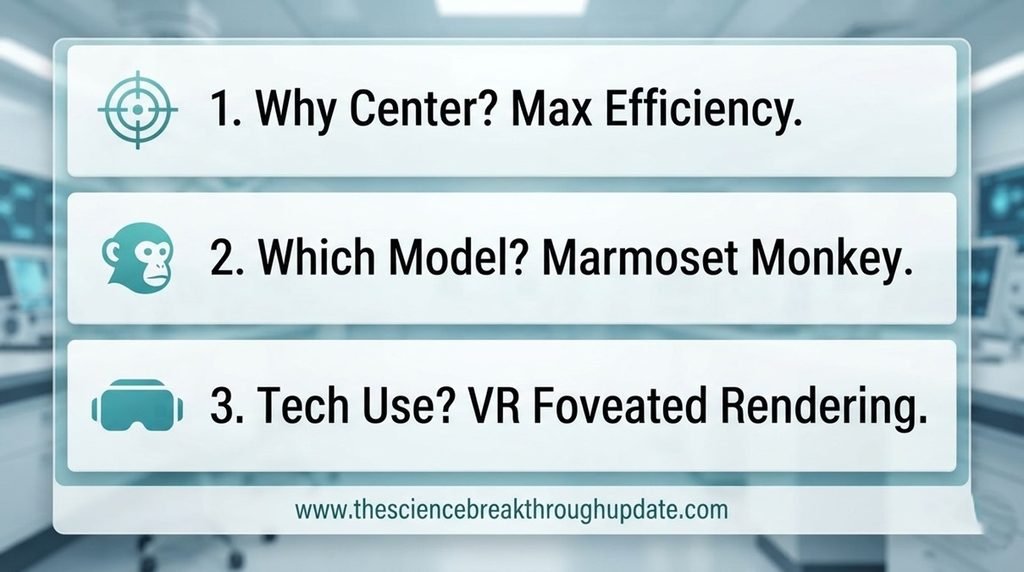
1. Why does the cortex focus feedback only on the central visual field?
The cortex concentrates its feedback on the central field to maximize processing efficiency. Prioritizing the center allows the visual system to analyze fine details rapidly without overloading the brain with heavy peripheral data.
2. What animal was studied to discover this visual feedback loop?
Researchers studied marmoset monkeys using precise retrograde tracer injections. This method allowed neuroscientists to map the exact pathways and ratios of feedback neurons in the primary visual cortex.
3. How does the Central-Peripheral Dichotomy theory affect modern technology?
The Central-Peripheral Dichotomy theory helps engineers develop efficient virtual reality headsets. Devices can save immense processing power by rendering high-resolution graphics only where the user directly looks, mimicking natural biology.
Source Document Link: arXiv.org
Share this useful knowledge with your friends now!”
Disclaimer: The information on this website is for educational and informational purposes only and is not intended as medical advice. Always consult a qualified healthcare professional before making any medical decisions or changes to your treatment plan.