
🪐 Astronomers just discovered a strange planetary world wrapped in a thick layer of scalding steam, completely challenging standard models.
Space telescopes just identified a highly unusual low-density super-Earth orbiting a nearby star. Named TOI-2211 b, this unique alien world orbits its host star in just 3.09 days, creating major interest among global planet hunting teams tracking new celestial systems.
Harsh cosmic radiation typically strips light atmospheric layers away very quickly. Instead of finding bare rock, researchers detected a heavy volatile envelope, proving this specific hot water world candidate retained its deep water components over long periods without losing its air.
💥 Why Close-In Planets Suffer Complete Atmospheric Destruction
- Extreme high-energy radiation from host stars constantly blasts close-in planets, stripping away their low-mass primordial hydrogen envelopes within a brief evolutionary window.
- Standard core accretion frameworks suggest that small planetary worlds orbiting in tight circles should eventually become bare rocky planetary cores completely dry.
- Astrophysicists often face serious physical challenges explaining why certain objects preserve a low bulk density despite enduring constant stellar irradiation.
- Most computer simulation models indicate that standard lightweight gas layers cannot physically survive under such harsh cosmic conditions for long climate periods.
🔭 The Multi-Telescope Dragnet That Exposed The Steam Layer
- Lead space scientist J. A. Egger combined precise XUV transit tracking data from CHEOPS and TESS space hardware to map out the planet shape.
- International research teams deployed ultra-stable spectrographs like ESPRESSO, KPF, and HARPS to track gravitational wobbles and measure the actual planetary mass.
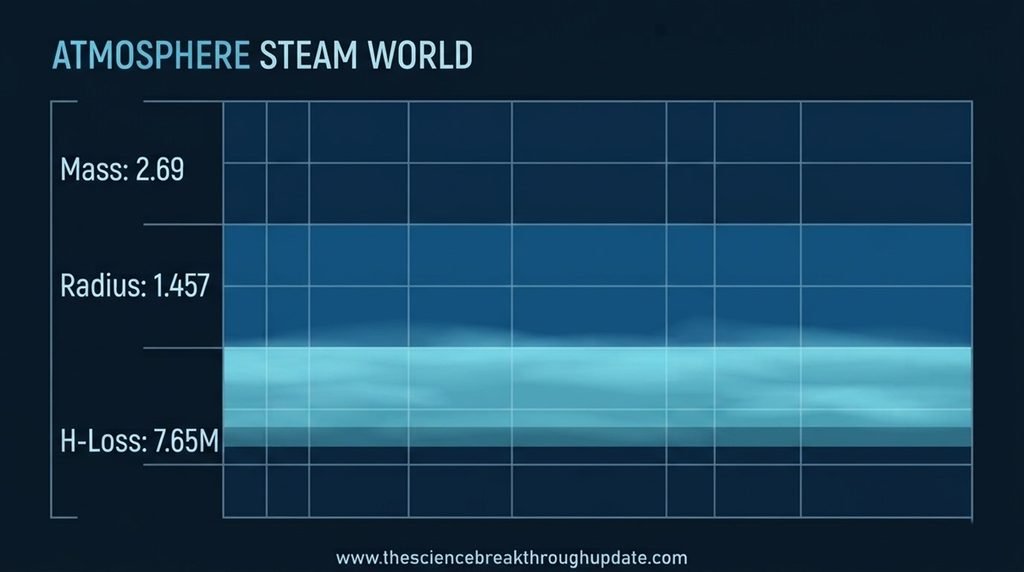
- The collected data showed TOI-2211 b holds 2.69 Earth masses inside a 1.457 Earth radii body, confirming its distinct low bulk density state.
- Specialized hydrodynamic code proved all light hydrogen evaporated within 7.65 million years, verifying the presence of a water-rich steam atmosphere instead.
🌌 How This Discovery Reshapes Our Architectural View Of Space
- The statistical study provides firm empirical backing showing hot water worlds represent a common planetary class rather than just rare cosmic anomalies.
- These new findings validate the predictive power of the Bern model of planet formation, aiding researchers tracking planetary system layouts everywhere.
- Precision radial velocity measurements confirmed a hidden, non-transiting neighbor called TOI-2211.02 which helps hold the entire planetary system in place.
- Future spectroscopic testing using advanced space instruments will analyze these heavy molecular weight envelopes to catalog their exact chemical gas mixtures.
My Take: Finding a planet retaining boiling steam under such extreme stellar heat proves our space textbooks are outdated. It forces us to rethink how worlds realistically survive hostile stellar environments.
❓ Reader Doubts: Core Questions Answered
- What makes TOI-2211 b unique compared to Earth?
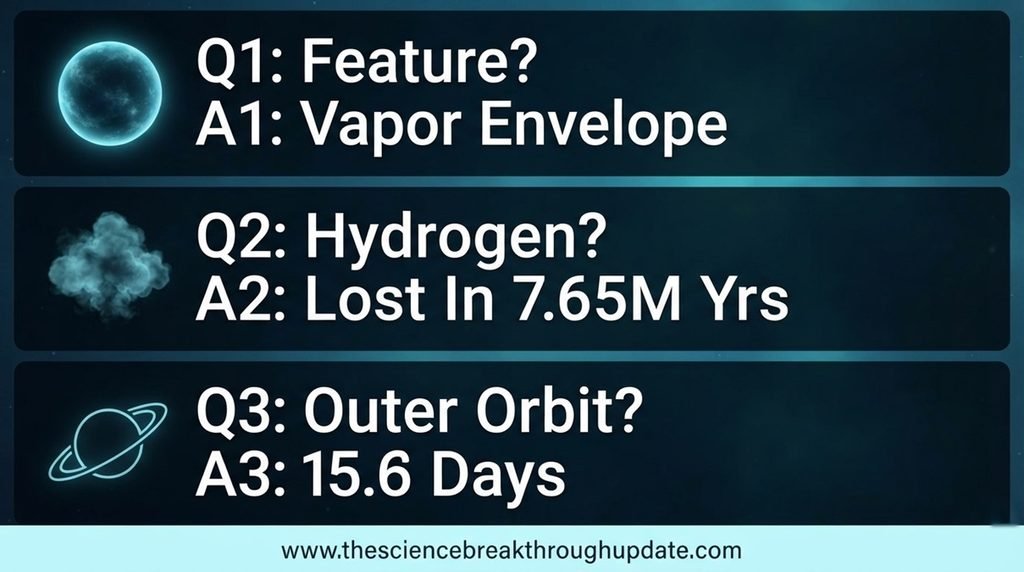
Earth features comfortable liquid oceans and a nitrogen sky, but the newly discovered TOI-2211 b showcases a thick volatile envelope. Its extreme equilibrium temperature easily reaches 1107 Kelvin, rapidly turning all surface liquids into a permanent blanket of scalding water vapor. This hyper-heated planetary environment makes any form of organic life completely impossible without relying on highly advanced planetary survival equipment. - How did astronomers rule out a lightweight hydrogen sky?
Powerful stellar winds strip light elements away from close orbits very quickly during the early stages of a star’s lifetime. Detailed evolution simulations confirm that a primordial hydrogen envelope would entirely dissipate within 7.65 million years under XUV irradiation. Consequently, only a heavy molecular weight atmosphere consisting of dense steam can survive over long cosmic eras without escaping out into space. - Are there other planetary bodies orbiting this specific star?
High-precision radial velocity tracking successfully detected an outer companion candidate planet which researchers officially designated as TOI-2211.02 inside their official database records. This non-transiting world weighs approximately 8.52 Earth masses and completes a full orbital revolution around the star every 15.6 days. Dynamical stability testing proves that both planets can coexist peacefully without disrupting their respective gravitational orbits over billions of years of cosmic history and stellar evolution.
Source Document Link: arXiv.org
Share this useful knowledge with your friends now!”
Disclaimer: This content is based on preliminary scientific research (Preprints) from arXiv.org and current global findings. It is shared strictly for educational and informational purposes and does not constitute professional, legal. Readers are encouraged to verify facts independently and consult relevant experts before making any decisions.