

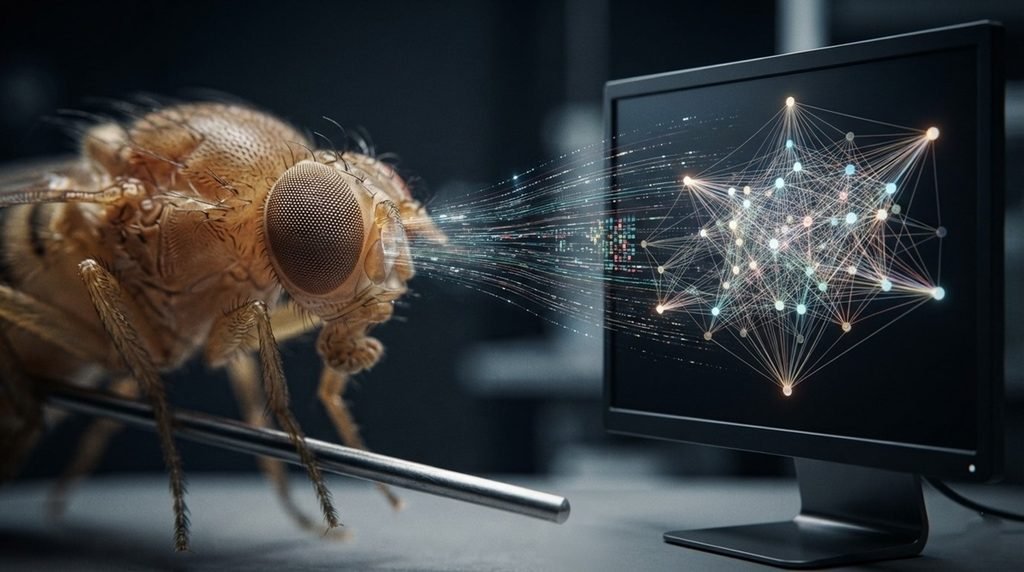
👁️ Scientists are cloning a tiny insect’s eye and brain mechanics to build ultra-efficient computer vision.
Tech experts struggle to build agile autonomous systems because modern computer vision requires massive processing power and bulky hardware. Heavy digital cameras and power-hungry neural networks constantly drain battery systems, making real-time navigation difficult for compact mobile devices.
Neurobiologists and engineers are now copying nature by mapping the precise neural architecture of the common fruit fly. By analyzing the insect’s compact visual brain pathways, researchers are designing highly efficient software models that process complex visual data instantly.
⚠️ The Massive Power Drain Inhibiting Next-Generation Artificial Intelligence
- Modern autonomous drones and self-driving vehicles rely on massive digital processors that consume too much electrical energy to navigate dynamic environments.
- Heavy computational models struggle to process fast visual inputs in real time, causing dangerous latency spikes during high-speed robotic maneuvers.
- Traditional artificial neural networks lack structural flexibility, forcing computers to waste processing cycles on irrelevant background data instead of moving objects.
- Standard cameras require thousands of bulky pixels, making it highly difficult to build lightweight, agile nanotech devices for tight spaces.
🧠 Replicating the Drosophila Visual Connectome for Digital Neural Networks
- Researchers Zongyu Li, Akito Yamauchi, Huaizhi Liu, Vishwanatha Rao, and Jia Guo translated biological wiring rules into an artificial model.
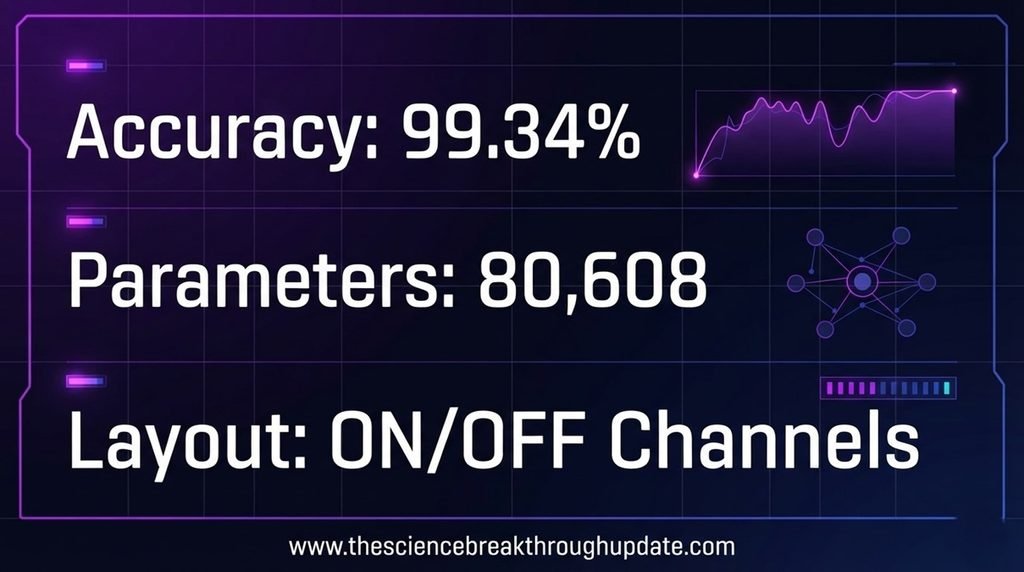
- The team developed a specialized trainable architecture framework named FlyVision to preserve natural parallel ON/OFF visual pathways.
- This network family successfully scaled capacity configurations to achieve a top-1 accuracy score of 99.34% on the MNIST validation benchmark.
- By routing digital data through specific population-level graph mixers, the model operates efficiently using just 80,608 trainable parameters.
🚀 The Global Shift Toward Low-Energy Bio-Inspired Robotic Automation
- Future industrial drones will fly through complex, unpredictable disaster zones with immense agility using fly-inspired micro-processors.
- Smart devices and wearable tech will run advanced spatial AI features locally without needing constant cloud connections or draining battery lifespans.
- Self-driving vehicles will achieve near-instantaneous hazard detection speeds, significantly reducing collision rates through ultra-fast neuromorphic tracking.
- This biological framework paves the way for sustainable green computing by slashing the massive carbon footprint of global AI data centers.
My Take: Ditching bloated chips for insect-sized brain logic is brilliant. If we can run spatial AI on absolute pocket change power, the sustainability crisis facing global tech completely changes.
❓ Reader Doubts: Core Questions Answered
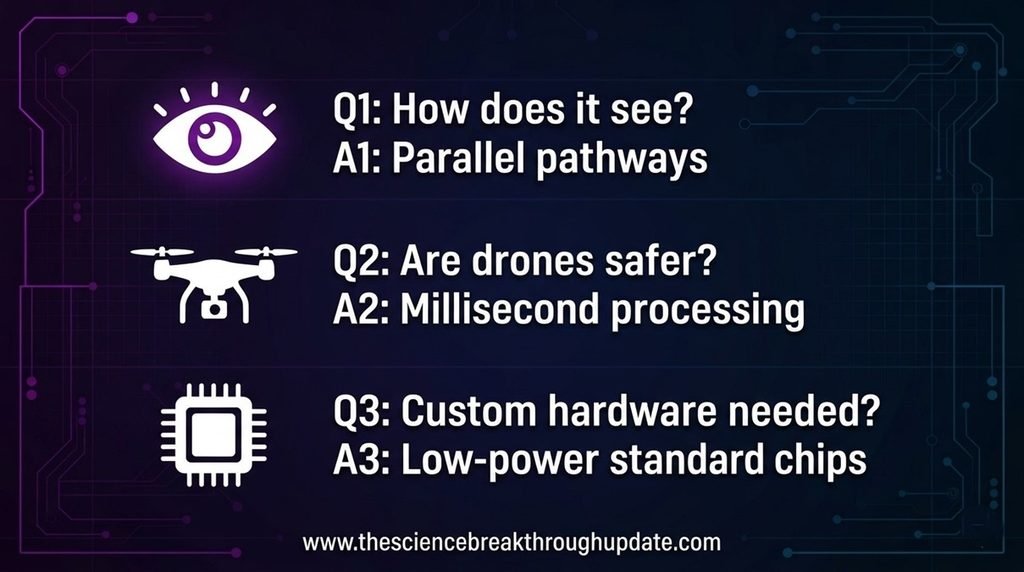
1. How does a fruit fly see better than a digital camera?
A fruit fly possesses a visual system that handles structured motion vectors via parallel ON/OFF pathways. Its brain processes this environmental data using recurrent graph-interaction stages, bypassing the slow frame-by-frame rendering methods utilized by standard digital image sensors.
2. Will this technology make autonomous drones safer?
Yes, this biological architecture reduces data processing latency to absolute milliseconds. Drones equipped with this software can detect sudden obstacles and adjust their flight paths instantly, preventing crashes in dense urban areas.
3. Does this system require expensive specialized hardware to run?
No, this software framework optimizes existing processing pipelines to run efficiently on low-power chips. It mimics natural neural pathways, allowing standard computational hardware to execute complex spatial awareness tasks with minimal energy consumption.
Source Document Link: arXiv.org
Share this useful knowledge with your friends now!”
Disclaimer: This content is based on preliminary scientific research (Preprints) from arXiv.org and current global findings. It is shared strictly for educational and informational purposes and does not constitute professional, legal. Readers are encouraged to verify facts independently and consult relevant experts before making any decisions.



