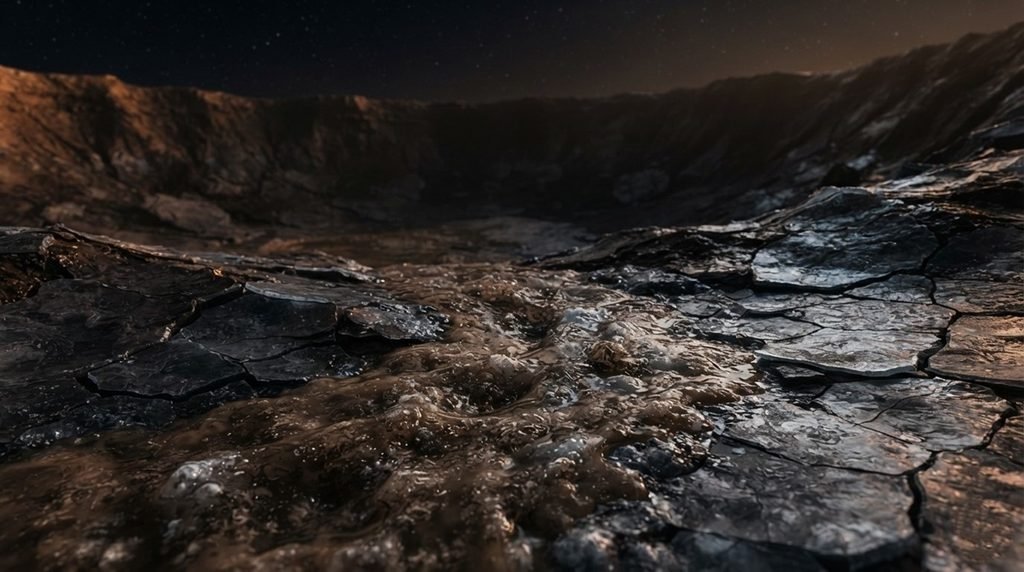
🌋 Scientists just discovered that freezing ice volcanoes on Saturn’s moon Titan might be mixing liquid water with organic material to create the building blocks of alien life.
Saturn’s mysterious moon Titan hides a complex, frozen surface covered entirely in rich organic matter. Space scientists have long wondered if liquid water from the warm interior ever breaks through this thick icy crust to interact with surface chemicals and trigger prebiotic chemistry.
A new study published in the noted journal Icarus reveals how planetary cryovolcanism and cosmic impacts serve as high-energy transport mechanisms. This research suggests that temporary liquid water flows can survive long enough on the frozen surface to alter primitive organic materials.
🪐 The Freezing Barriers Inhibiting Planetary Chemical Evolution
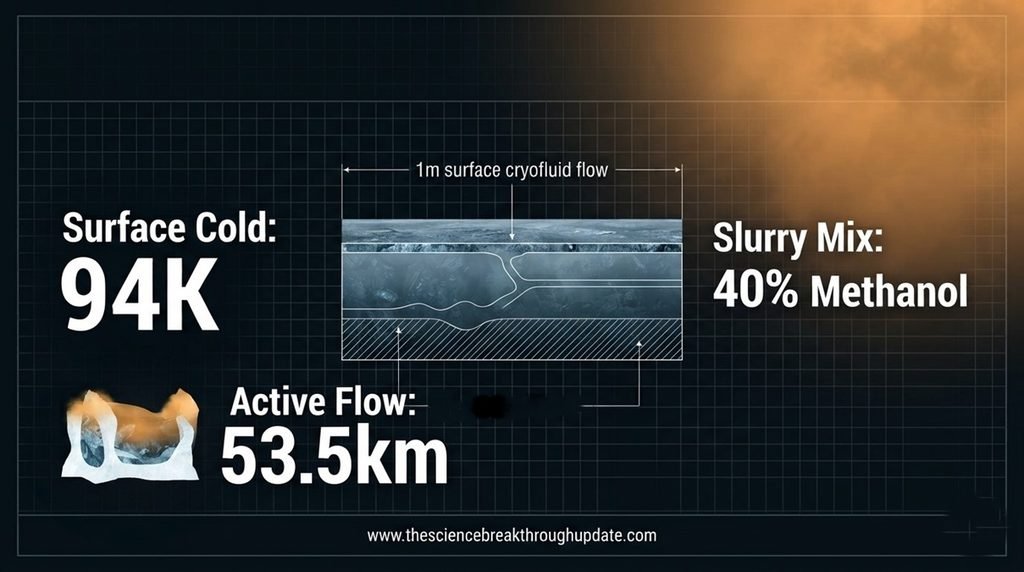
- Titan maintains an incredibly low surface temperature of 94 Kelvin that immediately freezes open liquid water bodies.
- A massive, rigid outer ice crust estimated between 80 to 100 kilometres thick blocks simple interior fluid transport.
- Complex atmospheric organic photochemistry products deposit thick sedimentary layers that remain completely isolated from internal liquid water pools.
- Scientists previously lacked verified thermodynamic data showing if shallow cryofluid flows could resist rapid planetary cooling mechanisms.
💻 Simulating Viscoplastic Slurries With High-Parallelism Computing
- Lead researcher Daniel Cordier and his co-authors developed an open-source simulation program named CALava using modern Fortran.
- The advanced program successfully uses cellular automata algorithms to solve momentum and vertical heat redistribution across grid cells.
- The model specifically simulates a viscoplastic Bingham fluid mixture consisting of 40% methanol and liquid water.
- Simulations tracked fluid movement across low-slope topography mimicking the famous Mohini Fluctus region found within Sotra Patera.
🧪 Sustaining Thermal Oases for Outer Solar System Life
- Erupted planetary fluids maintain active internal movement and stay warm for several weeks before reaching total environmental equilibrium.
- Extended liquid states allow vital hydrolysis reactions to occur when warm water encounters ubiquitous organic surface sediments.
- The model aligns with laboratory benchmarks from Farnsworth et al. demonstrating that amino acid production remains completely detectable.
- These verified dynamic profiles provide a predictive framework for instruments on NASA’s upcoming Dragonfly rotorcraft exploration mission.
My Take: Finding that water stays liquid on Titan reframes our search for life. It proves we do not need warm, Earth-like planets to find active, primitive biology brewing in deep space.
🔍 Reader Doubts: Core Questions Answered
- What chemical composition makes up Titan’s simulated cryolava?
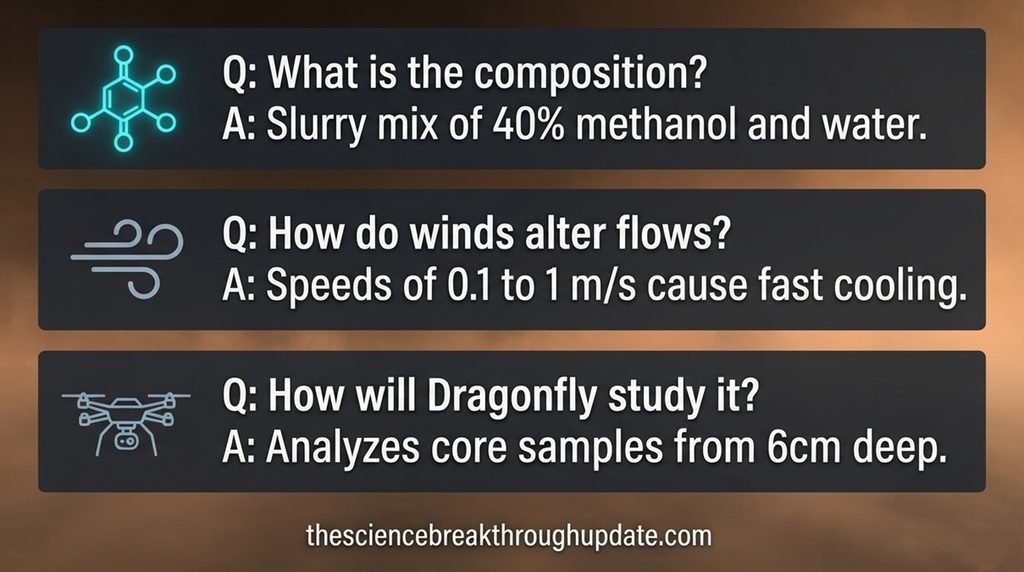
The simulation explicitly tracks a binary fluid slurry containing a mixture of 40% methanol and liquid water. This composition acts as a reliable proxy for sub-surface liquid reservoirs melted by local tectonic activities approximately 1 to 10 kilometres beneath the outer crust. The presence of methanol acts as an anti-freezing agent to alter the rheological properties and the freezing rates of the active planetary flow. - How do surface winds alter the behavior of these flows?
Atmospheric wind speeds between 0.1 and 1 metre per second generate highly efficient forced convective cooling across the upper layer of the active fluid. This rapid heat loss drastically drops the internal temperature, which spikes the plastic viscosity and creates thicker, shorter deposits compared to purely radiative cooling scenarios. The dynamic simulation shows that a strong wind limits the longitudinal runout to just 53.5 kilometres. - Which specific instruments will investigate these alien features?
NASA’s future Dragonfly mission will deploy a relocatable rotorcraft lander carrying the specialized DragonCam microscopic camera suite to capture surface textures at 60 micrometres per pixel. The vehicle also utilizes a surface drill alongside the Dragonfly Mass Spectrometer to extract and vaporize icy material from depths reaching 6 centimetres. These systems will directly look for macromolecular organic masses up to 2000 Daltons to confirm prebiotic alterations.
Source Document Link: arXiv.org
Share this useful knowledge with your friends now!”
Disclaimer: This content is based on preliminary scientific research (Preprints) from arXiv.org and current global findings. It is shared strictly for educational and informational purposes and does not constitute professional, legal. Readers are encouraged to verify facts independently and consult relevant experts before making any decisions.