Your favorite longevity app might be completely wrong about how fast your body is breaking down.
⚠️ Aging clocks are taking over the wellness world, promising to calculate your true biological age through advanced algorithms. However, a massive new international study reveals a hidden flaw in these biological aging models that could mislead millions of health-conscious consumers.
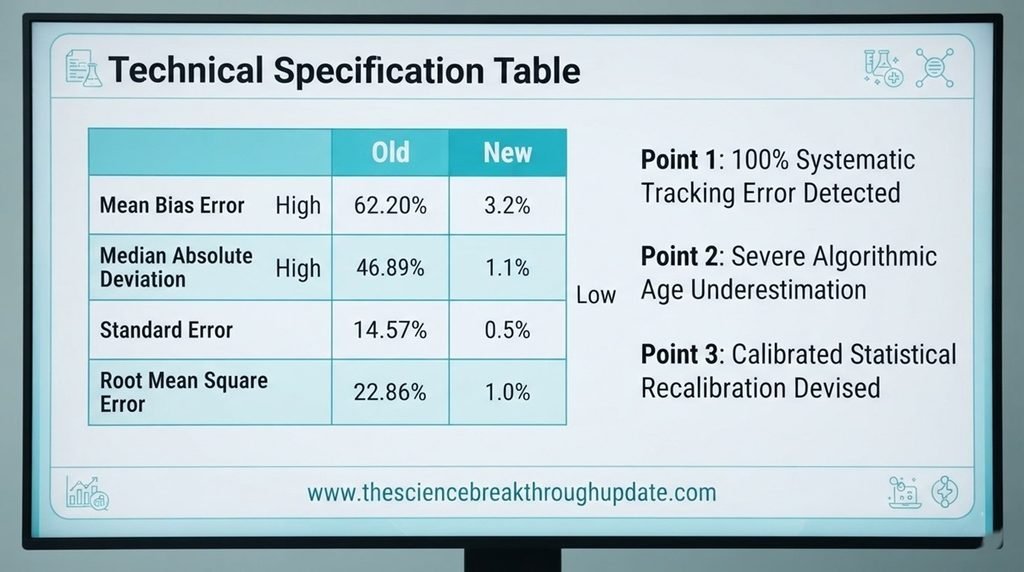
📉 The research shows that most current algorithms suffer from a severe prediction bias, artificially making older people look younger and younger people look older. This fundamental glitch distorts your real health data, meaning your expensive longevity routine might rely on flawed digital metrics.
Why Current Longevity Clocks Are Giving You Flawed Data
- 🛑 Current biological aging models suffer from a mathematical glitch called regression to the mean that warps your results.
- 📉 The algorithms systematically underestimate the biological age of older individuals, making them appear deceptively healthier than they are.
- 📈 Conversely, these same systems overestimate the age of younger people, causing unnecessary panic about premature cellular decline.
- 📊 Relying on these skewed baselines forces consumers and clinical trials to track inaccurate health progress over time.
How International Scientists Discovered the Statistical Glitch
- 🔬 Researcher Yiqun Lin alongside an international team analyzed massive datasets to uncover this systemic tracking error.
- 🧬 The team examined diverse biological markers, including epigenetics, blood biomarkers, and advanced eye images.
- 🌍 Their comprehensive analysis proved that the bias persists across different organs and modeling techniques globally.
- 🛠️ The scientists developed statistical corrections to recalibrate the algorithms and deliver true, unbiased age readings.
The Massive Shift in Personalized Medicine and Wellness Tracking
- 🏥 Fixing this computational bias allows longevity clinics to design highly accurate diagnostic tests for patients.
- 📱 Everyday consumers will finally receive reliable health data from their wearable devices and biohacking apps.
- 🧪 Clinical trials testing new anti-aging interventions can now measure genuine cellular rejuvenation without statistical noise.
- 🛡️ Eliminating these errors protects vulnerable people from buying ineffective supplements based on false baseline shifts.
My Take: This discovery strips away the marketing hype surrounding wellness apps, forcing the longevity industry to fix its math before selling people flawed data about their own bodies.
Reader Doubts: Core Questions Answered
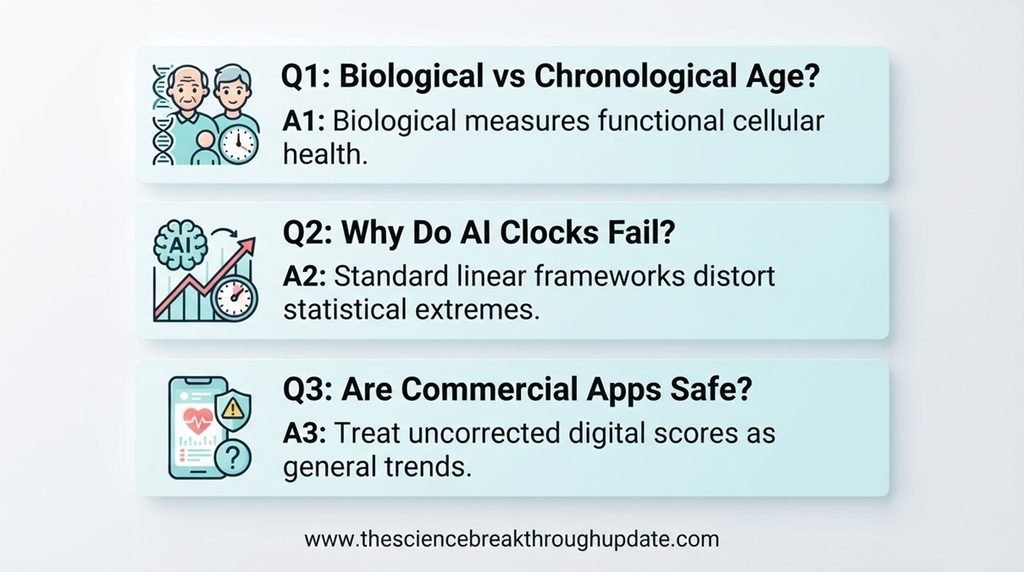
- How does biological age differ from chronological age?
- ⏳ Chronological age counts the exact years you have been alive. Biological age measures the actual functional state of your cells, organs, and physiological systems.
- Why do AI aging clocks make mistakes?
- 📉 Most models use standard linear frameworks that pull extreme data points toward the statistical average. This mathematical tendency creates an artificial flattening effect across different age groups.
- Can I still trust my longevity app metrics?
- ⚠️ Most current commercial apps still use the older, uncorrected formulas. You should treat their specific age scores as general trends rather than absolute scientific facts.
Source Document Link: arXiv.org
Share this useful knowledge with your friends now!”
Disclaimer: The information on this website is for educational and informational purposes only and is not intended as medical advice. Always consult a qualified healthcare professional before making any medical decisions or changes to your treatment plan.