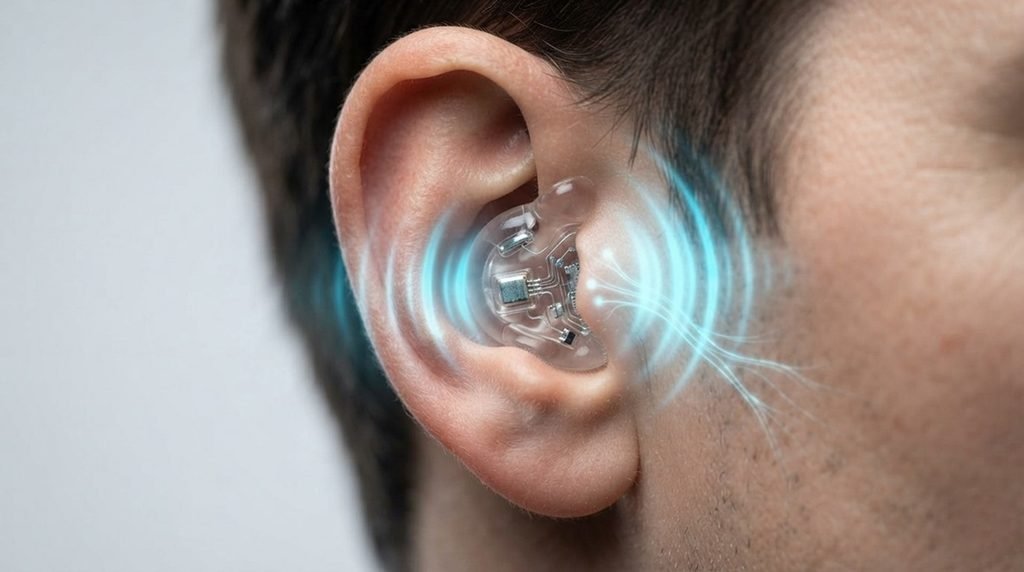
🧠 You can now target your nervous system and manage stress using a wireless, gel-free earpiece that safely directs sound waves into the ear.
Managing neurological conditions usually requires invasive surgeries or oral medications. However, researchers from ETH Zurich have developed a wireless ultrasonic earpiece that alters non-invasive neuromodulation by directing focused acoustic waves toward the auricular vagus nerve branches.
This wearable device utilizes custom dry acoustic coupling to comfortably interface with the body without relying on messy coupling gels. By engineering standards, the prototype represents a massive step toward practical auricular vagus nerve stimulation platforms built for long-term user wearability.
🛑 The Current Limitations of Non-Invasive Brain Stimulation
- Invasive vagus nerve stimulation options require surgical electrode implantation inside the body, which introduces clinical risks and heavily restricts widespread patient accessibility.
- Transcutaneous electrical stimulation setups often induce highly uncomfortable skin irritation and localized pain caused directly by the application of electric current.
- Previous portable acoustic hardware units remain impractical for continuous daily use due to rigid structural forms that cannot conform to human ear anatomy.
- Standard ultrasonic methods require the continuous application of liquid coupling gel to prevent immediate sound wave reflections caused by air gaps at the skin.
🧪 How Humimic Gels Remove the Need for Coupling Media
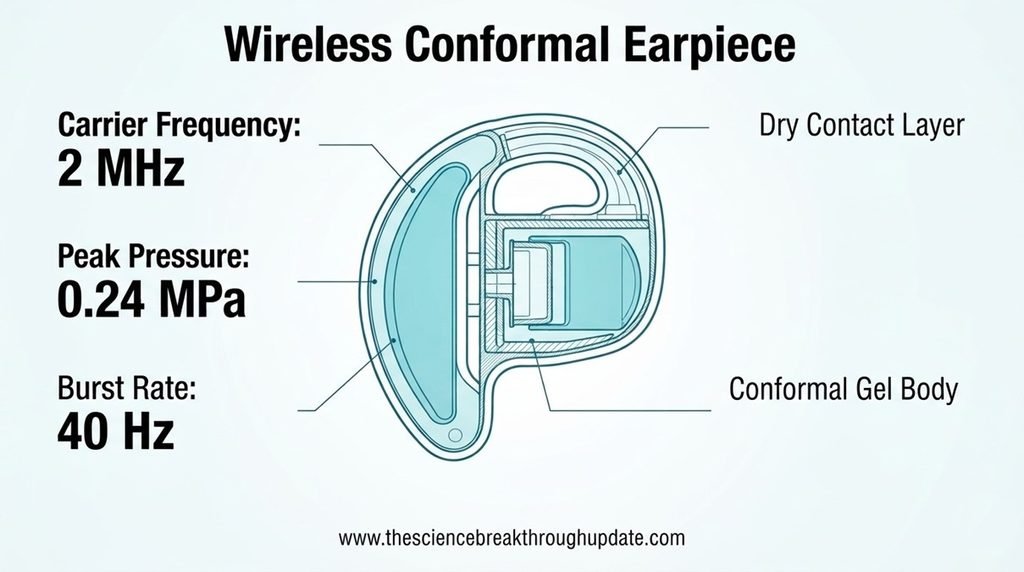
- Researcher Sebastian Frey embedded a miniature 2 MHz piezoelectric transducer directly into a custom-molded earpiece configured for anatomical placement inside the concha.
- The manufacturing team utilized a specialized vacuum chamber to mold a soft synthetic Humimic gel that perfectly replicates the individual geometry of the auricle.
- This vacuum-assisted fabrication technique minimizes trapped air pockets along the acoustic path to achieve an efficient dry acoustic contact layer over the emitting face.
- The complete wearable platform drives the transducer through a compact, battery-powered wireless system based on the custom-made WULPUS A-mode ultrasound framework.
📈 The Performance Metrics of Sound-Driven Neuromodulation
- Hydrophone calibration assessments in degassed water confirmed the earpiece produces a 0.24 MPa peak rarefactional pressure at a distance of 15 mm.
- The integrated microcontroller circuitry alternates electrical signals to maintain a 40 Hz burst repetition rate at a 50% burst duty cycle.
- Verified in vivo pulse-echo testing demonstrated stable in-ear acoustic transmission through cartilage and skin boundaries under realistic daily wearing conditions.
- Ongoing research tracks critical physiological responses to map functional stimulation effects by evaluating heart rate variability alongside real-time pupillary responses.
My Take: Swapping painful surgeries and messy gels for a simple, everyday earpiece makes neurological therapy practical. It shifts clinical wellness directly into our daily routines, changing health tracking completely.
❓ Reader Doubts: Core Questions Answered
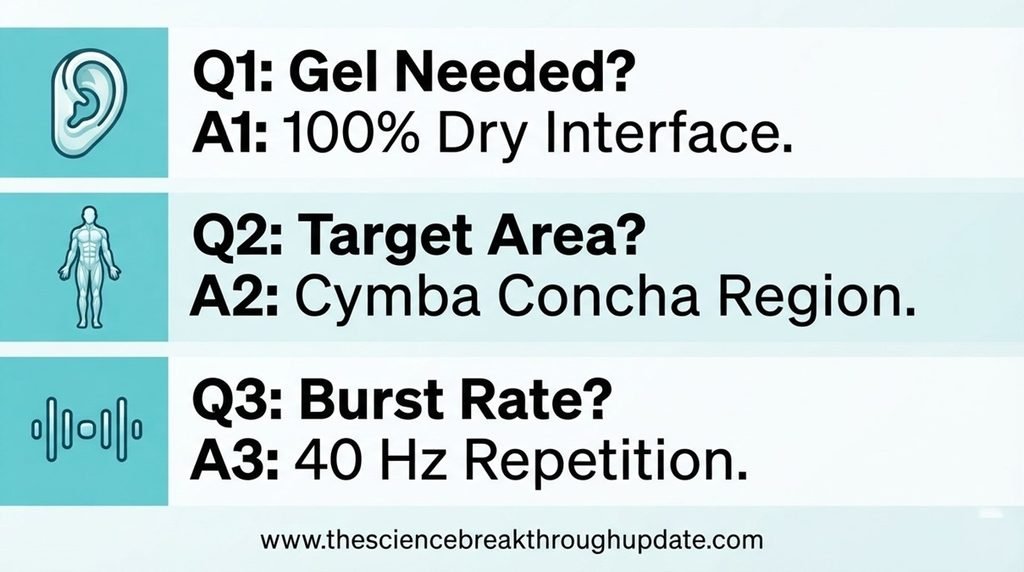
- How does this specific acoustic device transmit ultrasound waves without using liquid gel?
The system replaces standard liquid media by casting the earpiece body out of a soft, thermal-moldable Humimic gel. This personalized material structure eliminates internal air pockets and directly matches the unique outer ear contours to allow sound waves to pass cleanly into human tissue. - Which precise areas of human anatomy do these acoustic sound waves target?
The custom earmold aligns the emitting face of the piezoelectric transducer directly toward the cymba concha region of the outer ear. This specific zone features dense innervation from the auricular branch of the vagus nerve, which runs through the skin and cartilage layers. - What parameters govern the ultrasonic wave output generated by this wearable probe?
The battery-operated hardware utilizes an integrated ultrasonic sensing module to produce a 2 MHz carrier frequency. Internal programming gates this acoustic carrier using automated timer interrupts to establish a uniform 40 Hz burst repetition rate during active operations.
Source Document Link: arXiv.org
Share this useful knowledge with your friends now!”
Disclaimer: The information on this website is for educational and informational purposes only and is not intended as medical advice. Always consult a qualified healthcare professional before making any medical decisions or changes to your treatment plan.