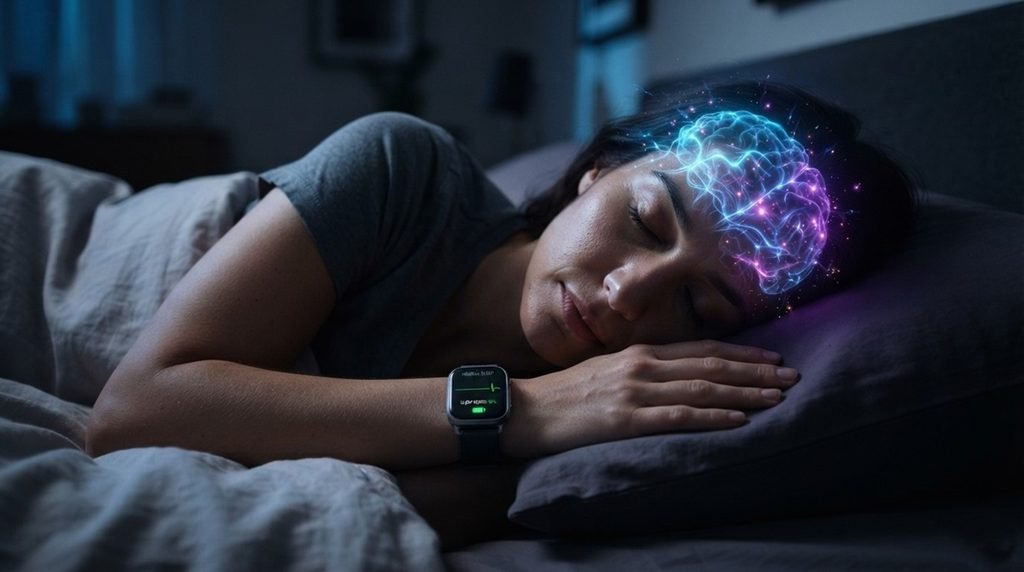
🧠 Your tracker might show a perfect sleep duration tonight, but a hidden brain wave glitch could leave you completely exhausted.
Millions of exhausted individuals experience profound daily frustration when they sleep for normal hours but wake up completely drained. Traditional medical tracking tools monitor total sleep time but completely miss the chaotic electrical battles happening inside your brain waves overnight.
To resolve this complex medical mystery, researcher Daniel Szelogowski from the University of Wisconsin–Whitewater built a biophysical model called DyssomniaNN. This framework carefully mimics human neural connections to explain why your mind fails to recharge even during consolidated sleep.

🔍 Why Traditional Clinical Sleep Tracking Consistently Fails
- Traditional clinical tracking metrics like sleep efficiency consistently fail to explain why many individual patients suffer from severe daytime impairment and chronic morning fatigue.
- Patients diagnosed with paradoxical insomnia often register completely perfect sleep durations on diagnostic medical equipment while still reporting profound, exhausting subjective insomnia symptoms.
- Individuals who suffer from narcolepsy type 1 frequently accumulate normal total sleep times but regularly deal with severe, uncontrollable daytime somnolence and muscle weakness.
- Existing academic diagnostic software packages simply cannot connect microscopic synaptic behavior with the macroscopic structural patterns of various chronic human sleep cycle disorders.
💻 An Advanced Biophysical Framework Maps the Nightly Chaos
- Experienced computer scientist Daniel Szelogowski developed DyssomniaNN to merge classic phenomenological tracking models with active, highly detailed subcortical brain network simulation frameworks.
- This advanced open-source software leverages virtual spiking neural networks to replicate authentic cortical cell activity patterns across continuous, multi-day environmental photoperiod timelines.
- The system successfully calculates a realistic synthetic local field potential that closely matches actual patient recordings from the open-access PhysioNet Sleep-EDF database.
- Szelogowski introduced a comprehensive new computational tool named the Well-Rested Index to mathematically evaluate the true restorative efficacy of overnight human sleep.
⚡ How Virtual Brain Simulations Redefine Restorative Medicine
- The simulation data clearly proves that total sleep duration completely fails to predict cognitive recovery when rapid, high-frequency waves corrupt deep slow-wave sleep.
- Severely reduced cortical interneuron inhibition causes individual paradoxical insomnia patients to maintain 85% to 95% subjective wakefulness during objective, deep slow-wave sleep cycles.
- Losing stabilizing chemicals forces the subcortical toggle switch to drop its bistable boundary hysteresis, which instantly triggers highly erratic, dangerous state transitions.
- This virtual simulation testbed allows modern neuroscientists to safely evaluate dual orexin receptor antagonists and other experimental compounds without risking real patient safety.
My Take: This framework finally proves basic sleep trackers lie to us. By exposing invisible neural battles, it opens the door for targeted, custom cures that fix real brain chaos.
❓ Reader Doubts: Core Questions Answered
- Why do many people feel completely exhausted after sleeping for normal hours?
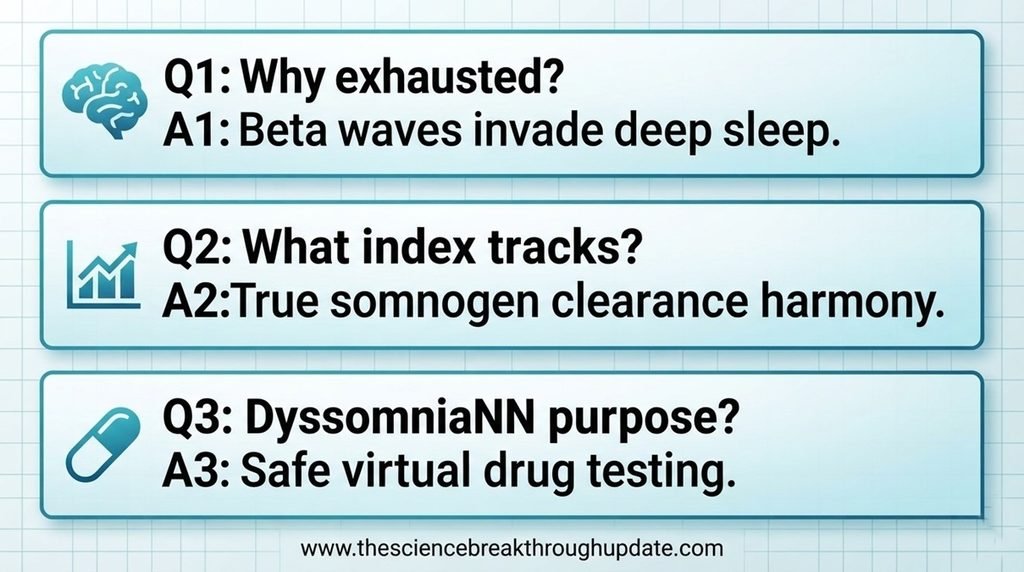
You might be experiencing a widespread medical phenomenon known as nocturnal cortical hyperarousal. This condition occurs when fast, high-frequency beta waves actively invade your deepest sleep cycles. Your subcortical switch successfully shuts down conscious awareness, but your overactive cortex remains awake and completely denies you physical recovery. - What specific metrics does the new Well-Rested Index evaluate to determine sleep quality?
The Well-Rested Index is a newly developed biophysical measurement tool that evaluates actual sleep quality instead of simple duration. The system computes crucial physiological factors like homeostatic clearance of brain somnogens, sleep architecture harmony, and proper circadian alignment. This comprehensive calculation determines the true restorative value your body receives overnight. - How does the DyssomniaNN computational framework help scientists develop better sleep medications?
This advanced framework allows global neuroscientists to simulate complex sleep disorders using digital spiking neural networks instead of living subjects. Researchers can observe how specific neurochemical deficiencies disrupt sleep architecture and map exactly how new target compounds restore balance. This process significantly accelerates the development of highly personalized treatments for insomnia.
Source Document Link: arXiv.org
Share this useful knowledge with your friends now!”
Disclaimer: This content is shared strictly for educational and informational purposes and does not constitute professional medical advice. Always consult a qualified healthcare professional or doctor before making any health decisions.