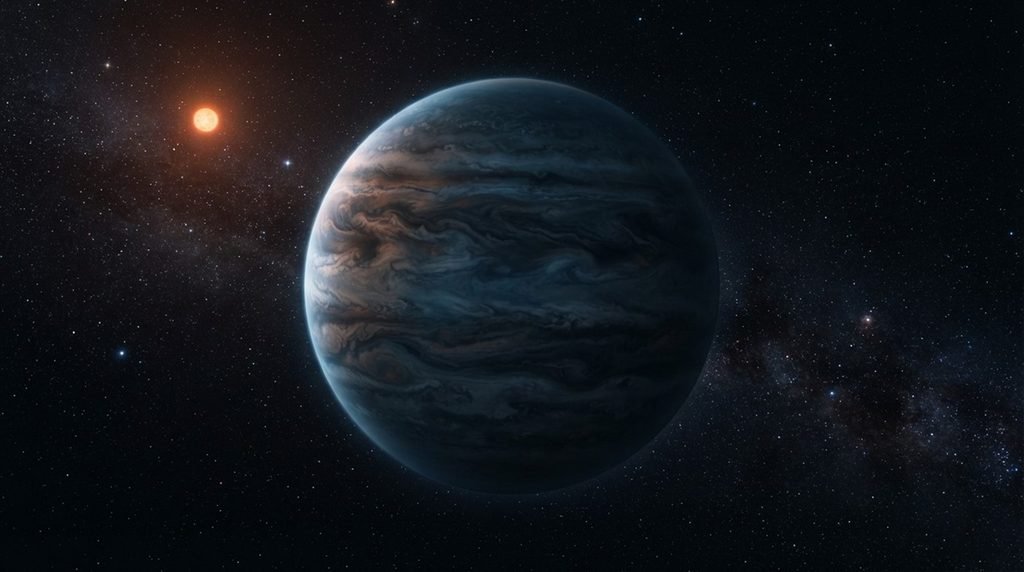
Astronomers just used a powerful space telescope to sniff out a giant nearby planet, and its unique chemical signature is rewriting the cosmic rulebook.
🔭 Looking into deep space usually feels like staring at faint, silent dots. However, the James Webb Space Telescope just changed how we see foreign worlds by capturing the first clear molecular map of a cold gas giant named Epsilon Indi Ab.
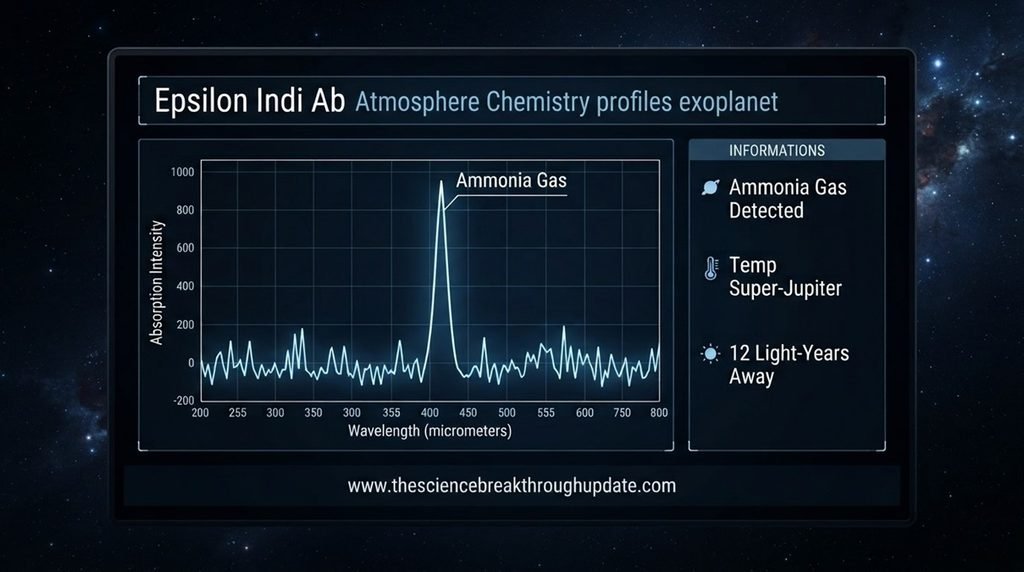
🧪 By analyzing the infrared light from this nearby world, a team led by researcher R. Kravtchenko successfully identified ammonia gas in the skies. This unexpected chemical discovery gives scientists a raw look at planets sitting outside our solar system.
The Challenge of Reading Frozen Giant Planets
- 🪐 Traditional ground-based instruments regularly struggle to observe cold gas giants because these incredibly faint planets hide completely inside the blinding, intense glare of nearby parent stars.
- ❄️ Astronomers rarely capture clean, direct light from these objects since cooler atmospheric temperatures mean the planets emit very little traceable infrared light radiation into open space.
- 🧩 Mixed chemical elements swirling in dense planetary atmospheres create a massive cosmic puzzle that standard recording equipment cannot decode without losing vital molecular tracking data during analysis.
- 📊 Previous attempts to study the atmosphere of Epsilon Indi Ab only provided vague baseline estimates instead of the highly detailed chemical maps needed to understand true planetary structures.
How Webb Unlocked the Chemical Secrets
- 🚀 A research team led by specialist R. Kravtchenko successfully utilized the extreme infrared sensitivity of the advanced James Webb Space Telescope to isolate the distant giant planet.
- 🔍 The experts filtered out the host star’s intense blinding light to read the clean, completely undisturbed molecular emission lines traveling directly through the planet’s thick upper atmosphere.
- ✨ This precise tracking revealed a highly distinct chemical fingerprint that conclusively confirms the presence of ammonia gas moving across the planet’s cold, frozen cloud decks.
- 🗺️ The final compiled dataset allowed the research group to construct an incredibly detailed space-time molecular map showing exactly how these gases distribute across the alien sky.
Why This Cosmic Map Changes Everything
- 🌍 This historic atmospheric achievement gives planetary scientists their very first direct look at the exact chemical composition of a temperate super-Jupiter sitting outside our solar system.
- 💻 Detecting massive concentrated pockets of ammonia gas forces global astrophysicists to heavily update their current computer simulation models regarding how giant alien worlds grow and evolve.
- ⚖️ The new data provides a flawless chemical baseline for comparing our own local gas giants like Jupiter and Saturn with systems orbiting completely different stars across the galaxy.
- 🔓 This successful mapping breakthrough opens the door for tracking carbon, water vapor, and other crucial chemical building blocks hidden inside nearby interstellar systems throughout deep space.
My Take: Mapping an alien sky from twelve light-years away proves we are moving past mere planet-hunting. We can finally dissect the exact chemical makeup of foreign worlds, bringing us closer to understanding our place in the cosmos.
Reader Doubts: Core Questions Answered
1. What makes Epsilon Indi Ab different from other exoplanets?
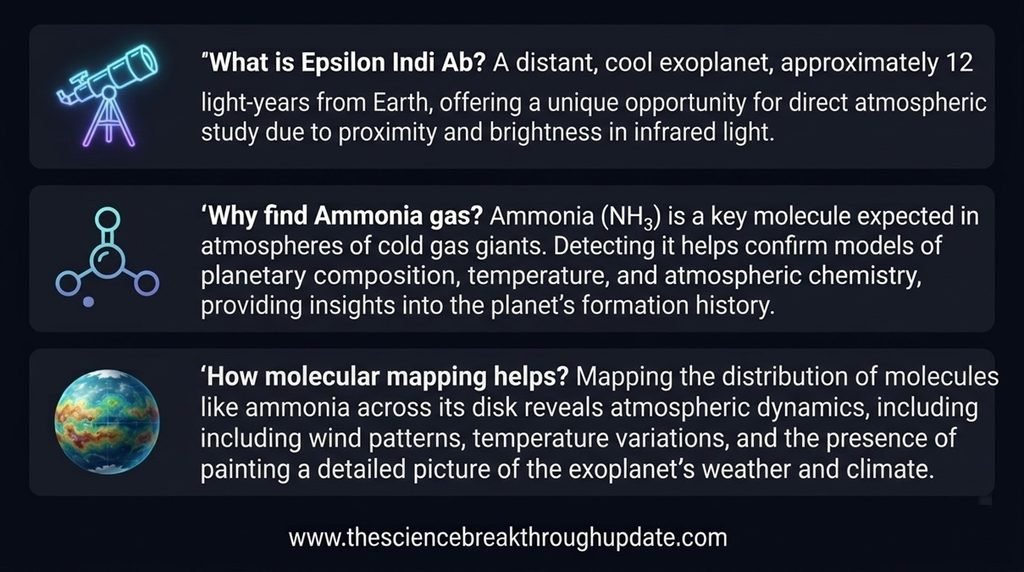
💡 This specific world stands out because it is a temperate super-Jupiter, which means it remains much colder and older than the hot gas giants telescopes normally find. It orbits a star located only 12 light-years away from Earth, providing scientists with an ideal nearby laboratory for advanced atmospheric exploration and direct imaging.
2. Why is finding ammonia in space such a big deal?
🔬 Ammonia represents a highly sensitive chemical marker that allows researchers to trace the exact temperature, atmospheric mixing, and original birth history of a foreign planet. Detecting this specific gas clearly demonstrates that modern instruments can now successfully analyze the chemistry of quiet, cold worlds that resemble our own outer solar system.
3. How does molecular mapping help ordinary science?
🗺️ Standard observations only look at a planet as a single pixel of light, whereas molecular mapping shows exactly how different gases distribute across the entire sky. This advanced data helps meteorologists and astronomers model complex global weather patterns, cloud formations, and thermal layers on worlds millions of miles away from us.
Source Document Link: arXiv.org
Share this useful knowledge with your friends now!”
Disclaimer: This content is based on preliminary scientific research (Preprints) from arXiv.org and current global findings. It is shared strictly for educational and informational purposes and does not constitute professional, legal. Readers are encouraged to verify facts independently and consult relevant experts before making any decisions.