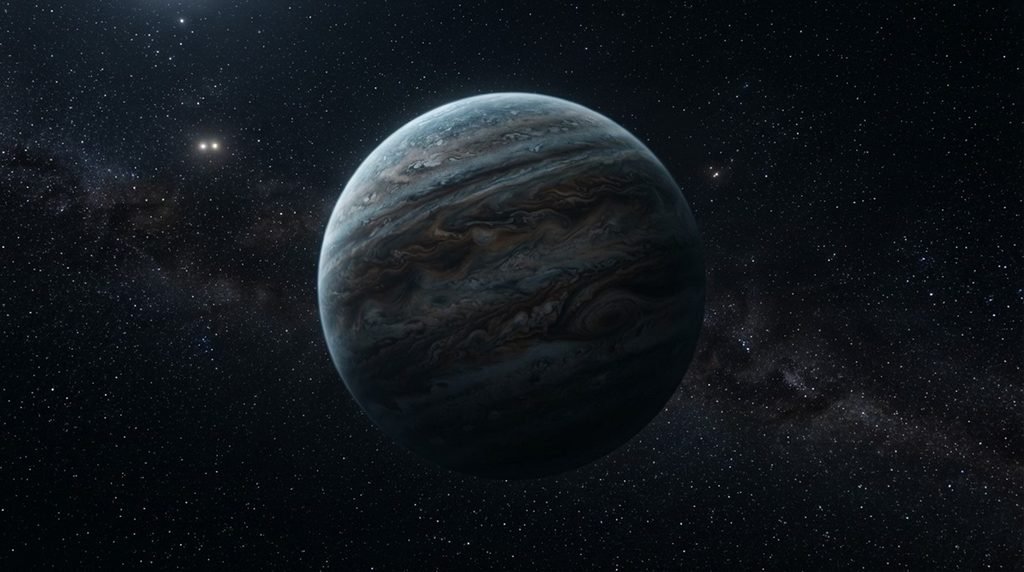
🪐 An invisible giant hiding right in our cosmic backyard is completely reshaping how we hunt for alien worlds.
Astronomers just detected a massive putative super-Jupiter hiding inside the nearby 61 Cygni binary system, located a mere 3.5 parsecs away from Earth. This massive find complicates future space missions designed to look for habitable, Earth-analogs around our closest stellar neighbors.
Led by researcher Aniket Sanghi from the California Institute of Technology, scientists combined decades of space data to pinpoint this elusive giant. The hidden planet weighs roughly 8 Jupiter masses, making its gravitational influence a major factor for nearby terrestrial planet stability.
☄️ The Hidden Chaos in a Nearby Solar System
- A hidden giant planet can act as a massive gravitational bully, completely destabilizing smaller terrestrial worlds over long periods through intense, chaotic dynamical perturbations.
- Identifying these massive hidden bodies around nearby stars remains incredibly difficult because their long-period orbits require decades of continuous monitoring to detect with absolute certainty.
- The team needed to reconcile highly conflicting data across multiple tracking methods, as early astronomical observations could not confirm which stellar component the candidate planet actually orbits.
- Failing to map these massive gas giants can severely compromise multi-billion dollar space exploration missions aimed at finding biosignatures on alien Earths in the future.
🔭 Sifting Through Decades of Cosmic Data
- The research team combined absolute astrometry from the historical Hipparcos and Gaia space catalogs with nearly 4 decades of precise radial velocity measurements.
- Scientists integrated ultra-precise new data from the advanced NEID spectrograph to create high-resolution planet detection completeness maps across a wide variety of orbital eccentricities.
- Advanced orbital modeling using the state-of-the-art Sonora Flame Skimmer evolutionary models successfully estimated the planet’s average effective temperature at 282 Kelvin with high precision.
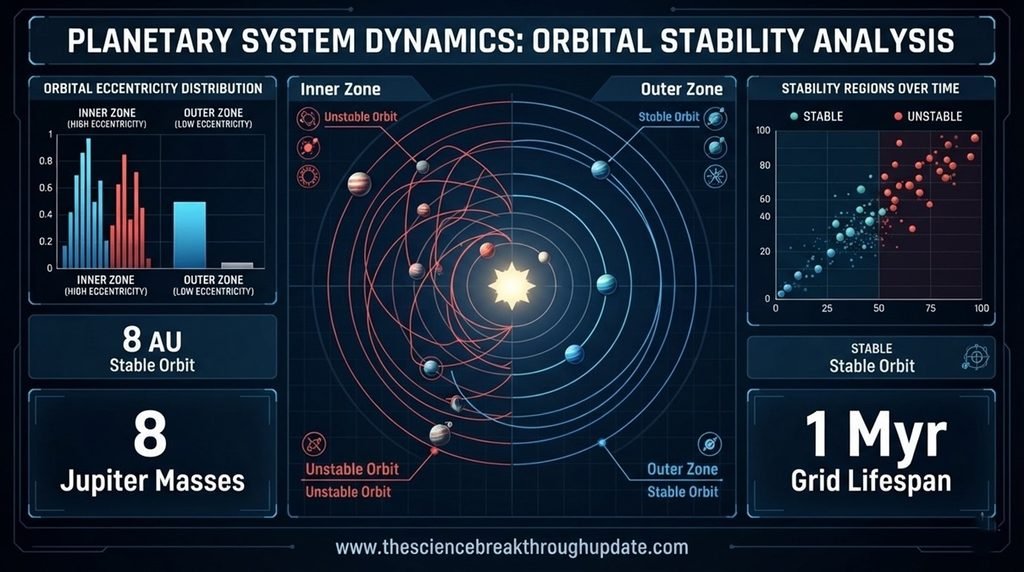
- Specialized N-body dynamical simulations tracked 1,000,000 candidate planetary orbits over a 1 million year timescale to safely eliminate all unstable cosmic configurations.
🚀 Why This Discovery Changes the Hunt for Exo-Earths
- The final mathematical models reveal that this massive super-Jupiter maintains a highly stable orbit averaging roughly 8 astronomical units away from its primary host star.
- Chaotic dynamical simulations prove that this giant planet completely disrupts the stellar habitable zone if its orbit falls anywhere under 5 astronomical units.
- Extreme misaligned orbital configurations between 5 and 10 astronomical units trigger intense von Ziepel-Lidov-Kozai oscillations that inevitably destroy developing terrestrial alien worlds.
- These critical scientific insights will directly guide target selection and observation strategies for upcoming flagship space telescopes like the highly anticipated Habitable Worlds Observatory.
My Take: Finding this gas giant next door forces us to rewrite our space exploration roadmaps. We cannot hunt for habitable Earths without mapping the massive hidden bullies that destroy them first.
❓ Reader Doubts: Core Questions Answered
1. Where is the 61 Cygni star system located?
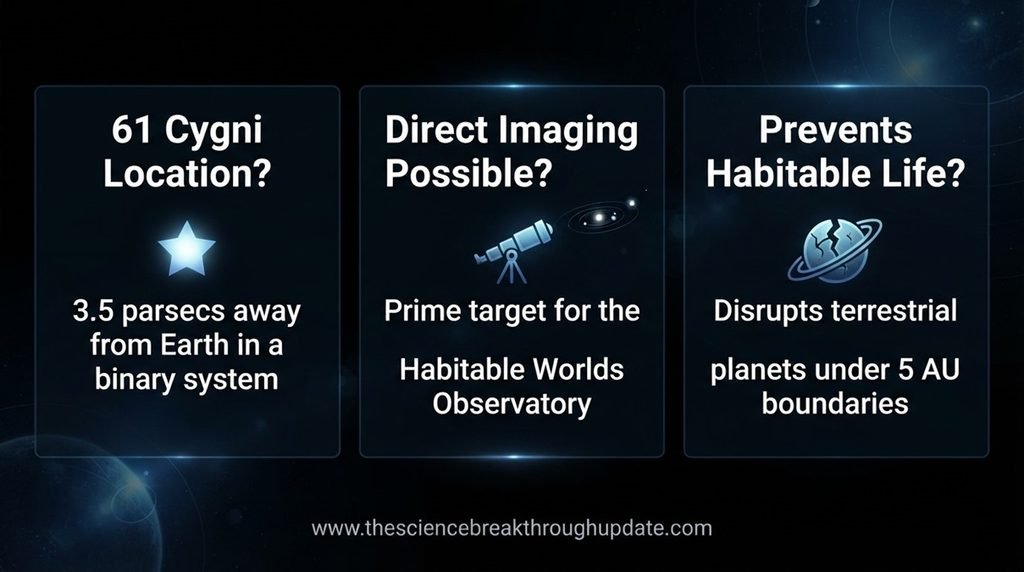
The 61 Cygni system rests just 3.5 parsecs away from our solar system, making it one of Earth’s closest stellar neighbors. It consists of 2 main-sequence K-dwarf stars locked in a long visual binary orbit. This close proximity makes it a prime location for future deep space observations.
2. Can humans directly image this newly found super-Jupiter?
Current instruments struggle to see it due to cosmic dust, but the planet remains a prime target for future direct imaging space missions. Flagship projects like the Habitable Worlds Observatory will eventually capture its reflected light. These instruments will allow scientists to analyze its atmosphere directly.
3. Does this giant planet prevent alien life from forming nearby?
It certainly makes things harder by disrupting the habitable zone where liquid surface water can easily exist over long periods. However, specific stable orbital alignments might still allow small, rocky planets to safely survive on the outer edges. Further orbital characterization is required to know for sure.
Source Document Link: arXiv.org
Share this useful knowledge with your friends now!”
Disclaimer: This content is based on preliminary scientific research (Preprints) from arXiv.org and current global findings. It is shared strictly for educational and informational purposes and does not constitute professional, legal. Readers are encouraged to verify facts independently and consult relevant experts before making any decisions.