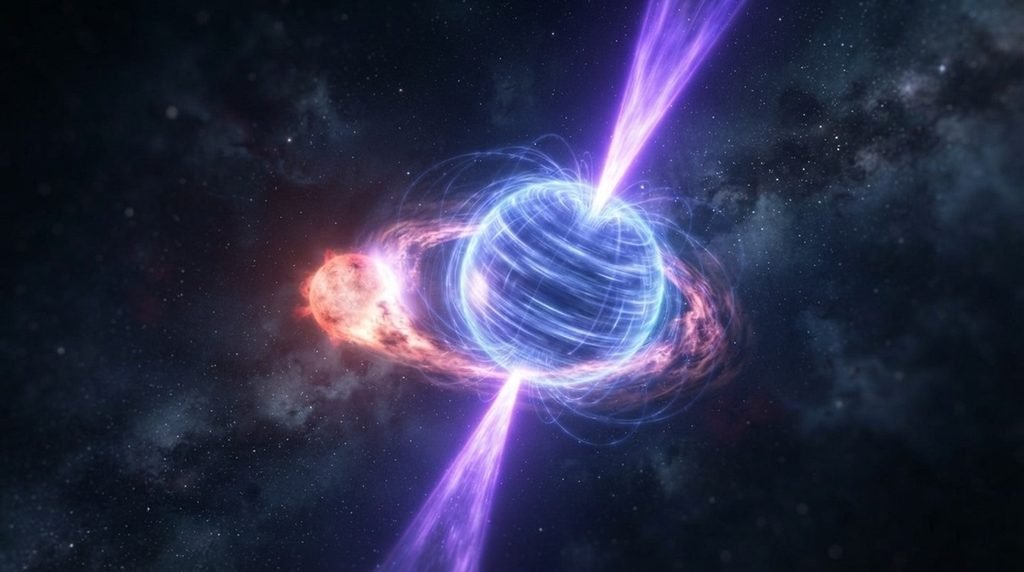
🚀 Imagine a cosmic cannibal hunting in the deep dark space, slowly ripping its closest partner to pieces.
Deep space telescopes just uncovered a terrifying galactic hunting ground where ultra-dense stars act like cosmic black widows. These fast-spinning stellar remnants blast their nearby companion stars with intense radiation, slowly vaporising them into thin air. A team of astronomers recently spotted three of these rare, destructive systems hiding inside our galaxy, changing everything we know about how stars die.
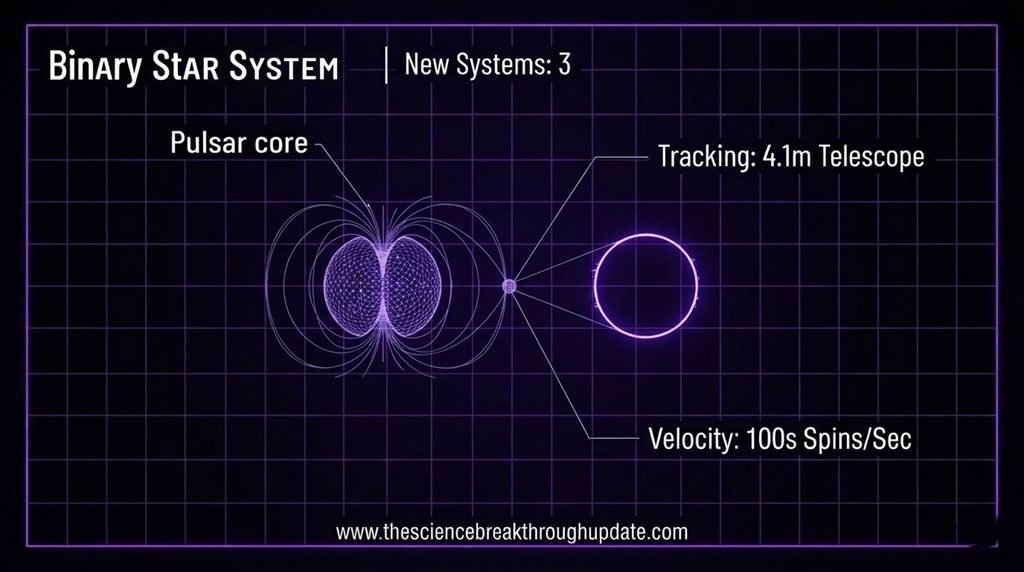
This rare cosmic destruction triggers massive shockwaves between the two cosmic bodies, creating a deadly playground of extreme physics. Discovering these hidden systems requires incredibly precise tracking instruments because these stellar monsters spin hundreds of times every single second. By studying these extreme interactions, scientists can finally map the violent lifecycle of the most dense matter in our universe.
🌌 The Hidden Cosmic Cannibals Destroying Their Neighbors
- Astronomers struggle to find spider pulsars because thick clouds of vaporised stellar debris constantly block our direct view of these systems.
- These dead stellar remnants spin hundreds of times per second, making their high-energy radiation beams incredibly difficult to track accurately.
- The intense energy blasts create massive intrabinary shocks that distort the light flowing from the companion star toward our earth.
- Standard space surveys regularly miss these destructive cosmic pairs because the companion stars remain completely veiled by plasma.
🔬 Unlocking Space Secrets with Advanced Kinematic Trackers
- A research team led by Jay Strader utilized the 4.1-meter SOAR telescope to pierce through the thick cosmic debris clouds.
- The scientists successfully identified three new dangerous spider systems by measuring the sharp, rhythmic velocity changes using optical spectroscopy methods.
- Using specialized observational data allowed the team to map the physical footprint of the intrabinary shocks ripping through space.
- This advanced observation method confirms the existence of massive energy fields locking these binary star systems together.
💥 Why These Spider Pulsars Change Our View of Space
- Finding these new systems provides crucial data on how ultra-dense matter behaves under extreme gravitational forces in space.
- The successful detection proves that optical tracking can find hidden stellar monsters that radio telescopes miss entirely during surveys.
- Mapping these cosmic shocks helps theorists calculate exactly how much energy these spinning dead stars blast into space continuously.
- This breakthrough creates a brand new blueprint for discovering hundreds of hidden cannibalistic star systems across our galaxy.
My Take: Finding these cosmic predators proves our space hunting tools are getting sharper. By tracking these hidden stellar dances, we are finally rewriting the rules of extreme cosmic survival.
❓ Reader Doubts: Core Questions Answered
- What exactly is a spider pulsar?
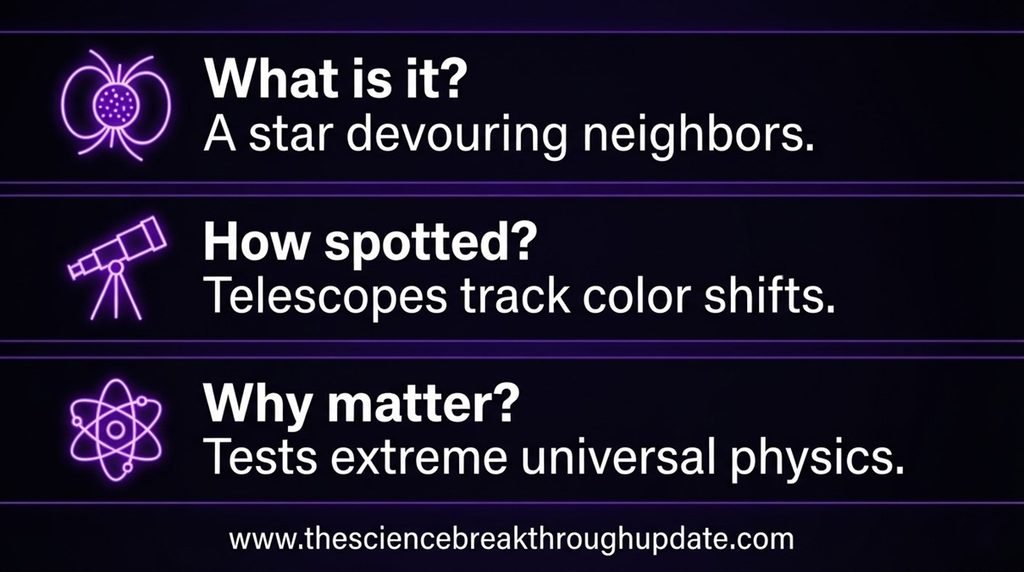
A spider pulsar is a super-dense, fast-spinning remnant of a dead star. It earns its creepy name by slowly destroying and eating its smaller companion star using intense radiation beams. - How do scientists spot these hidden space objects?
Astronomers use advanced optical telescopes to measure the precise movements and color shifts of the companion star. This tracking reveals the massive gravitational pull and shockwaves caused by the hidden pulsar. - Why does this space discovery matter to everyday people?
This research helps us understand the extreme laws of physics and how matter behaves under pressure. The advanced telescope technology developed for these discoveries often leads to better imaging sensors used on earth.
Source Document Link: arXiv.org
Share this useful knowledge with your friends now!”
Disclaimer: This content is based on preliminary scientific research (Preprints) from arXiv.org and current global findings. It is shared strictly for educational and informational purposes and does not constitute professional, legal. Readers are encouraged to verify facts independently and consult relevant experts before making any decisions.