

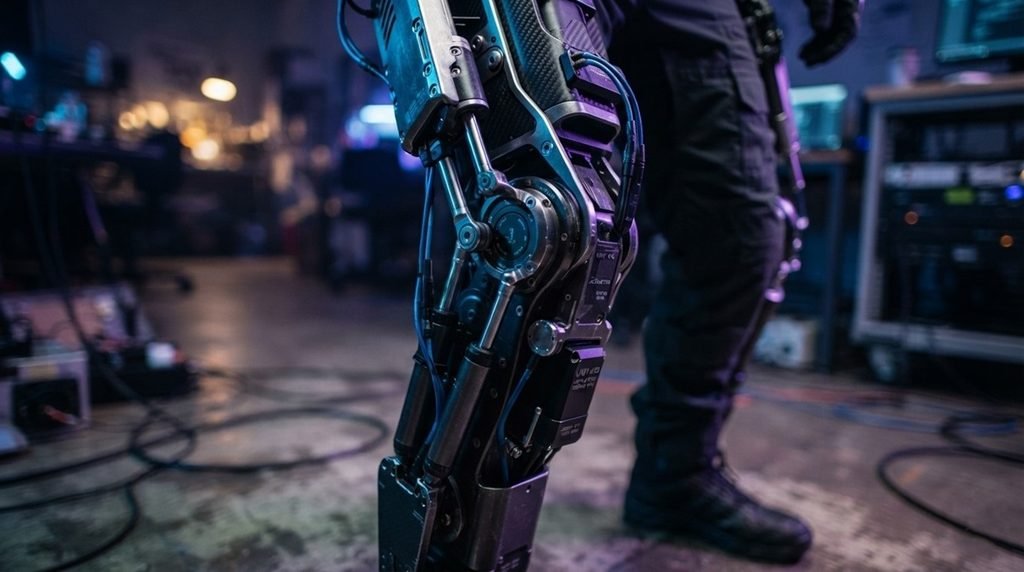
Imagine wearing a robotic suit that predicts your next physical move before your brain even finishes signaling your muscles.
🚀 Modern mobility science is chasing a massive goal to help individuals with limited movement regain control over their daily lives. Engineers use high-tech robotic exoskeletons to assist human legs, but making these machines feel completely natural remains an incredibly difficult task.
🧠 Traditional wearable devices fail to adapt smoothly because they rely on rigid, pre-defined programming rather than real-time human intention. Now, brilliant researchers from the Technical University of Darmstadt have developed a smart framework called ExoLaN to bridge this gap perfectly.
Why Current Wearable Robotics Struggle With Human Movement
- ⚠️ Conventional wearable control systems require separate programmed modules for every single daily physical activity like walking, standing, or climbing stairs.
- 🛑 These old hardware frameworks fail instantly when an individual changes their walking pace or encounters an unexpected physical obstacle outdoors.
- 📉 Standard machine learning algorithms cannot accurately calculate changing contact forces when your feet hit the ground intermittently during normal human locomotion.
- 🔒 Rigid black-box artificial intelligence models lack critical physical interpretability which creates severe safety concerns during direct, real-world human-robot interactions.
How ExoLaN Implements Deep Physics Laws In Real Time
- 🧪 Lead scientist Lucas Schulze and his elite engineering team built ExoLaN to learn the entire coupled physics dynamics of human-exoskeleton systems.
- 🧠 The architecture strategically utilizes an advanced Temporal Convolutional Network to analyze historical motion patterns and accurately estimate real-time human joint torques.
- 👟 A specialized, data-driven Learned Insole Mapping system tracks partial pressure data from smart footwear insoles to understand complex ground contact conditions.
- 📐 By embedding foundational Lagrangian mechanics directly into deep neural networks, the system successfully ensures energy conservation laws remain completely intact.
The Measured Accuracy and Future Impacts on Patient Care
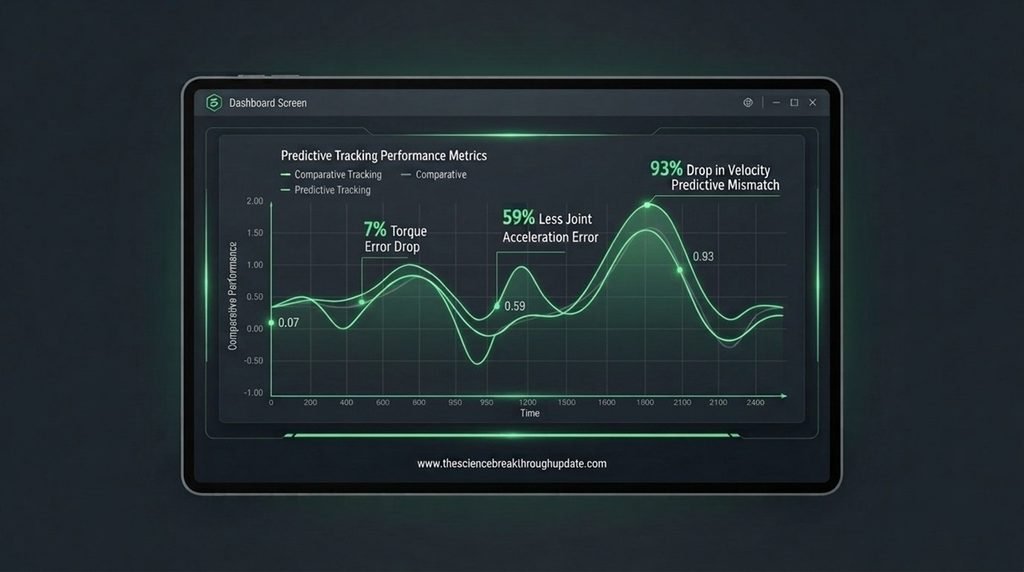
- 🎯 The physics-based system cuts torque estimation errors by 7% when tested on entirely unseen human users performing 21 unlearned activities.
- 📊 Multi-step training regularization constraints reduce joint acceleration calculation mistakes by a massive 59% during rigorous long-horizon predictive tracking tests.
- 📈 The smart framework reduces position and velocity tracking errors by 60% and 93% respectively over long-range state prediction rollout horizons.
- 🔮 The model captures clear, highly discriminative latent context information without explicit task labels, paving the way for adaptive, self-tuning assistive devices.
My Take: By reading human intent instead of forcing rigid pre-set modes, ExoLaN finally makes wearable robotics practically useful, giving real-world independence back to millions facing mobility challenges daily.
Reader Doubts: Core Questions Answered
- How does ExoLaN differ from older exoskeleton software applications?
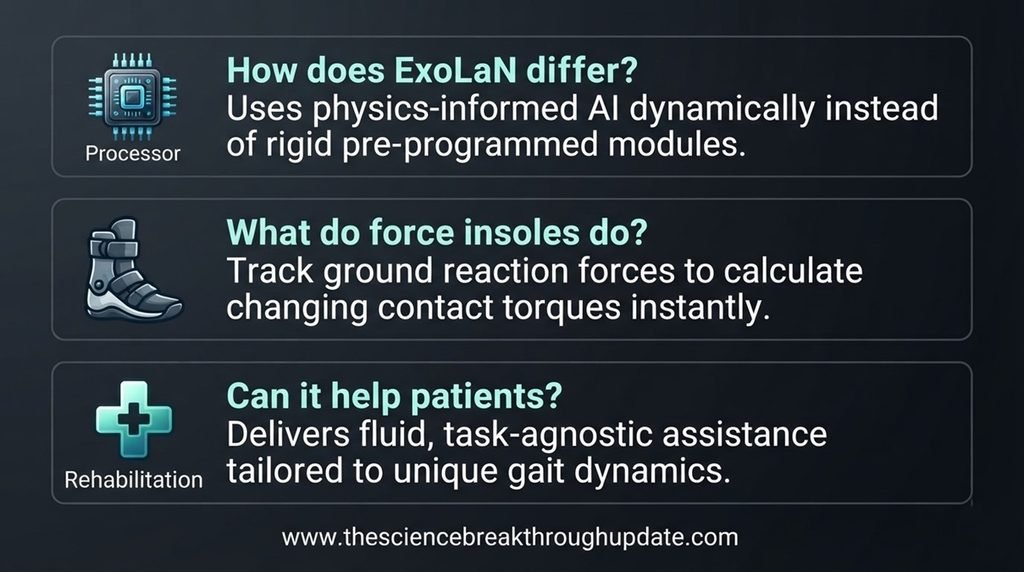
🤖 Older control software typically relies heavily on rigid pre-programmed tasks and switches between separate control modules clumsily during daily use. ExoLaN completely eliminates this computational issue by reading user intent continuously through advanced physics-informed neural networks that adapt dynamically on the fly. This sophisticated structural awareness allows the wearable machine to safely assist fluid, task-agnostic human movements across any unexpected, complex terrain without any manual configuration changes. - What role do the wireless force insoles play in this setup?
👟 The exoskeleton system tracks human movement by incorporating wireless, pressure-sensitive insoles that measure vertical ground reaction forces during locomotion. Because direct multi-directional contact force is incredibly difficult to observe outside laboratory force plates, a custom mapping translation calculates these complex contact torques instantly. This allows the framework to seamlessly recognize when a patient stands up, bends down, or takes a step forward in real-world scenarios. - Can this framework help disabled patients in clinical rehabilitation centers?
🏥 Yes, this medical technology delivers highly customized, task-agnostic assistance tailored specifically to an individual patient’s unique gait dynamics and physical conditions. By recognizing user intention without manual mode switching, it makes intensive physical therapy sessions significantly more responsive, predictable, and remarkably safer for the user. It could eventually empower paralyzed individuals or elderly citizens to navigate diverse indoor and outdoor environments completely unassisted with absolute confidence.
Source Document Link: arXiv.org
Share this useful knowledge with your friends now!”
Disclaimer: This content is based on preliminary scientific research (Preprints) from arXiv.org and current global findings. It is shared strictly for educational and informational purposes and does not constitute professional, legal. Readers are encouraged to verify facts independently and consult relevant experts before making any decisions.



