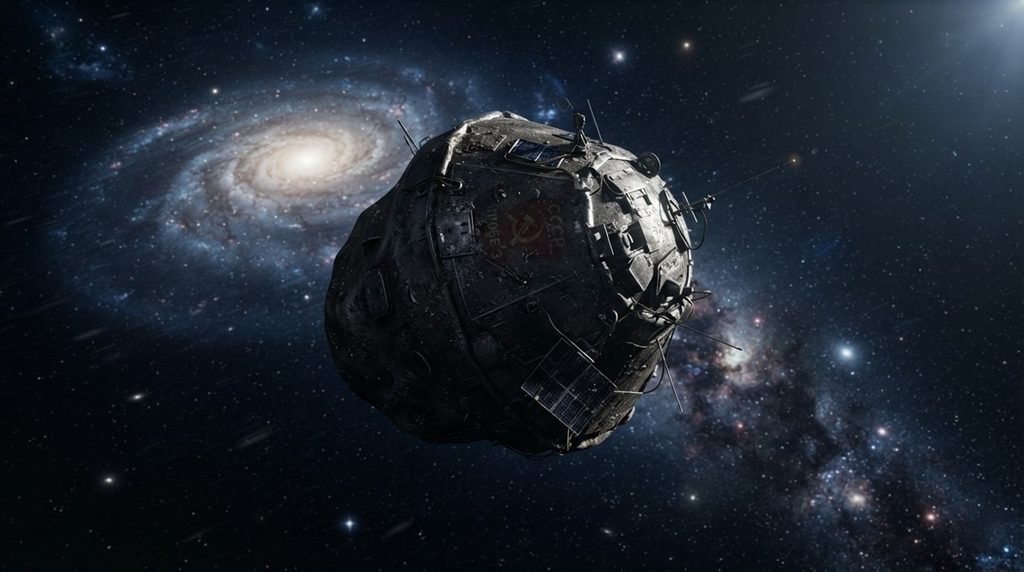
Is a Lost 1988 Soviet Spacecraft Hiding in Plain Sight as a Fast-Spinning Near-Earth Asteroid?
🪐 Could a mysterious space rock orbiting close to Earth actually be a piece of forgotten human history? A thrilling new study co-authored by Harvard astrophysicist Abraham Loeb investigates whether a strange, fast-spinning dark comet is actually the lost Soviet Phobos 1 space probe. While standard astronomy logs class this object as a natural asteroid, its bizarre behavior has forced researchers to reconsider its true mechanical origins.
🚀 The object in question, known as 1998 KY26, exhibits a series of anomalous orbital movements that defy normal expectations for space rocks. By looking closely at its non-gravitational acceleration, the research team explores a radical but mathematically sound scenario where solar radiation pressure is pushing against a hollow metallic hull instead of a solid rocky surface. This cosmic detective work opens up a fascinating debate about space junk masquerading as asteroids.
The Bizarre Cosmic Body That Defies Natural Explanations
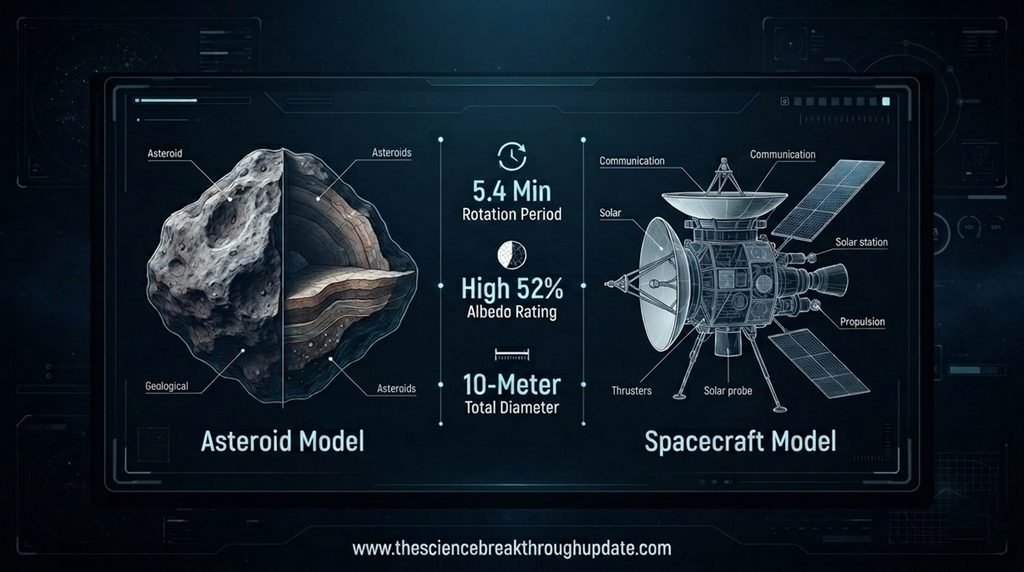
- 🕒 Astronomers discovered that 1998 KY26 spins at an extreme speed, boasting a rapid 5.4-minute rotation period that would normally cause loose space rocks to fly completely apart.
- ☄️ This mysterious object lacks the typical bright, visible gas tail or coma that scientists expect to see when a traditional icy comet gets close to the Sun.
- 🌌 The object exhibits a significant non-gravitational acceleration, meaning an unseen force is subtly pushing it out of its regular calculated gravitational orbit.
- 🪨 Standard models struggle to explain how a tiny, 10-meter natural body could maintain its shape under these brutal rotational forces unless it is a solid monolith.
Testing the Radical Lost Spacecraft Hypothesis
- 🛰️ Researcher Adam Hibberd and his team used precise orbital dynamics to track the historical trajectory of the lost Soviet Phobos 1 probe.
- 🔴 Engineers lost contact with the massive Phobos 1 spacecraft in 1988 due to a fatal software error during its journey toward Mars.
- 📐 The new mathematical model calculates how two propulsive velocity thrusts totaling 1.9 kilometers per second combined to push against a lightweight, hollow metal structure.
- 📊 Data shows the physical dimensions and high 52% albedo of the abandoned probe perfectly align with the light curve signatures observed from 1998 KY26.
Why Solving This Asteroid Identity Crisis Matters for Our Future
- 🌍 Proving this object is human-made would confirm that dead spacecraft can drift back into Earth-crossing orbits and confuse planetary defense networks.
- 🇯🇵 Japan’s space agency, JAXA, currently plans to send its Hayabusa2 spacecraft to rendezvous with this target in July 2031, making its true identity critical for mission success.
- 🧮 This study establishes a new scientific framework for using advanced trajectory modeling to separate real alien rocks from historical space debris.
- ☢️ Discovering a lost 30-year-old probe would offer engineers an unprecedented chance to study how human technology survives long-term deep space radiation.
My Take: If this asteroid is truly a ghost ship from the Cold War era, it proves our expanding celestial junk drawer is already back to haunt us, completely redrawing planetary defense tracking metrics.
Reader Doubts: Core Questions Answered
1. What exactly was the Soviet Phobos 1 mission?
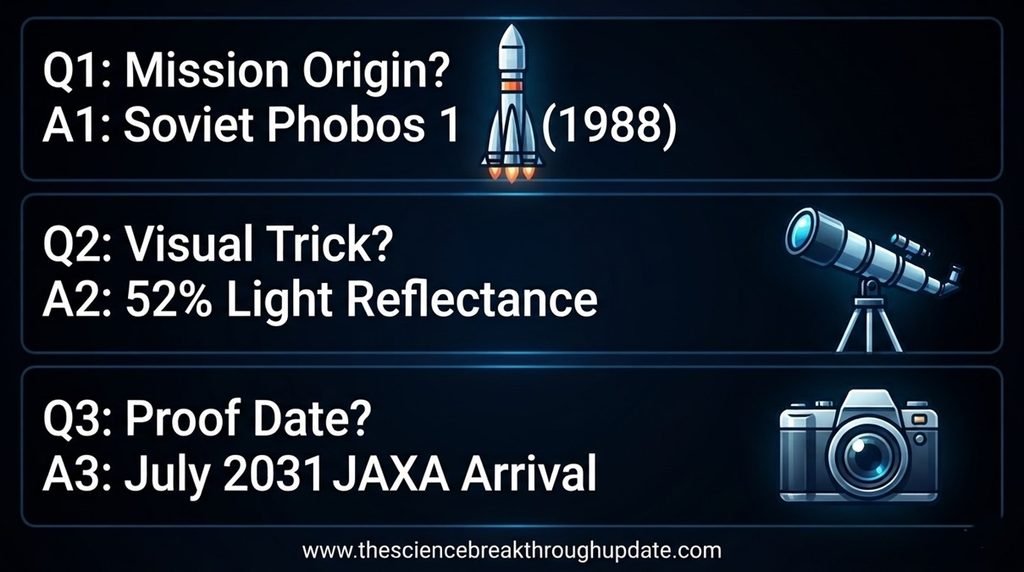
🛠️ Phobos 1 was a robotic space probe launched by the Soviet Union in July 1988 to study Mars and its largest moon. A faulty command uploaded in August caused the spacecraft to lose orientation, drifting away into a permanent solar orbit after ground control lost contact.
2. How can a spacecraft look like a comet to telescopes?
🔭 From millions of miles away, a small spacecraft with a 10-meter solar panel span reflects sunlight in a choppy pattern. This visual signature has a high 52% reflectance rating that closely mirrors the light reflections of an elongated, fast-spinning asteroid.
3. Will we ever know for sure if 1998 KY26 is a machine?
📸 Yes, we will get a definitive answer when JAXA’s Hayabusa2 spacecraft arrives at the target in July 2031. The upcoming close-up imaging will easily spot the difference between a natural rocky surface and human-engineered metal solar arrays.
News source link: arXiv.org
Share this useful knowledge with your friends now!”
Disclaimer: This content is for educational and informational purposes only.