☀️ Something invisible is lurking at the center of our solar system, and scientists are using deep-sea technology to hunt it down.
Deep space mysteries often require looking downward rather than upward. A global team of astrophysicists is hunting for invisible dark matter trapped inside our Sun, using an underwater telescope submerged deep within the Mediterranean Sea to detect elusive ghost particles in total clarity.
This ambitious search focuses on Weakly Interacting Massive Particles, commonly known as WIMPs. Scientists believe these mysterious particles sink into the solar core, collide with ordinary matter, and annihilate each other, leaving behind a unique trail of high-energy neutrino signals now.
💀 The Hidden Cosmic Predator Inside Our Core
- Cosmological observations confidently prove that non-baryonic dark matter makes up about 5 times more mass in the universe than ordinary visible matter across space.
- The Sun functions as a massive gravitational trap, slowly capturing passing WIMPs from the surrounding Galactic dark matter halo over long cosmic time periods continuously.
- These trapped particles eventually pack tightly inside the hot solar center, triggering spontaneous particle annihilation reactions that destroy them and release secondary high-energy particle streams.
- Standard astronomical instruments cannot observe this process directly because the dense solar plasma blocks traditional light radiation, hiding these crucial cosmic interactions completely from view.
⚓ Hunting for Ghost Particles in the Deep Ocean
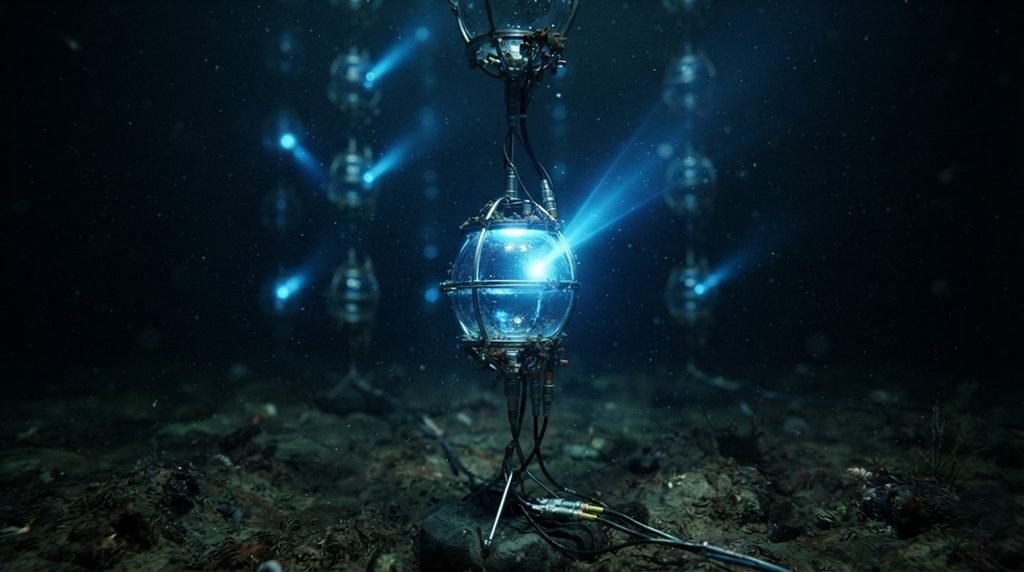
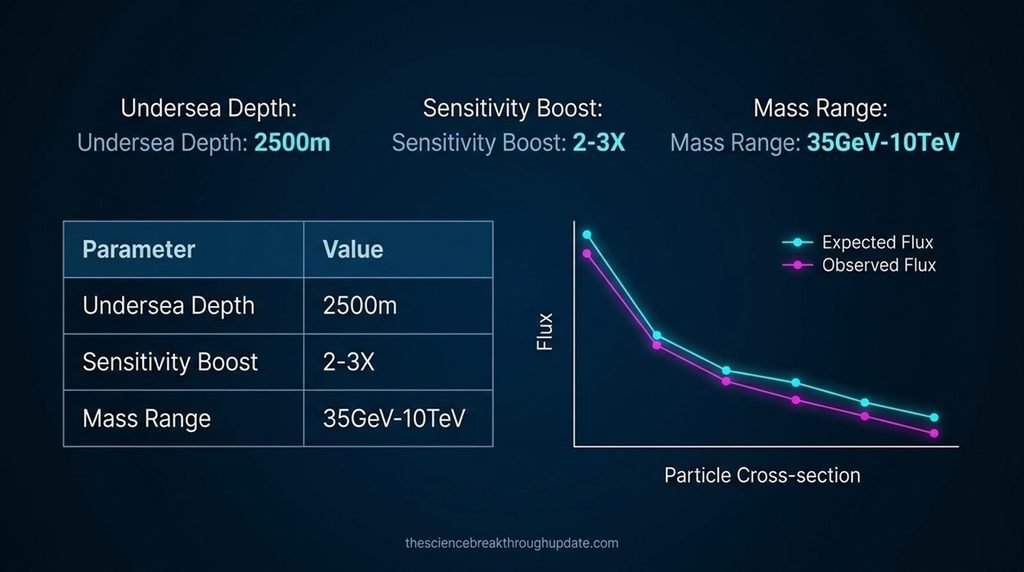
- Physicists successfully deployed the sensitive ANTARES neutrino telescope 2500 meters below the ocean surface to isolate weak cosmic signals from disruptive atmospheric background surface noise.
- This specialized deep-sea array utilizes 12 vertical lines holding hundreds of pressure-resistant glass spheres to record faint blue Cherenkov light flashes clearly during active runs.
- These advanced underwater sensors specifically track up-going muon neutrino signatures that travel completely through the Earth from the opposite deep southern planetary side space direction.
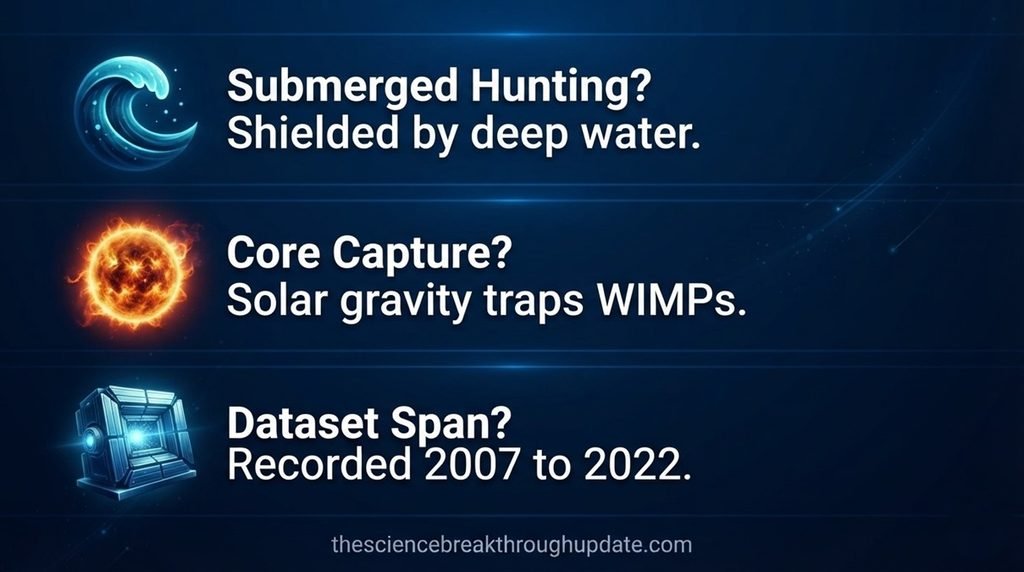
- The research team carefully analyzed data spanning from 2007 to 2022, matching observations with simulated models using WimpSim software for highly accurate analytical scientific verification.
🌌 Setting New Boundaries for the Invisible Universe
- The comprehensive analysis revealed no unexpected neutrino excess, successfully narrowing down the mathematical limits of the WIMP-proton interaction cross section values for multiple particle channels.
- This newly completed dataset improves previous sensitivity boundaries by factors between 2 and 3, establishing a superior benchmark for modern physics research studies globally now.
- These independent deep-sea measurements perfectly complement terrestrial experiments like Lux-Zeplin and XENONnT, offering vital cross-verification for dark matter particle research fields across the entire world.
- The scientific breakthrough significantly refines our understanding of solar astrophysics while refining operational tracking models for the future global KM3NeT observatory facility deep underwater now.
My Take: Turning our oceans into cosmic mirrors proves we do not need expensive spaceships to map the dark universe. Earth itself holds the ultimate toolkit for unlocking deep space.
❓ Reader Doubts: Core Questions Answered
- Why do scientists look for dark matter deep underwater?
Ocean water acts as an excellent natural shield against disruptive cosmic radiation and heavy atmospheric background noise at the surface. Elusive cosmic particles like neutrinos produce tiny flashes of unique blue Cherenkov light when interacting with deep water molecules. Submerged optical modules inside the deep sea can easily capture and reconstruct these rare particle directions accurately. - How exactly does the Sun capture dark matter particles?
Our solar system constantly travels through an invisible cloud of ancient Weakly Interacting Massive Particles distributed across the galactic dark matter halo. The Sun’s intense gravitational potential attracts these passing particles, forcing them to repeatedly collide and scatter off dense solar atomic nuclei. These physical interactions steadily reduce WIMP velocity until they become permanently trapped inside the hot solar core. - What did the completed ANTARES experiment ultimately prove?
The full ANTARES dataset recorded from 2007 to 2022 found no significant high-energy neutrino excess originating from the direction of the Sun. This lack of signal allows physicists to calculate precise upper limits for both spin-dependent and spin-independent WIMP-proton scattering cross section parameters. These new boundaries successfully restrict dark matter masses ranging from 35 GeV to 10 TeV completely now.
Source Document Link: arXiv.org
Share this useful knowledge with your friends now!”
Disclaimer: This content is based on preliminary scientific research (Preprints) from arXiv.org and current global findings. It is shared strictly for educational and informational purposes and does not constitute professional, legal. Readers are encouraged to verify facts independently and consult relevant experts before making any decisions.