
🌌 A bizarre alien world split down the middle by fire and ice might actually hold the key to finding extraterrestrial life.
Astronomers just discovered how tidally-locked planets manage their limited water supplies without completely drying up. The deep space investigation shows that atmospheric circulation acts like a massive planetary conveyor belt, constantly moving moisture across hemispheres to prevent extreme climate death.
This breakthrough changes how we hunt for habitable alien worlds across the universe. By analyzing wind patterns and moisture limits, researchers from the University of Exeter have mapped out the exact conditions required for alien oceans to survive under a permanent, unmoving sun.
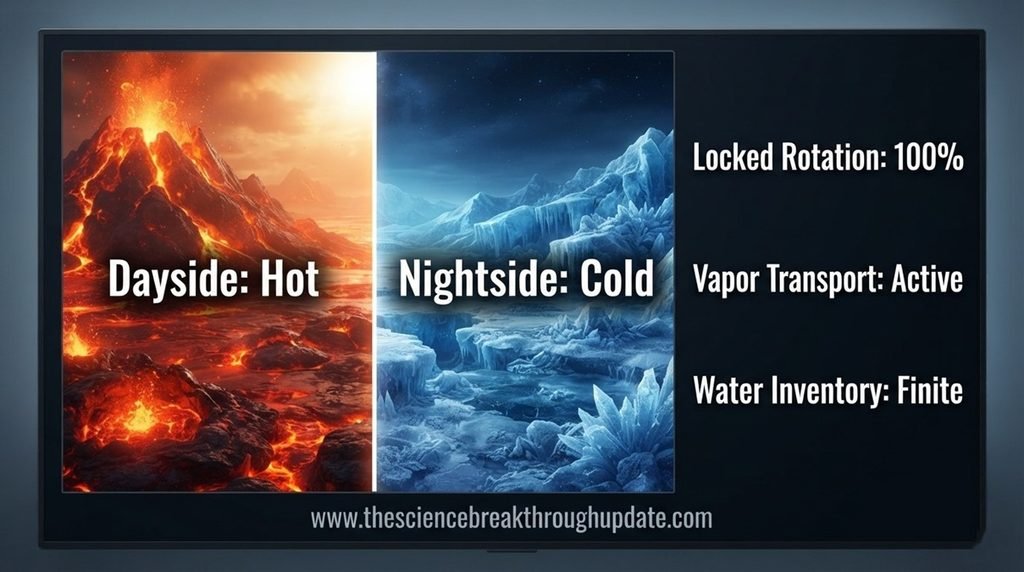
☀️ The threat of permanent ice traps and scorching deserts
- A major planetary crisis occurs because these unique planets always face their host star with the exact same side, creating a permanent day and night split.
- The fierce, continuous heat on the dayside threatens to rapidly evaporate all liquid water and trigger a runaway greenhouse effect over time.
- Meanwhile, the intense, sub-zero cold on the nightside acts like a giant cold trap, freezing atmospheric moisture into massive permanent ice sheets.
- This severe climatic imbalance forces standard scientific models to predict that these planets will inevitably lose all their usable surface water.
💨 How planetary winds create a global water conveyor belt
- Climate scientists solved this mystery by utilizing advanced three-dimensional atmospheric models to simulate long-term moisture movement across alien worlds.
- The dynamic simulations show that strong, high-altitude winds continuously transport evaporated water vapor from the hot dayside to the dark nightside.
- Instead of freezing forever, heavy clouds form along the border and return water to the dayside through massive planetary wind currents.
- This continuous atmospheric loop ensures that a finite water inventory can actively circulate without getting permanently trapped in the freezing dark.
🌌 Why this redefines our search for alien life
- This critical climate discovery expands the cosmic zone where astronomers can realistically search for active, water-rich alien ecosystems in deep space.
- Space observation frameworks can now target these specific atmospheric signatures to identify stable, liquid water oceans.
- Understanding these complex hydrological cycles helps planetary experts filter out dead, dry rocks from genuinely habitable alien worlds during surveys.
- The innovative research completely changes our understanding of planetary habitability by proving that extreme weather can actually sustain life-supporting conditions.
My Take: Finding water on extreme, split-personality worlds proves nature always finds a way. It expands our cosmic map, showing that life might thrive in places we previously dismissed as dead deserts.
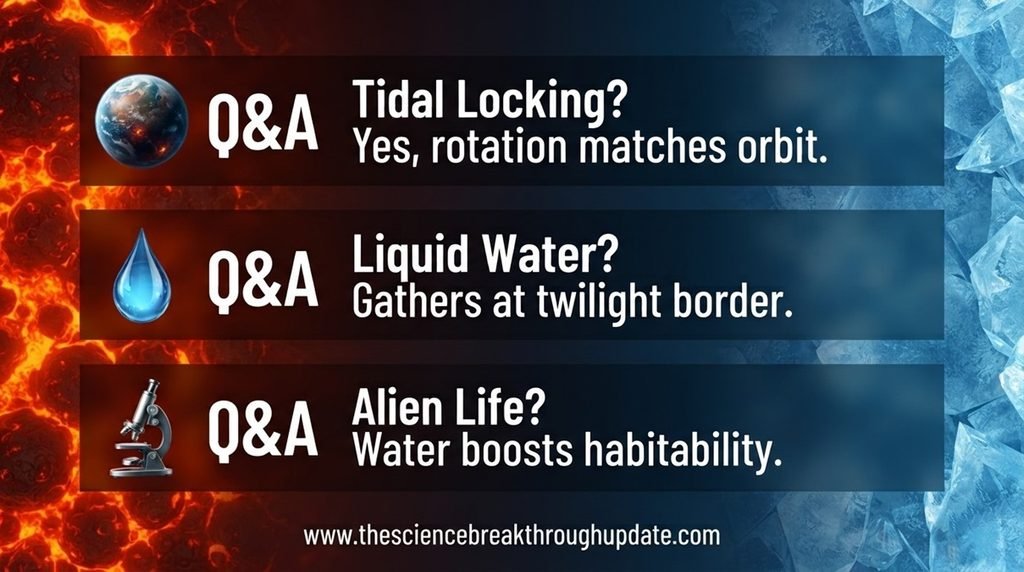
❓ Reader Doubts: Core Questions Answered
- Can a planet really have a permanent day and night side?
Yes, this phenomenon is called tidal locking. It happens when a planet rotates on its axis at the exact same speed that it orbits its star, keeping one side in constant light and the other in dark. - Where would liquid water exist on such a planet?
Liquid water would most likely exist in the twilight zone. This is the narrow, moderate border region between the burning dayside and the freezing nightside where temperatures are stable. - Does this mean alien life exists on these worlds?
This research proves that water can survive, which is a primary requirement for life. However, actual confirmation of alien life requires further observational data from advanced telescopes.
Source Document Link: arXiv.org
Share this useful knowledge with your friends now!”
Disclaimer: This content is for educational and informational purposes only.