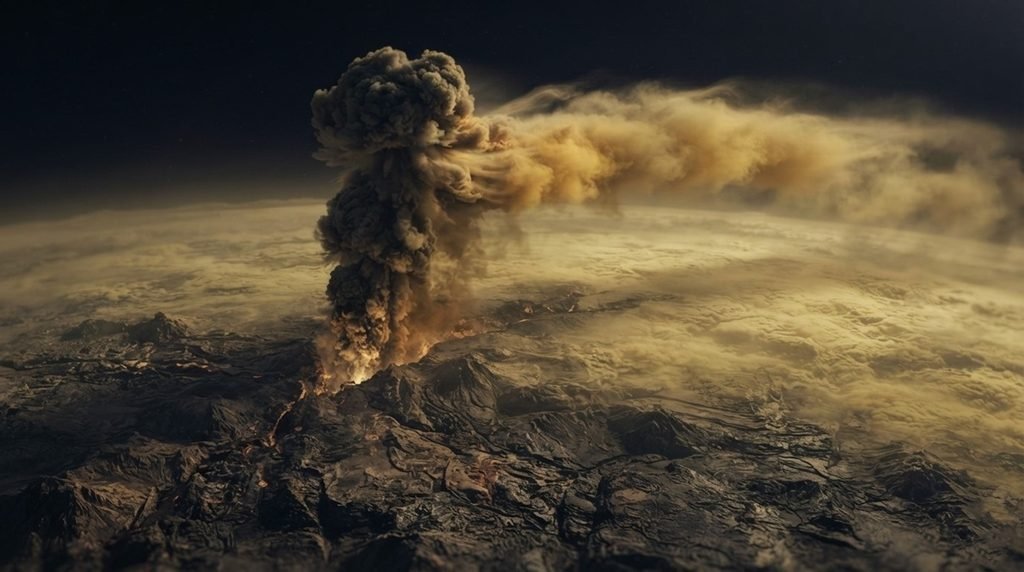
🌋 Venus hides active volcanoes beneath its thick, toxic atmosphere, but scientists have finally figured out exactly where and how to spot their elusive eruptions.
For decades, planetary scientists have debated whether our closest neighbor still harbors active volcanism. The planet’s crushing air pressure and impenetrable acid clouds make direct surface observation nearly impossible, leaving researchers searching for atmospheric clues like sudden gas plumes.
Now, a breakthrough study utilizing advanced three-dimensional climate modeling reveals that volcanic gases disperse rapidly, leaving a very narrow window for detection. Finding these volcanic signatures requires knowing precisely which gases to track and the exact altitude where they linger longest.
🔍 The Great Cosmic Blindspot Obscuring Toxic Clouds
- Planetary scientists struggle to confirm active eruptions on Venus because the planet’s dense, high-pressure atmosphere quickly crushes and dilutes volcanic gases.
- High-altitude winds moving at blistering speeds shred volcanic plumes within hours, making standard satellite observations nearly impossible to time right.
- Active chemical reactions and natural wave patterns in the upper atmosphere create massive background noise that easily mimics volcanic activity.
- These chaotic atmospheric dynamics trap or alter key gases like carbon monoxide, leaving astronomers with conflicting data about current geologic activity.
🗺️ Mapping the Invisible Trails of Alien Volcanos
- Lead researcher Maureen Cohen and her team at The Open University simulated gas dispersal using the advanced Venus Planetary Climate Model.
- The team tested localized injections of water vapor, hydrogen chloride, carbon monoxide, and carbonyl sulfide across 3 distinct altitudes.
- Simulating different eruption strengths up to 50% above baseline allowed scientists to map how winds advect gases downstream.
- The simulations proved that tracking chemically stable, inert gases provides a much higher probability of successful plume detection than active species.
🚀 The Prime Target Areas for Future Space Missions
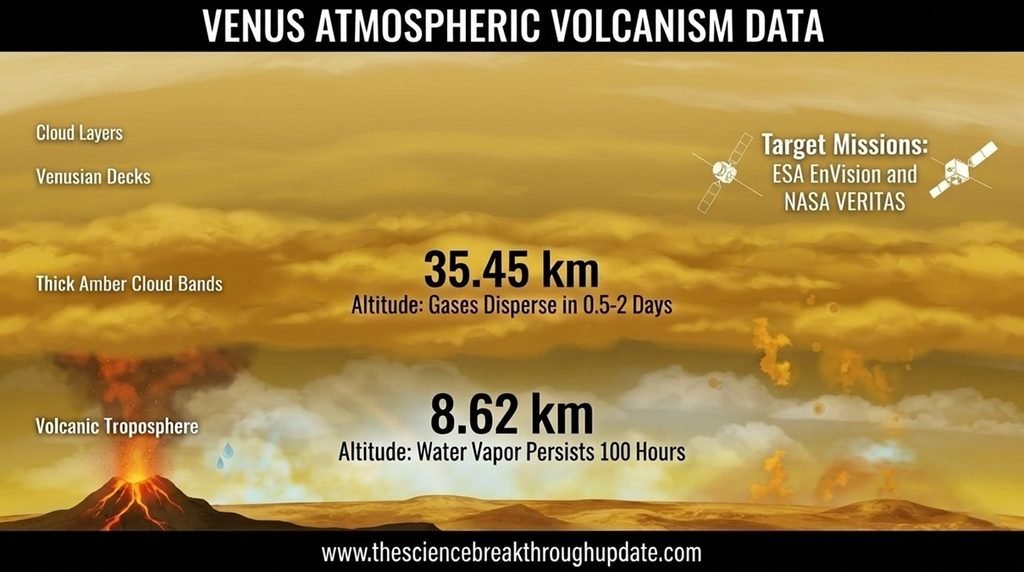
- The model shows that tracking water vapor near the surface at 8.62 kilometers offers the best chance to witness active volcanism.
- Low-altitude equatorial plumes remain distinct from background atmospheric variability for up to 100 hours, forming long downstream streaks.
- These findings will directly guide targeted observations for upcoming state-of-the-art space missions, including ESA’s EnVision and NASA’s VERITAS.
- Knowing that high-altitude gases disperse within 12 hours allows mission controllers to optimize spectrometer instruments for maximum efficiency.
My Take: This brilliant map stops us from blindly hunting alien eruptions. By targeting water vapor streaks, upcoming missions save years of wasted orbit time and finally solve our neighbor’s deepest geological mystery.
❓ Reader Doubts: Core Questions Answered
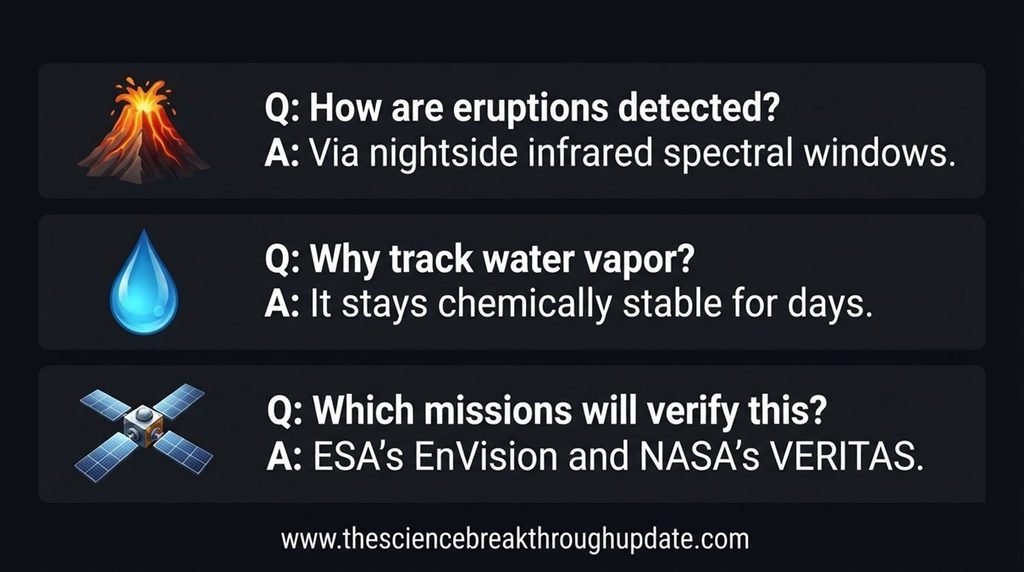
1. How do scientists detect volcanic eruptions through the thick clouds of Venus?
Spacecraft use specific near-infrared spectral windows to peer underneath the thick cloud layers on the nightside of the planet. These instruments look for sudden, localized spikes in thermal radiation and gas concentrations caused by hot volcanic plumes.
2. Why is water vapor the best gas to track for volcanic activity on Venus?
Water vapor behaves as a chemically inert gas in the lower atmosphere of Venus, meaning it does not react quickly with other elements. Because it stays stable, it forms long, recognizable wind streaks that remain visible for up to 4 Earth days.
3. When will the next space missions verify these volcanic models?
The next generation of planetary missions, including the European Space Agency’s EnVision and NASA’s VERITAS, are scheduled for launch in the early 2030s. Both orbiters carry specialized spectrometers designed specifically to scan the lower atmosphere for these predicted volcanic signatures.
Source Document Link: arXiv.org
Share this useful knowledge with your friends now!”
Disclaimer: This content is shared strictly for educational and informational purposes. Readers are encouraged to verify facts independently.